
I'll be honest: trying to explain the claustrum is like trying to describe that one coworker who somehow gets cc'd on every email but nobody knows what they actually do. Scientists have been scratching their heads over this sliver of brain tissue for decades. But here's the thing - researchers just caught it red-handed coordinating your brain's drug memories, and the bust is worth talking about.
Meet the Claustrum: The Brain's Weirdest Middleman
The claustrum makes up roughly 0.25% of your brain - think less "major department" and more "suspiciously busy closet." Yet this tissue-thin sheet tucked between your cortex and basal ganglia is the most densely connected structure in your entire brain, volume for volume. Francis Crick (yes, the DNA guy) spent his final years convinced it held the key to consciousness itself.
Look. When the co-discoverer of DNA's structure gets obsessed with a brain region smaller than a Post-it note, you pay attention.
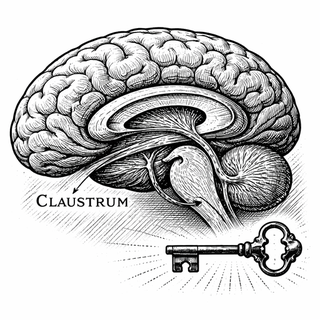
New research published in the Journal of Clinical Investigation reveals the claustrum isn't just some neural switchboard operator - it's actively running a relay system that lets drug memories hijack your behavior.
The Circuit That Makes Relapse Click
Here's the setup: researchers at Nanjing Medical University mapped a previously uncharted highway connecting three brain regions. The ventral tegmental area (VTA) - your brain's dopamine factory - sends signals to the claustrum, which then routes them to the medial prefrontal cortex (mPFC), headquarters for decision-making and executive control.
The team used methamphetamine conditioned place preference in male mice - basically training mice to associate a specific chamber with getting high. When they chemogenetically shut down this VTA-claustrum-mPFC circuit, something remarkable happened: the mice "forgot" which chamber meant drugs.
The memories weren't erased. The mice just couldn't access them.
Dopamine Is the Password
Every good heist movie needs someone with the access codes. In this circuit, that's dopamine. The claustrum neurons express D1 receptors - molecular locks that dopamine keys can open. Block those receptors? The mice couldn't retrieve their drug memories even when standing in the exact spot where they'd previously gotten high.
This matters because drug-associated environmental cues are one of the most powerful triggers for relapse. That street corner. That friend's apartment. That particular smell. Your brain has catalogued all of it, filed under "things that predict feeling amazing." The claustrum, it turns out, is the filing clerk.
Why Scientists Didn't See This Coming
The claustrum has been the brain's best-kept secret partly because it's a nightmare to study. It's thin, elongated, and there are virtually no cases of humans with isolated claustrum damage. You can't easily poke around in there without hitting something else.
Recent work has implicated the claustrum in attention and salience detection - essentially flagging what's important in your environment. Earlier research showed that D1R-expressing claustrum neurons are activated by cocaine and mediate contextual association of reward. Separate findings demonstrated the claustrum-ACC circuit supports methamphetamine taking while cue-triggered seeking recruits the reverse pathway.
The new study ties these threads together into a coherent story about how drug memories get stored, maintained, and retrieved.
What This Means for Addiction Treatment
Current addiction treatments often target broad neurotransmitter systems - think medications that blunt dopamine signaling everywhere. The problem? Dopamine also handles motivation, pleasure, learning, and basically not feeling like a zombie. Carpet-bombing your reward system tends to have downsides.
This circuit identification opens the door to precision interventions. If you could selectively target claustrum neurons receiving VTA projections, you might disrupt drug memory retrieval without tanking someone's ability to enjoy a sunset or remember their kid's birthday. The mPFC-NAc engram circuits identified in parallel research suggest similar specificity is achievable.
We're not there yet. The gap between "works in mice" and "available at your pharmacy" spans roughly a decade and several billion dollars. But for a field that's struggled to move beyond "just say no" and broad-spectrum medications, mapping specific circuits is the first step toward actual solutions.
The Bigger Picture
The brain doesn't store memories like files on a hard drive. It stores them like secrets at a party - distributed across conversations, triggered by context, accessible only if you know who to ask. The claustrum appears to be that weirdly connected person who knows everyone and can retrieve any piece of gossip on demand.
For addiction, this means environmental cues don't just "remind" you of drugs. They activate a specific relay system that reconstructs the entire experience - the want, the anticipation, the certainty that the next hit will feel exactly like the first one did.
Understanding the wiring diagram gives us something to work with. And in addiction research, that's not nothing.
References:
-
Zhao Z, He Y, Liu Y, et al. A midbrain-cortical circuit mediated by a claustrum neuronal ensemble orchestrates drug-paired context memory processing. J Clin Invest. 2026. DOI: 10.1172/JCI196944
-
Terem A, Bharat N, et al. Claustral Neurons Projecting to Frontal Cortex Mediate Contextual Association of Reward. Curr Biol. 2020;30(17):3522. PMID: 32707061
-
Zingg B, Bhattacharyya J, et al. Distinct role of claustrum and anterior cingulate cortex bidirectional circuits in methamphetamine taking and seeking. Nat Commun. 2025. DOI: 10.1038/s41467-025-62188-w
-
Scarpa G, Bhattacharyya J, et al. Drug-Induced Conditioned Place Preference and Its Practical Use in Substance Use Disorder Research. Front Behav Neurosci. 2020;14:582147. DOI: 10.3389/fnbeh.2020.582147
-
Graf R, Bhattacharyya J. Changing the Cortical Conductor's Tempo: Neuromodulation of the Claustrum. Front Neural Circuits. 2021;15:658228. DOI: 10.3389/fncir.2021.658228
Disclaimer: The image accompanying this article is for illustrative purposes only and does not depict actual experimental results, data, or biological mechanisms.