
The shortest version of this story: a protein better known for causing eye disease is secretly leaking glutamate in your prefrontal cortex, and that leak might be why chronic pain drags anxiety along for the ride. The interesting version takes a bit longer.
Pain and Anxiety: The World's Worst Buddy Comedy
If you've ever stubbed your toe and felt briefly angry at the universe, multiply that by infinity and subtract the hope of it ever stopping. That's chronic neuropathic pain - and for somewhere between 30% and 50% of people living with it, anxiety becomes an uninvited roommate who never pays rent (Chen et al., 2022). Doctors have known about this pain-anxiety tag team for decades, but the "how" has remained frustratingly murky. Is the brain just generally miserable? Is anxiety a side effect of never sleeping well? Or is something more specific going on at the circuit level?
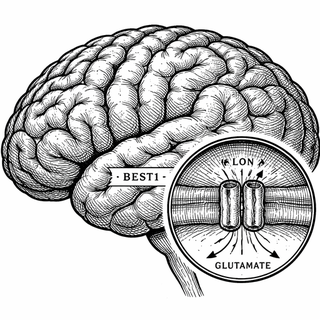
A team led by Shuai Xiong and colleagues just dropped a paper in Cell Reports that nails down a surprisingly specific answer, and it involves a protein called bestrophin-1 (BEST1) doing something it really shouldn't be doing (Xiong et al., 2026).
Meet BEST1: The Overachiever With a Side Hustle
BEST1 is a calcium-activated ion channel that ophthalmologists know well because mutations in it cause a form of macular degeneration (Oh & Lee, 2017). But BEST1 also shows up in the brain, where it sits on both astrocytes and neurons and is weirdly permeable to glutamate and GABA, two of the brain's most important neurotransmitters. Under normal conditions, BEST1-mediated glutamate release helps fine-tune synaptic transmission. Think of it as a volume knob on neuronal chatter.
But what happens when chronic pain turns that volume knob into a fire hose?
The Two-Hit Mechanism (Because One Problem Is Never Enough)
Here's where it gets clever. The researchers used a spared nerve injury model in mice - basically, they created chronic neuropathic pain and then watched what happened in the contralateral ventromedial prefrontal cortex (vmPFC), a brain region that acts as your emotional thermostat, regulating fear, anxiety, and decision-making.
They found a dual mechanism:
Hit #1 - AMPA Receptor Trafficking: Chronic pain shoves more AMPA receptors (the fast-acting glutamate receptors that handle most of your brain's excitatory signaling) onto the synaptic membrane. More receptors at the surface means neurons are primed to fire harder. But here's the twist: this alone wasn't enough to cause anxiety. The receptors were loaded and ready, but they needed a trigger.
Hit #2 - BEST1-Mediated Tonic Excitation: That trigger turned out to be BEST1 leaking extra glutamate into the extracellular space. This ambient glutamate bath - what neuroscientists call "tonic excitation" - activates those newly trafficked AMPA receptors and cranks synaptic transmission past the point of no return. It's like installing a bigger engine AND pouring rocket fuel into the tank. Either one alone? Manageable. Both together? Anxiety city.
Recent structural work on bestrophin channels has revealed exactly how neurotransmitters pass through these channels, even identifying small molecule binding sites that could be targeted therapeutically (Cho et al., 2024).
The Knockout Punch
The real showstopper was the knockout experiment. When the researchers deleted BEST1 specifically from neurons in the vmPFC, the mice still had chronic pain (sorry, mice), but their anxiety-like behaviors vanished. Even better, when they combined BEST1 knockout with standard pain relief, the mice showed anxiolytic-like effects that went beyond baseline - they were actually chiller than normal mice.
This is a big deal because most pain treatments don't touch the anxiety component. You can pop an analgesic and still feel like the world is ending. The fact that targeting BEST1 independently addresses anxiety without needing to fix the pain first suggests a genuinely new therapeutic angle.
Why Should You Care?
Chronic pain affects roughly 20% of adults worldwide, and the anxiety that comes with it isn't just an emotional inconvenience - it worsens pain perception, disrupts sleep, and makes treatment less effective. It's a vicious cycle that current medications handle poorly. Benzodiazepines are addictive. SSRIs take weeks. And neither was designed for pain-induced anxiety specifically.
BEST1 offers something different: a molecular target sitting right at the intersection of pain processing and emotional regulation. The fact that this dual mechanism - receptor trafficking plus tonic excitation - has been mapped out in such detail gives drug developers something concrete to aim at. We're not just saying "the prefrontal cortex is involved" anymore. We're saying "this specific channel, on these specific neurons, releases this specific neurotransmitter, which hits these specific receptors." That's the kind of precision that turns basic science into medicine.
Of course, these are mouse studies, and mouse anxiety isn't human anxiety (though anyone who's watched a mouse in an open field test might disagree). But the molecular machinery is conserved, and the therapeutic logic is sound. Watch this space.
References
-
Xiong, S., Li, T., Chen, Z.-J., Ma, Z.-C., Lin, L., Shi, G.-S., Wu, H.-Y., Chang, L., Lin, Y.-H., Zhu, D.-Y., & Luo, C.-X. (2026). BEST1-mediated tonic excitation facilitates anxiety-like behaviors in a mouse model of chronic neuropathic pain. Cell Reports, 44, 117229. DOI: 10.1016/j.celrep.2026.117229 | PubMed
-
Chen, T., Zheng, J., Li, C., & Wang, Y. (2022). Current understanding of the neural circuitry in the comorbidity of chronic pain and anxiety. Neural Plasticity, 2022, 4217593. DOI: 10.1155/2022/4217593 | PMC8863453
-
Oh, S.-J., & Lee, C. J. (2017). Distribution and function of the bestrophin-1 (Best1) channel in the brain. Molecules and Cells, 40(8), 523-532. DOI: 10.14348/molcells.2017.0094 | PMC5491579
-
Cho, C. H., et al. (2024). Neurotransmitter-bound bestrophin channel structures reveal small molecule drug targeting sites for disease treatment. Nature Communications, 15, 10887. DOI: 10.1038/s41467-024-54938-z | PMC11685958
-
Kim, Y., et al. (2024). GAD65 tunes the functions of Best1 as a GABA receptor and a neurotransmitter conducting channel. Nature Communications, 15, 7763. DOI: 10.1038/s41467-024-52039-5
Disclaimer: The image accompanying this article is for illustrative purposes only and does not depict actual experimental results, data, or biological mechanisms.