
Scientists love naming things, and this one's called the "intralaminar thalamic nuclei" - which sounds less like a brain structure and more like what you'd get if a committee of Latin professors tried to name a startup. "IntraLam: We Relay Signals No One Asked For." But despite the branding nightmare, a team from Kobe University just proved this overlooked brain region is running one of the most consequential middleware services in your entire nervous system.
Here's the pitch: your brain has a tic problem. About 1% of school-age kids have Tourette syndrome, and for decades neuroscientists have been trying to reverse-engineer the bug. We knew the basal ganglia were involved - they're your brain's quality control department, deciding which movements ship to production and which get killed in staging. Motor tics looked like unauthorized deployments, movements pushing to production without proper code review. But nobody had mapped the full stack.
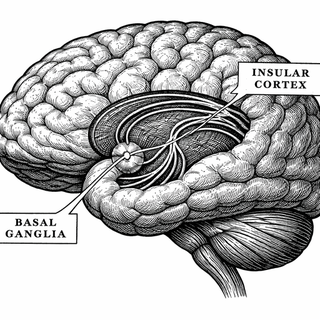
The Feature Nobody Requested
And here's the key insight. Tics aren't just motor glitches. About 90% of people with Tourette syndrome report "premonitory urges" - a rising internal tension, like a notification you can't dismiss, that builds until the tic fires (Li et al., 2023). Your phone buzzing in your pocket, except there's no phone and your body just... moves. The motor system and the feelings system were clearly talking to each other, but nobody could find the Slack channel.
Enter Kuno et al. (2026), who ran a full network diagnostic on the tic pipeline in mice. Their approach was elegant in that very specific way neuroscience is elegant: they injected bicuculline (a GABA receptor blocker) into the striatum, essentially removing the brakes from the basal ganglia's output. Think of it as disabling the CI/CD pipeline's safety checks. The result? Tic-like movements on the opposite side of the body, because the brain loves to cross-wire everything.
Tracing the Bug to Its Source
But here's where it gets spicy. When they mapped which brain regions lit up during tics using c-Fos (a molecular receipt showing recent neural activity), they found activation not just in the motor cortex - the obvious suspect - but in the insular cortex. The insula handles interoception, emotional processing, and that general sense of "something feels off." It's the region that makes you aware you need to sneeze before you sneeze (Jackson et al., 2020).
So how was the motor system's spam getting routed to the feelings department? Through our terribly named middleware - the intralaminar thalamic nuclei. The team traced a direct pathway: basal ganglia output from the substantia nigra pars reticulata passes through these thalamic relay neurons and lands in the insular cortex. A dedicated pipeline connecting movement errors to conscious awareness, shipping every glitch straight to the user's internal notification center.
Killing the Process
The real product validation came when they used DREADDs (designer receptors - neuroscience does occasionally nail the branding) to selectively shut down either the insular cortex or the thalamo-insular pathway. Tic intensity dropped significantly. The mice still ticked at the same frequency, but the amplitude - the force of each tic - was dampened. The bug reports kept filing, but someone turned down the alert volume.
This distinction is a pivot-worthy insight. The motor cortex generates the tic, but the insular cortex amplifies it, determining how intensely you experience the movement and, likely, how strongly you feel that premonitory urge. The insula isn't starting the fire. It's fanning the flames.
The Roadmap
"We believe that the neuronal circuit we found plays a key role as a bridge connecting brain regions that were previously thought to act independently," lead researcher Tachibana Yoshihisa explained. And here's why this matters beyond academic bragging rights: this pathway could explain why Tourette syndrome so frequently co-occurs with OCD, ADHD, and anxiety. The same thalamo-insular relay that amplifies tics might be cross-pollinating motor dysfunction with emotional processing gone sideways (Johnson et al., 2023).
Treatment-wise, this opens a genuinely exciting vector. Instead of deep brain stimulation - the nuclear option - you could potentially target this specific pathway with focused ultrasound neuromodulation, dialing down the thalamo-insular relay without cracking open anyone's skull. The intralaminar thalamus is already on the radar as a neurosurgical target for multiple conditions (Arnts et al., 2023).
So next time someone tells you tics are "just" a motor problem, know this: your brain built an entire internal notification system to make sure you feel every single one. The intralaminar thalamic nuclei may have terrible SEO, but they're running the most important cross-functional integration your nervous system never asked for.
References
-
Kuno H, Tsuji N, Kobayashi K, Takumi T, Tachibana Y. (2026). Intralaminar thalamus relays basal ganglia output to the insular cortex to drive tic generation. Cell Reports. DOI: 10.1016/j.celrep.2026.117272. PMID: 42025160
-
Jackson SR, Loayza J, Crighton M, Sigurdsson HP, Dyke K, Jackson GM. (2020). The role of the insula in the generation of motor tics and the experience of the premonitory urge-to-tic in Tourette syndrome. Cortex, 126, 119-133. DOI: 10.1016/j.cortex.2019.12.021. PMID: 32070809
-
Johnson KA, Worbe Y, Foote KD, Butson CR, Gunduz A, Okun MS. (2023). Tourette syndrome: clinical features, pathophysiology, and treatment. Lancet Neurology, 22(2), 147-158. DOI: 10.1016/S1474-4422(22)00303-9. PMID: 36354027
-
Li Y, Yu L, Zhang H, Wang X, Cui Y, Li Y. (2023). The Severity and Neural Correlates of Premonitory Urge in Tourette Syndrome: A Systematic Review and Meta-Analysis. Journal of Integrative Neuroscience, 22(6), 159. DOI: 10.31083/j.jin2206159. PMID: 38176915
-
Arnts H, Coolen SE, Fernandes FW, Schuurman R, Krauss JK, Groenewegen HJ, van den Munckhof P. (2023). The intralaminar thalamus: a review of its role as a target in functional neurosurgery. Brain Communications, 5(3), fcad003. DOI: 10.1093/braincomms/fcad003. PMID: 37292456
Disclaimer: The image accompanying this article is for illustrative purposes only and does not depict actual experimental results, data, or biological mechanisms.