
Think of your brain as a sprawling city. There are bustling downtown districts handling decision-making, quiet residential neighborhoods storing memories, and a tangled highway system ferrying signals from one borough to the next. Deep in the old part of town - the brainstem, if you will - sits a tiny but loud neighborhood called the locus coeruleus. It's the city's emergency dispatch center, flooding the streets with norepinephrine whenever stress rolls in like a thunderstorm. And for decades, neuroscientists assumed the dispatches only went to other neurons. Turns out, some of the most important calls were going to the janitorial staff all along.
The Tiny Blue Spot That Runs the Show
The locus coeruleus (Latin for "blue spot," because it genuinely looks blue under a microscope - nature has a flair for naming) is a cluster of neurons no bigger than a grain of rice. Don't let the size fool you. This little nucleus is the brain's primary norepinephrine factory, and its reach is absurd - projections stretch from the cortex all the way down to the spinal cord, like a single post office delivering mail to every zip code in the country (Castejón España et al., 2024).
When you're stressed - say, stuck in traffic or face-to-face with a bear (roughly equivalent situations, neurochemically) - the locus coeruleus fires up and douses your nervous system in norepinephrine. This usually helps. It sharpens your attention, kicks your fight-or-flight response into gear, and under normal circumstances, it actually dampens pain. Which makes sense: you don't want to be distracted by a stubbed toe while fleeing from said bear.
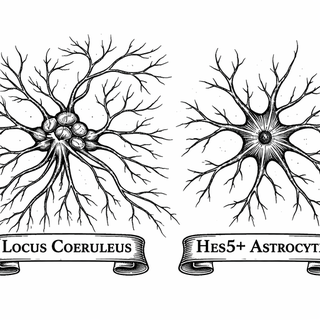
But here's where things get weird.
When the Pain Volume Knob Gets Stuck
A team of researchers in Japan, led by Riku Kawanabe-Kobayashi and colleagues, decided to investigate something clinicians have long observed but couldn't fully explain: stress sometimes makes pain worse, not better. Anyone who's had a bad week and noticed their back hurts more already knew this intuitively, but the biological "how" remained stubbornly unclear.
Using mice exposed to acute restraint stress (basically the rodent equivalent of being stuck in a middle seat on a transatlantic flight), the team traced a specific pathway from the locus coeruleus down to the spinal dorsal horn - the spinal cord's pain processing center. They watched these descending noradrenergic neurons light up during stress using in vivo calcium imaging, then confirmed their role by selectively destroying them. No neurons, no stress-induced pain amplification. Simple enough so far (Kawanabe-Kobayashi et al., 2026).
But the real plot twist wasn't about neurons at all.
Enter the Astrocytes (The Unlikely Villains)
When those descending norepinephrine signals arrived in the spinal cord, their primary target wasn't other neurons. It was a specific subset of star-shaped glial cells called Hes5-positive astrocytes. If neurons are the city's telephone lines, astrocytes are the maintenance crew - traditionally seen as support staff, keeping things tidy and functional. Except this particular crew has a side hustle that nobody saw coming.
These Hes5+ astrocytes carry α1A-adrenaline receptors, which soak up the incoming norepinephrine like a sponge. Once activated, they release adenosine, which acts on A1 receptors sitting on nearby inhibitory neurons - the very neurons whose job is to keep pain signals in check. The astrocytes essentially tell the bouncers at the pain gate to take a coffee break. With the inhibitory neurons suppressed, pain signals waltz through unchecked (Xu et al., 2021).
It's a beautifully devious chain of events: stress activates the locus coeruleus, which sends norepinephrine to the spinal cord, where astrocytes - not neurons - pick up the signal and quietly dismantle the pain-filtering system from the inside.
Why This Matters Beyond the Mouse Cage
This finding reshapes how we think about pain modulation in a few important ways. First, it adds to a growing body of evidence that glial cells aren't just passive bystanders in the nervous system. They're active players, and in the case of pain, sometimes they're running the whole operation while neurons get all the credit (Li et al., 2022).
Second, it offers a potential explanation for why drugs like duloxetine - a norepinephrine reuptake inhibitor commonly prescribed for chronic pain - sometimes don't work as well as expected. If boosting norepinephrine in the spinal cord also activates these pro-pain astrocytes, you might be stepping on the gas and the brake simultaneously.
Most intriguingly, it suggests entirely new therapeutic targets. Instead of chasing neurons exclusively, future pain treatments might focus on these Hes5+ astrocytes or their adenosine signaling - a lane of research that barely existed five years ago. For the millions of people whose chronic pain worsens under stress (which is, conservatively, most of them), understanding this circuit could eventually mean the difference between treatment that works and treatment that merely exists.
There's something poetic about it, really. The cells we overlooked for decades - the ones we thought were just holding things together - turn out to be quietly orchestrating one of the most common human experiences: the way stress makes everything hurt a little more.
References
-
Kawanabe-Kobayashi, R., Uchiyama, S., Yoshihara, K., Koga, K., Kojima, D., McHugh, T. J., Hatada, I., Matsui, K., Tanaka, K. F., & Tsuda, M. (2026). Descending locus coeruleus noradrenergic signaling to spinal astrocyte subset is required for stress-induced mechanical pain hypersensitivity. eLife, 13, e104453. DOI: 10.7554/eLife.104453 | PubMed: 41800998
-
Castejón España, J., Yasoda-Mohan, A., & Vanneste, S. (2024). The Locus Coeruleus in Chronic Pain. International Journal of Molecular Sciences, 25(16), 8636. DOI: 10.3390/ijms25168636 | PMCID: PMC11354431
-
Li, J., Wei, Y., Zhou, J., Zou, H., Ma, L., Liu, C., Xiao, Z., Liu, X., Tan, X., Yu, T., & Cao, S. (2022). Activation of locus coeruleus-spinal cord noradrenergic neurons alleviates neuropathic pain in mice via reducing neuroinflammation from astrocytes and microglia in spinal dorsal horn. Journal of Neuroinflammation, 19, 125. DOI: 10.1186/s12974-022-02489-9 | PMCID: PMC9145151
-
Xu, Q., Ford, N. C., He, S., Bhagat, Q., Bhagat, R., Bhagwagar, S., Bhatt, R., Chen, Z., Dong, X., & Guan, Y. (2021). Astrocytes contribute to pain gating in the spinal cord. Science Advances, 7(45), eabi6287. DOI: 10.1126/sciadv.abi6287 | PMCID: PMC8565904
Disclaimer: The image accompanying this article is for illustrative purposes only and does not depict actual experimental results, data, or biological mechanisms.