
The suspects were lined up: twenty-five species of macaque, each with an alibi and a distinctly different attitude toward personal space. For decades, neuroscientists had been working the cold case of why some primate societies run like cooperative communes while others resemble a particularly tense episode of a workplace drama. The prime suspect? A small, almond-shaped brain structure called the amygdala - long typecast as the brain's panic button. But the evidence that just came in has blown the case wide open, and the culprit isn't who anyone expected.
Not All Monkeys Are Created Equally Rude
Macaques are the neuroscientist's dream genus. With 25 species spread across Asia, they've managed to evolve social systems ranging from ruthlessly despotic to remarkably chill - all within roughly six to eight million years. Primatologist Bernard Thierry classified them on a four-grade scale: Grade 1 species like rhesus macaques (Macaca mulatta) run steep dominance hierarchies where subordinates must literally bare their teeth in submission. Grade 4 species like Tonkean macaques (Macaca tonkeana) from Sulawesi are the laid-back flatmates of the primate world - sharing food, reconciling after spats, and generally behaving as if they've read a self-help book on conflict resolution.
The question that kept researchers up at night: does all this social variation leave a mark on the brain?
Enter the Amygdala (Stage Left, Looking Suspiciously Innocent)
A team led by Sarah Silvere at the University of Strasbourg decided to find out. They collected post-mortem MRI scans from 43 individuals across 12 macaque species - including Tonkean and Tibetan macaques that had never been brain-scanned before - and measured two key structures: the amygdala and the hippocampus (Silvere et al., 2026).
The results were, to use British understatement, rather striking. Tolerant species had significantly larger amygdalae than their despotic cousins. The hippocampus, meanwhile, shrugged and showed no consistent pattern - apparently it has other things on its mind.
Now, here's where it gets properly weird. The amygdala has spent most of its public relations career being described as the brain's "fear centre." But in tolerant macaques, a bigger amygdala doesn't mean more anxiety - it appears to mean better social processing. Think of it less as a smoke alarm and more as a sophisticated social switchboard, routing complex information about who's friends with whom, who needs a reconciliatory grooming session, and whether that new group member is worth trusting.
Your Brain on Friendship (The Developmental Plot Twist)
Perhaps the most eyebrow-raising finding was what happens over a lifetime. Tolerant macaques are essentially born with larger amygdalae that gradually shrink with age - as though the hardware comes pre-installed and gets optimised through use. Intolerant species show the opposite: their amygdalae grow throughout life, perhaps because navigating a rigid, paranoid social hierarchy requires ever-increasing vigilance. It's a developmental pattern never before documented in primates.
This dovetails neatly with Robin Dunbar's social brain hypothesis, which established that primate brain size scales with social group complexity (Dunbar, 2024). Previous work by Sallet and colleagues showed that even within a species, individual macaques with larger social networks have more grey matter in the amygdala and prefrontal cortex (Sallet et al., 2011). What the new study adds is evidence that this relationship extends across species and is baked into evolutionary trajectories, not just individual experience.
Three Flavours of Social Brainpower
The researchers also introduced a clever cognitive framework, sorting 18 behavioural traits into three categories. "Socio-cognitive demands" - the mental overhead of complex communication, coalition-building, and cooperation - were linked to larger amygdalae. "Behavioural inhibition" - essentially the ability to not punch someone who annoyed you - was associated with smaller ones. And "environmental predictability" - how much social life follows a script versus requiring improvisation - affected both structures in opposite directions.
In other words, being tolerant isn't just about being nice. It's cognitively expensive. Living in an egalitarian society means constantly reading the room, managing nuanced relationships, and exercising restraint. The despotic alternative is, paradoxically, simpler: know your rank, defer to those above, dominate those below, and call it a day.
Why Should You Care About Monkey Manners?
Because, of course, we're primates too. While the study wisely avoids drawing direct lines to humans, it raises a quietly devastating question about our own evolutionary trajectory. If tolerance demands more neural infrastructure than tyranny, what does that tell us about the cognitive cost of democracy, diplomacy, and getting along with the neighbours?
The amygdala, it turns out, was never just about fear. It was always about figuring out what other minds are up to - and in species that chose the cooperative path, evolution gave it a bit more room to work with. One suspects our own brains might have a similar story to tell, if only someone would think to ask.
References
-
Silvere, S., Lamy, J., Po, C., Legrand, M., Sallet, J., & Ballesta, S. (2026). Toward neuroanatomical and cognitive foundations of macaque social tolerance grades. eLife, 15, e106424. DOI: 10.7554/eLife.106424 | PMID: 41772958
-
Sallet, J., Mars, R.B., Noonan, M.P., et al. (2011). Social network size affects neural circuits in macaques. Science, 334(6056), 697-700. PMID: 22053054
-
Dunbar, R.I.M. (2024). The social brain hypothesis - thirty years on. Annals of Human Biology, 51(1). DOI: 10.1080/03014460.2024.2359920
-
Thierry, B. (2007). Unity in diversity: Lessons from macaque societies. Evolutionary Anthropology, 16(6), 224-238. DOI: 10.1002/evan.20147
-
Brent, L.J.N., et al. (2022). Social connections predict brain structure in a multidimensional free-ranging primate society. Science Advances, 8(8). DOI: 10.1126/sciadv.abl5794
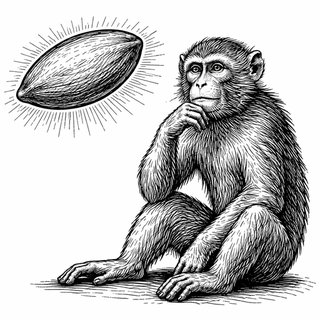
Disclaimer: The image accompanying this article is for illustrative purposes only and does not depict actual experimental results, data, or biological mechanisms.