
Slot machine jingles make rats - and almost certainly you - ignore losses and chase bad bets, but only when the sounds reliably show up with a reward. Let me explain how we got here.
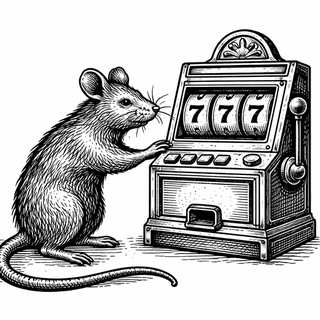
What do you call a rat that keeps pressing the wrong lever? A gambling addict. I'm sorry. That was terrible. But it's also basically what a team of researchers at the University of British Columbia found when they ran six different versions of a rat casino game, and honestly, the science is way more interesting than my jokes. (Low bar, I know.)
The Recipe for a Risky Rat
Think of decision-making like a recipe. You've got your ingredients - rewards, penalties, timing - and then you've got your garnish: the flashy lights and celebratory sounds that casinos slather on top like hot sauce on everything. The question Catharine Winstanley's lab wanted to answer was pretty specific: which part of the garnish actually changes the flavor of the dish?
They used something called the rat gambling task, or rGT, which is exactly what it sounds like. Rats choose between four options. Some options pay out big on a single trial but come with brutal timeout penalties - think ordering the fancy souffle that takes three hours and collapses half the time. The smart play is the low-and-slow option: smaller, steadier sugar pellet rewards with shorter, rarer penalties. A nice reliable simmer versus a risky flambe.
Here's where the magic ingredient comes in. When researchers added casino-style audiovisual cues - lights and tones that scaled with reward size, delivered right when rats won - way more rats started picking the risky, bad-deal options (Hathaway et al., 2025). The rats weren't just excited. They were strategically worse at the game.
Not All Dings Are Created Equal
But here's the part that should make every slot machine designer slightly nervous (or proud, depending on their moral compass). The researchers didn't just test one cue setup. They tested six.
When cues only showed up randomly on half the trials? No effect. The rats shrugged and made perfectly fine decisions. When cues were paired exclusively with losses? Decision-making actually improved. It's like the rats heard the sad trombone and thought, "Yeah, no thanks, I'll stick with the sensible option."
The trouble started - and stayed - whenever cues reliably tagged wins. Even when cues also appeared on losing trials, as long as they were consistently present on wins, the rats kept making bad bets. You could flip the complexity of the cues (big flashy for small wins, subtle for big wins) and the risk-promoting effect still held.
So the cues aren't just pumping up arousal like a double espresso. They're teaching the brain something specific: this signal means good things happened. And once the brain learns that association, it starts filtering out the bad stuff.
Your Brain on "Almost Winning"
The computational modeling is where this gets really spicy. When the researchers fit reinforcement learning models to the rats' choices, the key difference wasn't that cued rats valued rewards more. It was that they cared about losses less. The punishment signal was getting turned down like the volume on an inconvenient phone call.
This dovetails with what we know about human gambling. A 2025 study in the Journal of Neuroscience found that people with gambling problems show altered loss-learning signals in the insular cortex - the brain region that normally screams "this is a bad idea" (Anselme & Robinson, 2025). Slot machines are essentially seasoned to suppress that signal, using carefully timed sounds and lights to make losses taste less bitter.
Previous work from the same lab showed that dopamine D3 receptors are critical for this cue-driven risk effect - a D3 receptor blocker could rescue good decision-making, but only when cues were present (Barrus & Winstanley, 2016). And a recent 2025 study found that rats actually prefer the cued version of the gambling task, choosing the flashy casino over the quiet one, much like humans gravitating toward the loudest machines on the floor (Hales et al., 2025).
Why This Matters Beyond the Rat Casino
This isn't just about rodents pressing levers for sugar. Every slot machine, loot box, and mobile game notification is a carefully baked sensory cue designed to pair with rewards. This research gives us a clearer recipe for what makes those cues dangerous: they need to be predictable and win-associated. Random noise? Harmless. Loss-paired alerts? Actually helpful. But reliable win-paired signals? That's the ingredient that turns a casual player into someone who ignores mounting losses.
Understanding the recipe means we might finally know which ingredients to regulate - and that's something worth making noise about.
References:
-
Hathaway, B. A., Kim, D. R., Malhas, S. B. A., Hrelja, K. M., Kerker, L., Hynes, T. J., Harris, C., Langdon, A., & Winstanley, C. (2025). Audiovisual cues must be predictable and win-paired to drive risky choice. eLife, 14, e105951. DOI: 10.7554/eLife.105951 | PMID: 41972307
-
Hales, C. A., Hrelja, K. M., Ansary, S., Chong, E., Russell, B., & Winstanley, C. A. (2025). Most rats prefer gambling opportunities featuring win-paired cues that drive risky choice. Journal of Psychopharmacology. DOI: 10.1177/23982128251352235
-
Barrus, M. M., & Winstanley, C. A. (2016). Dopamine D3 receptors modulate the ability of win-paired cues to increase risky choice in a rat gambling task. Journal of Neuroscience, 36(3), 785-794. DOI: 10.1523/JNEUROSCI.2421-15.2016 | PMID: 26791209
-
Anselme, P., & Robinson, M. J. F. (2025). Computational and neural evidence for altered fast and slow learning from losses in problem gambling. Journal of Neuroscience, 45(1), e0080242024. DOI: 10.1523/JNEUROSCI.0080-24.2024
-
Limbrick-Oldfield, E. H., Mick, I., Cocks, R. E., et al. (2017). The effect of losses disguised as wins and near misses in electronic gaming machines: A systematic review. Journal of Gambling Studies, 33(4), 1241-1260. DOI: 10.1007/s10899-017-9688-0 | PMCID: PMC5663799
Disclaimer: The image accompanying this article is for illustrative purposes only and does not depict actual experimental results, data, or biological mechanisms.