
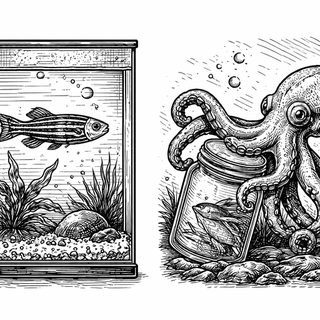
An octopus can unscrew a jar like a tiny underwater locksmith, while a zebrafish mostly looks like it forgot why it swam into the room. Yet both can teach us something awkward about human brains: intelligence is not the only thing that makes biology messy - routine is. And in neuroscience, a lot of our "clean" experiments may be getting remixed by something embarrassingly ordinary: a person with a net, a feeding scoop, and bad timing.
A new opinion piece by Benjamin Tsang and Robert Gerlai argues that zebrafish behavioral neuroscience has a hidden-variable problem hiding in plain sight - human interaction and husbandry timing [1]. Translation: the fish are not just reacting to the experiment. They may also be reacting to Steve, who cleaned the tank too aggressively at 8:12 a.m.
The lab fish are not living in a vacuum - they are living in a workplace
Zebrafish have become neuroscience darlings for good reasons. They are cheap to keep, breed fast, and share a surprising amount of biology with us. Scientists use them to study stress, anxiety-like behavior, learning, social behavior, addiction, and drug effects [2,3]. They are, in other words, little silver MVPs.
But behavioral research has a classic enemy: context. If you want to know whether a drug changes behavior, you need the background noise low. The problem is that fish facilities are full of background noise, and not all of it hums through the filter.
Tsang and Gerlai point out that normal husbandry tasks - netting, feeding, tank cleaning, water changes, moving tanks around - can act like repeated acute stressors. One stressful event is one thing. Repeated little stress hits? That starts looking less like a blip and more like a whole vibe. In animals, repeated stress can alter physiology and behavior over time. So the fish you test on Thursday may not just be "a zebrafish." It may be "a zebrafish that got surprise-handled by three different humans all week and now has opinions."
Tiny fish, big confounds
This matters because zebrafish behavior is often the data. If the fish swims less, freezes more, avoids novelty, or behaves more anxiously, researchers need to know whether that came from the experimental treatment or from the lab equivalent of a chaotic morning commute.
And the paper's sneaky-smart point is that these effects may not be random. They may be systematic.
Different facilities do husbandry at different times. Different handlers move differently, feed differently, hover differently. One lab may clean tanks before testing. Another may test first. One technician may be smooth and predictable. Another may arrive like a caffeine-powered heron. If those patterns go unreported, then labs can follow the same published protocol and still get different outcomes. Not because the science is bad, but because the fish had different daily lives.
That is reproducibility's annoying cousin: the variable nobody logged.
Timing is not a detail - it is part of the experiment
Behavior changes over time. Stress hormones change over time. Activity levels change over time. Animals have daily rhythms, and zebrafish are no exception [4]. So when husbandry happens can matter almost as much as what happens.
This is where the paper gets especially sharp. If tank cleaning always happens right before one kind of test, or if feeding routines differ across days or handlers, you can accidentally build time-linked bias into the study. Same fish species. Same apparatus. Same official methods. Different hidden schedule. Different result.
That sounds boring until you realize it is the scientific version of trying to compare two songs when one was mixed in a studio and the other in a subway tunnel.
Why this is bigger than fish
This is a zebrafish paper, but the lesson is universal. Animal behavior research has long wrestled with the effects of handling, housing, experimenter presence, and circadian timing [5-7]. Mice, rats, fish - everybody has a nervous system that notices when a giant primate keeps barging into the room.
So this paper is really about a broader scientific habit: we love the dramatic variables and ignore the mundane ones. We track gene edits, drug doses, and fancy imaging settings, then act shocked when "who fed the animals" turns out to matter. Biology loves a plot twist, and the plot twist is often administration.
Okay, so what should labs do?
The authors are not saying zebrafish research is doomed or that every result is secretly fish gossip. They are saying labs should recognize and document these factors better.
That means reporting handling routines, husbandry schedules, tank maintenance timing, and maybe even who did what and when. It also means designing experiments with these variables in mind instead of treating them like wallpaper. More consistency. More transparency. Fewer hidden remixes.
If that happens, the payoff is huge. More reliable behavioral data. Better comparisons across labs. Stronger drug screens. Cleaner models of stress and brain function. Less time chasing effects that were really caused by the aquatic equivalent of a disruptive office manager.
And honestly, there is something refreshing about this argument. It does not need a futuristic gadget or a sexy new biomarker. It just asks science to notice the obvious thing standing in the room holding the fish net.
References
-
Tsang B, Gerlai R. Reproducibility and replicability in zebrafish behavioural neuroscience research: The importance of animal-human interaction and temporal aspects of husbandry conditions. Neurosci Biobehav Rev. 2026; DOI: 10.1016/j.neubiorev.2026.106712
-
Stewart AM, Ullmann JFP, Norton WHJ, Parker MO, Brennan CH, Gerlai R, et al. Molecular psychiatry of zebrafish. Mol Psychiatry. 2015;20(1):2-17. DOI: 10.1038/mp.2014.128 PMCID: PMC4393076
-
Gerlai R. Reproducibility and replicability in zebrafish behavioral neuroscience research. Pharmacol Biochem Behav. 2019;178:30-38. DOI: 10.1016/j.pbb.2018.02.005
-
Choi TY, Choi TI, Lee YR, Choe SK, Kim CH. Zebrafish as an animal model for biomedical research. Exp Mol Med. 2021;53(3):310-317. DOI: 10.1038/s12276-021-00571-5 PMCID: PMC7990512
-
Sorge RE, Martin LJ, Isbester KA, Sotocinal SG, Rosen S, Tuttle AH, et al. Olfactory exposure to males, including men, causes stress and related analgesia in rodents. Nat Methods. 2014;11(6):629-632. DOI: 10.1038/nmeth.2935 PMCID: PMC4096763
-
Voelkl B, Würbel H. Reproducibility crisis: are we ignoring reaction norms? Trends Pharmacol Sci. 2016;37(7):509-510. DOI: 10.1016/j.tips.2016.05.003
-
Kent ML, Buchner C, Watral VG, Sanders JL, LaDu J. Husbandry and care of zebrafish. In: Cartner SC, Eisen JS, Farmer SC, Guillemin KJ, Kent ML, Sanders GE, editors. The Zebrafish in Biomedical Research. Elsevier; 2020. DOI: 10.1016/B978-0-12-812431-4.00003-7
Disclaimer: The image accompanying this article is for illustrative purposes only and does not depict actual experimental results, data, or biological mechanisms.