
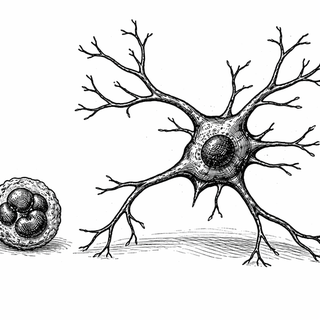
A neutrophil is about 12 micrometers across. A microglia, the brain's resident immune cell, stretches its spindly arms to maybe 50 micrometers tip to tip. Together, these microscopic players - each invisible to the naked eye - can gang up and shut down your ability to walk. And according to a new study, they do it through a secret handshake involving complement fragments, sticky DNA webs, and a receptor that already has an FDA-approved drug targeting it.
Your Immune System: Helpful Until It Isn't
Neuromyelitis optica spectrum disorder (NMOSD) is one of those diseases that sounds like your body just... turned on itself. Because it did. In about 80% of cases, the immune system produces antibodies against aquaporin-4 (AQP4), a water channel protein sitting on astrocytes throughout the brain and spinal cord (Bhatt et al., 2023). These aren't obscure cells in some forgotten corner of your nervous system. Astrocytes are everywhere, doing everything from maintaining the blood-brain barrier to feeding neurons their lunch.
When AQP4 antibodies show up and start binding, the complement system activates, neutrophils swarm in, and things go sideways fast. Patients can lose vision, become paralyzed, or both. It affects roughly 0.5 to 10 per 100,000 people depending on where you live, and women get hit hardest - over 80% of relapsing cases.
Neutrophils and Microglia: The Worst Buddy Cop Movie Ever
Here's where the new research from Qi and colleagues, published in the Journal of Clinical Investigation, gets genuinely wild (Qi et al., 2026).
The team built a clever mouse model: they continuously dripped a non-complement-activating AQP4 antibody into the spinal subarachnoid space. This let them study what happens before the full complement cascade tears everything apart - the precytolytic phase, in science speak.
What they saw was a buddy cop scenario where both cops are corrupt. Neutrophils infiltrated the spinal cord, trailing sticky DNA webs called neutrophil extracellular traps (NETs), and physically glommed onto microglia. Two-photon microscopy caught them in the act - soma-to-soma, soma-to-process contact, the whole shebang. And electron microscopy confirmed it wasn't just proximity. These cells were touching.
Kill the neutrophils? Motor function improves. Wipe out the microglia? Same thing. Both have to be present for the damage to stick. It's a tag team, and your motor neurons are the ones getting pinned.
C5a: The Molecular Gossip That Started It All
The smoking gun turned out to be C5a, a fragment of complement protein C5 that neutrophils were carrying into the spinal cord like contraband. Once there, C5a latched onto C5aR1 receptors on microglia, flipping them into a disease-associated state. These activated microglia - now dual-positive for Galectin-3 and P2Y12 - swarmed motor neurons, triggering lipid droplet accumulation, oxidative stress, and loss of the molecular machinery neurons need to produce acetylcholine.
The result? Mice progressively lost their ability to stay on a rotating rod, bottoming out around day 8. But here's the plot twist: when the antibody infusion stopped, they recovered. The damage was reversible.
Mice lacking C5aR1 showed dramatically less neutrophil infiltration, less microglial activation, fewer stressed-out neurons, and better motor function. A pharmacological C5aR1 blocker (PMX 205) did the same thing. This matters because avacopan, an FDA-approved C5aR1 antagonist already used for ANCA-associated vasculitis (Jayne et al., 2021), exists and is sitting right there on pharmacy shelves.
This Builds on a Pattern
This isn't the first time this group has caught microglia misbehaving in NMO. A 2020 study from the same lab showed astrocyte-microglia crosstalk through complement C3a signaling as an early driver of lesion formation (Chen et al., 2020). The new work adds neutrophils to that equation and identifies CXCL1 - a chemokine produced by astrocytes only when microglia are also present - as the recruitment signal that brings neutrophils crashing through the door.
Blocking CXCL1 prevented neutrophil infiltration entirely and stopped motor dysfunction cold. That's two potential drug targets from a single paper.
From Mice to Humans (The Part That Actually Matters)
The team didn't stop at mice. They examined spinal cord tissue from an NMO patient and found the same disease-associated microglia surrounding motor neurons in early, non-destructive lesions. It's a small sample, but it suggests the mouse model isn't just academic theater - it's reflecting something real happening in human disease.
Look. NMOSD already has several approved therapies - eculizumab targets C5, inebilizumab goes after B cells, satralizumab blocks IL-6. But these all hit the disease after complement activation is already underway. What this study reveals is a therapeutic window before irreversible destruction begins, when motor neuron dysfunction is still reversible and C5aR1 blockade could stop the cascade at its source.
That's not just interesting science. For the roughly 15,000 people living with NMOSD in the United States, it could mean catching attacks before they cause permanent damage.
References:
-
Qi F, Lennon VA, Zhao S, et al. Neutrophil-microglia interaction drives motor dysfunction in a neuromyelitis optica model induced by subarachnoid AQP4-IgG. J Clin Invest. 2026. DOI: 10.1172/JCI199706. PMID: 41665955
-
Chen T, Lennon VA, Liu YU, et al. Astrocyte-microglia interaction drives evolving neuromyelitis optica lesion. J Clin Invest. 2020;130(8):4025-4038. DOI: 10.1172/JCI134816. PMID: 32568214
-
Jayne DRW, Merkel PA, Schall TJ, Bekker P; ADVOCATE Study Group. Avacopan for the treatment of ANCA-associated vasculitis. N Engl J Med. 2021;384(7):599-609. DOI: 10.1056/NEJMoa2023386. PMID: 34006155
-
Bhatt DK, Bhatt S, Bhargava P. Pathogenic antibodies to AQP4: neuromyelitis optica spectrum disorder (NMOSD). Biochim Biophys Acta Biomembr. 2023;1865(2):184057. DOI: 10.1016/j.bbamem.2021.183772
-
Papadopoulos MC, Bhatt DK. Neutrophil extracellular traps in central nervous system pathologies: a mini review. Front Med. 2023;10:1083242. DOI: 10.3389/fmed.2023.1083242. PMCID: PMC9981681
Disclaimer: The image accompanying this article is for illustrative purposes only and does not depict actual experimental results, data, or biological mechanisms.