
The fruit fly hovers above your forgotten banana, wings beating 200 times per second. A gust from the air conditioner hits. In less than the blink of your eye, the fly has already corrected its course-not by thinking about it, but because dozens of microscopic sensors on its wings detected the wobble and fired off corrections before its brain could even process what happened.
How does a creature with a brain smaller than a poppy seed pull off aerial maneuvers that would make a fighter pilot jealous?
Your "Sixth Sense" Has a Tiny Cousin
You probably don't think much about proprioception-your body's ability to know where your limbs are without looking at them. Close your eyes and touch your nose. That's proprioception at work. It's the unsung sixth sense that keeps you from faceplanting every time you walk down stairs in the dark.
Flies have it too. And a new study from researchers at the University of Washington has just mapped exactly how it works in the fruit fly wing-down to individual neurons and their connections.
Enter the Wing Whisperers
Here's the setup: scientists have been building these incredible connectomes-basically complete wiring diagrams of entire nervous systems. The fruit fly ventral nerve cord (think of it as the fly's spinal cord) now has roughly 45 million mapped synapses. But there was a problem. Most connectome datasets chop off the sensory neurons during sample preparation. It's like having a detailed map of a city's phone system but no idea where the phones actually are.
Ellen Lesser, Anthony Moussa, and John Tuthill decided to fix that gap for the wing. They reconstructed 490 sensory axons from electron microscopy data and traced each one back to its physical origin on the wing itself (Lesser et al., 2026).
What they found was not what anyone expected.
The Secret Hotline to Motor Neurons
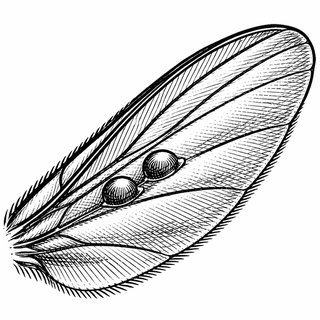
Among the wing's sensory equipment are structures called campaniform sensilla-tiny dome-shaped strain gauges embedded in the wing's outer shell. These mechanosensors detect bending and torsional forces encountered during flight, essentially telling the fly's nervous system exactly how the wing is flexing in real time.
The surprise? The researchers discovered a previously unknown population of these proprioceptors that connect directly to wing steering motor neurons. No intermediaries. No processing centers. Just a monosynaptic speed dial from sensor to muscle command.
That's like finding out your car's tires can adjust the steering wheel without going through the computer first. It explains how flies can make corrections within a single wingbeat-faster than any brain-processed decision could manage.
Not All Neighbors Are Friends
Here's where it gets weird. The team found that sensory neurons from adjacent campaniform sensilla-literally neighbors on the wing-have completely different shapes and connect to completely different downstream partners.
Think about that. Two sensors sitting right next to each other, detecting nearly the same thing, but their wires route to entirely different places. It's as if two people standing shoulder to shoulder at a concert were each hearing a completely different band.
This suggests an absurd level of specificity in how fly nervous systems wire themselves up during development. Each sensor apparently knows exactly which motor neurons it needs to talk to, and it finds them with precision that would make a GPS system weep with envy.
Why Should You Care About Fly Wings?
Fair question. Beyond satisfying our collective curiosity about the aerial acrobatics happening above our fruit bowls, this research has real implications.
First, understanding how flies achieve such rapid, precise motor control could inform bio-inspired robotics and drones. Engineers have already created strain sensors modeled on campaniform sensilla. Knowing exactly how the biological originals connect to control systems could make artificial versions far more effective.
Second, fruit flies share surprising genetic overlap with humans when it comes to basic neural circuitry. The principles governing how sensory feedback loops wire themselves up may translate to understanding proprioceptive disorders in people-conditions that leave patients unable to sense where their limbs are in space.
The Bigger Picture
The researchers didn't just find cool neurons. They built what they call a "wing proprioceptor atlas"-a comprehensive toolkit for studying how sensory feedback controls movement. Because fly wing anatomy is remarkably consistent from one individual to another, their findings can be applied across different connectome datasets.
This is the kind of foundational work that transforms a field. Before you can understand how something works, you need a parts list. Now we have one for the fly wing's sensory system, and it's already revealing that the wiring is far more specialized than anyone guessed.
So next time a fruit fly dodges your swatting hand with insulting ease, remember: it's not just fast reflexes. It's a masterpiece of evolutionary engineering, with sensors talking directly to motors in ways we're only beginning to understand.
References
-
Lesser, E., Moussa, A.J., & Tuthill, J.C. (2026). Peripheral anatomy and central connectivity of proprioceptive sensory neurons in the Drosophila wing. eLife, 107867. https://doi.org/10.7554/eLife.107867 | PMID: 41805047
-
Cheong, H.S.J., et al. (2024). Connectomic reconstruction of a female Drosophila ventral nerve cord. Nature. https://doi.org/10.1038/s41586-024-07389-x
-
Yarger, A.M., & Fox, J.L. (2021). Spatial distribution of campaniform sensilla mechanosensors on wings: form, function, and phylogeny. Current Opinion in Insect Science, 48, 8-17. https://doi.org/10.1016/j.cois.2021.06.002 | PMID: 34175464
-
Bellen, H.J., Tong, C., & Tsuda, H. (2010). 100 years of Drosophila research and its impact on vertebrate neuroscience: a history lesson for the future. Nature Reviews Neuroscience, 11(7), 514-522. https://doi.org/10.1038/nrn2839
-
Dickerson, B.H., et al. (2014). Neural evidence supports a dual sensory-motor role for insect wings. Proceedings of the Royal Society B, 281(1791). https://doi.org/10.1098/rspb.2014.1649
Disclaimer: The image accompanying this article is for illustrative purposes only and does not depict actual experimental results, data, or biological mechanisms.