
This costs billions of dollars per year - not because mice are running up invoices, but because disorders that blunt social connection, empathy, and prosocial behavior ripple through healthcare, caregiving, lost productivity, and everyday human misery in ways economists can count only imperfectly. We know social bonds matter the way rain matters to a forest. Take away enough of them, and the whole system starts to look brittle. So when scientists ask why one mouse will learn to free another in distress, they are not being quirky for sport. They are poking at one of the oldest and weirdest questions in biology: why does a brain built to keep itself alive sometimes decide someone else is worth the trouble?
A new paper in Cell Reports points the flashlight at an unexpected suspect - the dorsal hippocampus, a brain region famous for memory and navigation, like the overqualified friend who came to brunch and somehow also fixed your Wi-Fi. The study suggests this region does not just help mice remember where they parked their tiny mouse car. It also helps them learn and carry out rescue behavior.
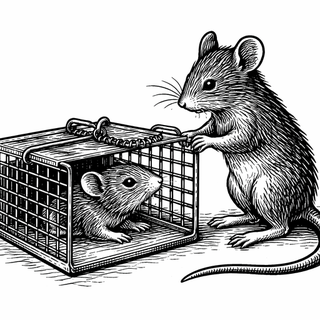
The mouse hero exam
The researchers studied a task where one mouse could free another mouse that was trapped. If that sounds oddly dramatic, it is. Tiny rodent rescue missions. Pixar, call your agent.
Scientists already knew some brain areas tied to emotion and social behavior matter for helping behavior. But the hippocampus had been hanging around the edges of the story. That was odd, because the hippocampus does more than map space. It also helps stitch together experiences, context, and emotional meaning - basically the brain’s scrapbook editor, except with higher stakes and fewer decorative stickers.
In this study, the team used chemogenetics, which is a very elegant way of saying they gave certain neurons an off-switch that can be triggered with a drug. When they dampened activity in the dorsal hippocampus, mice struggled to learn the rescue behavior. When they targeted the ventral hippocampus, that effect did not show up. That split matters, because these two hippocampal neighborhoods often get cast in different roles - dorsal for cognition and spatial memory, ventral for emotion and anxiety-related processing.
Plot twist: the more "mapmaker" end of the hippocampus turned out to be essential for becoming a better helper.
Memory, but make it moral-adjacent
So what might the dorsal hippocampus actually be doing here?
Probably not "empathy" in the Hallmark-movie sense. Mice are not sitting around pondering the fragility of existence. But they are using social and contextual information. A trapped cage-mate creates a very specific scene: something is wrong, there is a door, an action leads to release, and that action becomes meaningful over repeated experiences.
The dorsal hippocampus may help build that structured memory - who is stuck, where the relevant cue is, what sequence of actions works, and why this moment stands out from all the other moments in a mouse’s busy schedule of sniffing things with profound commitment.
The team also used calcium imaging to watch populations of dorsal hippocampal neurons during the task. They found that neural networks in this region appeared to consolidate during successful rescues. In plain English, the neurons started acting less like random people trying to leave a stadium and more like a coordinated group chat. Certain ensembles synchronized in ways linked to liberation of the trapped mouse. That suggests rescue behavior is not just one brave neuron yelling "DOOR!" but a whole network learning the social script.
Why this is cooler than "mice were nice"
This matters because prosocial behavior is one of those things we often treat as soft and fuzzy until it disappears. Then suddenly it is everyone’s problem. Conditions that affect social motivation or social understanding - including autism spectrum condition, schizophrenia, depression, and some trauma-related disorders - can profoundly alter how people connect, respond, and care for one another. No, this mouse study does not explain human empathy wholesale. The brain is never that polite. But it gives researchers a mechanistic foothold.
It also nudges neuroscience away from a cartoon version of social behavior where one "empathy center" does all the work. Brains do not run on single magic buttons. They run on shifting coalitions. The hippocampus may contribute by weaving social events into memory and context so helping becomes learnable, repeatable, and meaningful.
That idea fits with other recent work showing the hippocampus helps encode social relationships and social memory, not just locations on a map. Which, honestly, is kind of poetic. Maybe memory is not just about where you were. Maybe it is also about who needed you there.
The annoying, necessary caveats
A few caution flags, because science is a party but someone still has to check the fire exits.
First, this is a mouse study. Mice are useful, not miniature philosophers in fur coats. Second, rescue behavior in lab settings is a simplified version of helping, shaped by experimental context. Third, brain regions rarely do one thing only. The dorsal hippocampus might support attention, learning, context processing, stress responses, or action sequencing - all of which could feed into rescue.
So the takeaway is not "scientists found the kindness blob." It is more interesting than that. They found evidence that a memory-related network helps animals learn how to help.
And that feels strangely human, too. Maybe care is not just a feeling. Maybe it is also a practiced pattern - a path the brain learns to walk until helping another creature becomes a little more natural than looking away.
References
-
Corrêa MDS, Agafonova A, Braun A, et al. Neuronal networks in the dorsal hippocampus causally regulate rescue behavior in mice. Cell Rep. 2026;116923. doi:10.1016/j.celrep.2026.116923
-
Okuyama T. Social memory engram in the hippocampus. Neurosci Res. 2018;129:17-23. doi:10.1016/j.neures.2017.12.001
-
Tavares RM, Mendelsohn A, Grossman Y, et al. A map for social navigation in the human brain. Neuron. 2015;87(1):231-243. doi:10.1016/j.neuron.2015.06.011
-
Lee W, Dowd HN, Nikain C, et al. Distinct hippocampal circuits mediate social memory and generalization. Trends Neurosci. 2023;46(8):640-654. doi:10.1016/j.tins.2023.05.004
-
Oliva A, Fernández-Ruiz A, Buzsáki G, Berényi A. Role of hippocampal CA2 region in social memory and behavior. Cell Mol Life Sci. 2020;77(23):4565-4578. doi:10.1007/s00018-020-03525-5
Disclaimer: The image accompanying this article is for illustrative purposes only and does not depict actual experimental results, data, or biological mechanisms.