
Natural enzymes are unstable and finicky, yet we need enzyme-like activity to keep our brains healthy and our neural implants working. Scientists have built artificial enzymes from precisely arranged gold atoms that outperform the real thing and could solve both problems at once.
The Body's Worst Roommate Problem
Stick anything into the brain - even the fanciest neural electrode money can buy - and the brain treats it like an uninvited houseguest. Within hours, immune cells swarm the intruder. Inflammation kicks in. A glial scar forms like biological bubble wrap, insulating the foreign object from the very neurons it was designed to record. Signal quality plummets. The blood-brain barrier springs leaks. Reactive oxygen species corrode the electrode surfaces. It's a well-documented cascade of biological rejection that has plagued brain-computer interface development for decades.
Traditional approaches have tried softer materials, anti-inflammatory coatings, and fancy surface treatments. None have fully cracked the code.
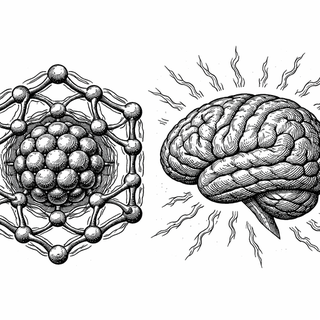
Enter clusterzymes - a portmanteau of "cluster" and "enzyme" that sounds like it was invented by a marketing team but was actually coined by serious chemists at Tianjin University.
What Exactly Is a Clusterzyme?
Imagine taking somewhere between 20 and 30 gold atoms - not a chunk of gold, not a nanoparticle, but a precise molecular assembly where every single atom is accounted for - and wrapping them in a protective shell of organic molecules. The result sits in a strange middle ground between chemistry and materials science, exhibiting properties that neither individual atoms nor bulk metals possess.
At this quantum-confined scale, adding or removing a single atom dramatically changes the cluster's behavior. This means researchers can fine-tune catalytic activity with atomic precision. Swap one gold atom for copper, and your cluster suddenly mimics superoxide dismutase 137 times better than the natural antioxidant trolox. Substitute cadmium instead, and you get 160 times better performance.
The new review in Advanced Science by Sun and colleagues systematically examines how these programmable little machines could transform neuroscience from three angles: treating neuroinflammation, enabling deep-tissue imaging, and dramatically improving neural electrode performance.
Fighting Brain Inflammation, Atom by Atom
Your brain maintains a delicate balance of reactive oxygen species - necessary for signaling but toxic in excess. After traumatic brain injury, stroke, or neurodegenerative disease, this balance tips toward oxidative chaos. Natural antioxidant enzymes like catalase and superoxide dismutase normally clean up the mess, but they're fragile. They denature in heat. They fail outside narrow pH ranges. They don't survive long in hostile inflammatory environments.
Clusterzymes maintain up to 85% of their catalytic activity across pH ranges from 2 to 10 and temperatures from 4 to 90°C. They scavenge reactive oxygen species with ruthless efficiency. In mouse models of traumatic brain injury, Au24Cd1 clusterzymes significantly reduced neuroinflammation by suppressing IL-1β and IL-6 - inflammatory cytokines that perpetuate brain damage after the initial injury.
Even better, these clusters are small enough (under 2 nanometers) to be cleared through the kidneys rather than accumulating in organs. Studies have shown negligible toxicity even at doses of 500 mg/kg - a safety profile that would make any drug developer weep with joy.
Seeing Deep Into the Brain
The review also highlights how these same atomic-scale properties enable infrared-emitting clusters that can image deep into brain tissue. Traditional fluorescent probes fade quickly under continuous laser illumination and struggle to penetrate more than a few millimeters of tissue. Metal clusters with tuned electronic structures emit light in the near-infrared window where biological tissue is relatively transparent, enabling 3D visualization of disease progression in living animals.
Researchers have already demonstrated this in APP/PS1 transgenic mice - an Alzheimer's disease model - where cluster-based probes achieved specific accumulation and high signal-to-noise ratio imaging in disease-relevant brain regions.
Neural Electrodes That Actually Get Along With Neurons
Perhaps the most striking application involves coating neural electrodes with semiconductor gold clusters. The results are almost comically superior to existing technology: impedance 26 times lower than state-of-the-art metal electrodes, sensitivity for local field potentials about 10 times higher than clinical platinum-iridium electrodes, and signal-to-noise ratios hitting 14.7 dB for single-neuron recordings.
But the real magic lies in biocompatibility. These nanozyme-coated electrodes deliver over 100-fold higher antioxidant activity, actively scavenging the reactive oxygen species that drive the foreign body response. They reduced neuronal injury area by 67% by inhibiting the glial proliferation that normally entombs implanted devices. In epileptic rat models, the improved signal quality enabled more precise localization of seizure foci - the kind of precision that could eventually help surgeons remove exactly the right tissue and nothing more.
The Road Ahead
The researchers are refreshingly candid about remaining challenges. Natural enzymes work within carefully orchestrated biochemical networks; artificial substitutes might disrupt these delicate systems in ways we can't yet predict. During catalysis, nanoclusters can themselves generate free radicals, potentially causing the very damage they're meant to prevent. And translating beautiful mouse data into human therapies remains the perennial challenge of biomedical research.
Still, the fundamental insight is compelling: by controlling matter at the atomic level, we can engineer catalytic activities that evolution never stumbled upon. We can build artificial enzymes that remain stable where natural ones fall apart, tune their specificity through single-atom substitutions, and integrate them into devices that must coexist with living tissue indefinitely.
The brain, it turns out, might accept a precisely engineered gold cluster more readily than it accepts a sterile silicon probe. Sometimes the solution to a biological problem isn't more biology - it's better chemistry.
References
-
Sun, S., Liu, D., Zhou, S., Wang, Y., Wang, H., Zheng, Z., & Zhang, X.-D. (2026). Atomically Precise Clusterzymes: A Programmable Optoelectronic Platform for Neuroscience. Advanced Science. DOI: 10.1002/advs.202519438
-
Liu, H., et al. (2020). Catalytically potent and selective clusterzymes for modulation of neuroinflammation through single-atom substitutions. Nature Communications, 11, 114. DOI: 10.1038/s41467-020-20275-0
-
Liu, D., et al. (2024). A Nanozyme-Based Electrode for High-Performance Neural Recording. Advanced Materials, 36(3), 2304297. DOI: 10.1002/adma.202304297
-
Jin, R. (2012). Quantum sized gold nanoclusters with atomic precision. Accounts of Chemical Research, 45(9), 1519-1528. DOI: 10.1021/ar200331z | PMID: 22720781
-
Liang, Z., et al. (2025). Revolutionizing brain-computer interfaces: overcoming biocompatibility challenges in implantable neural interfaces. Journal of Nanobiotechnology. PMC12243264
Disclaimer: The image accompanying this article is for illustrative purposes only and does not depict actual experimental results, data, or biological mechanisms.