
Neuroscience has a long history of borrowing from nature and then nervously wondering if it went too far. We split the atom, we cloned a sheep, and now - in what feels like the opening scene of a sci-fi movie nobody asked for - we're growing miniature brain-like structures in petri dishes. They're called brain organoids, they're roughly the size of a pea, and they're forcing scientists, ethicists, and lawyers to have some very uncomfortable lunch conversations.
Tiny Blobs, Big Questions
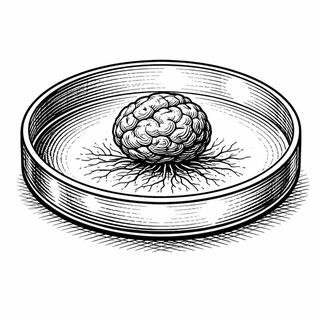
Brain organoids are three-dimensional clusters of human brain cells, grown from stem cells that have been coaxed into behaving like neural tissue. Take some induced pluripotent stem cells (adult cells reprogrammed back to their flexible, anything-is-possible youth), feed them the right molecular signals, and within months you've got a little ball of neurons, glia, and organized layers that look eerily like a developing human cortex.
The technique has been around since Madeline Lancaster and colleagues first described cerebral organoids in 2013 (Lancaster et al., 2013), and it's matured at a pace that would make a Silicon Valley startup jealous. Early organoids were rough sketches. Today's versions? They can generate electrical activity, form synaptic connections, and - in one headline-grabbing 2025 development - replicate neural wiring patterns resembling those of a kindergarten-aged child. Your five-year-old's brain, in miniature, sitting in a dish somewhere in a Stanford lab. Let that sink in for a second.
Why Scientists Are So Excited (and Slightly Nervous)
The excitement is justified. Brain organoids have already proven their worth. When the Zika virus swept through Brazil, researchers used organoids to show exactly how the virus targets neural progenitor cells and causes microcephaly - a discovery that would have been nearly impossible with traditional cell cultures or animal models (Qian et al., 2016). Since then, organoids have been deployed to study Alzheimer's disease, autism, schizophrenia, and even the neurological effects of COVID-19.
The appeal is obvious: these are human brain cells organizing themselves into human-like structures, offering a window into human neurodevelopment that mouse brains simply can't provide. Mice are great, but their cortex is smooth and simple compared to our gloriously wrinkled one. Organoids bridge that gap.
But here's where it gets complicated. As these tiny brain blobs grow more sophisticated, a question keeps nudging its way into the room like an uninvited guest at a dinner party: could they be conscious? Could a pea-sized cluster of neurons in a dish experience something?
The "C" Word Nobody Wants to Define
The short answer is: almost certainly not, at least not yet. Current organoids lack the full architecture, blood supply, and sensory input that a real brain needs to generate anything resembling awareness. They're missing entire brain regions, they have no body to interact with, and they max out structurally around the equivalent of early fetal development.
But "not yet" is doing a lot of heavy lifting in that sentence. The field is advancing so quickly that researchers are openly debating what happens when organoids get complex enough to blur the line. A 2025 review in the AJOB Neuroscience mapped the ethical and philosophical landscape around organoid consciousness, and the takeaway was essentially: we don't have a consensus definition of consciousness, we don't have a reliable way to measure it in organoids, and we're moving forward anyway (Lavazza & Massimini, 2025).
That's not exactly reassuring.
Asilomar, Round Two
This tension is precisely why, in late 2025, Stanford neuroscientist Sergiu Pasca organized a conference at Asilomar - the same California retreat where, fifty years earlier, scientists had gathered to hash out the first guidelines for genetic engineering. The symmetry was deliberate. Pasca brought together researchers, bioethicists, patient advocates, and lawyers for two days of what must have been the most existentially charged scientific meeting of the year.
The conference tackled questions that sound like philosophy exam prompts: Should organoids be transplanted into animal brains? At what point does a cluster of neurons deserve moral consideration? How do we protect research animals from experiments that might cause suffering through implanted human tissue?
As one Nature editorial put it bluntly: brain organoids are a transformative technology, but they need regulation (Nature, 2026). The potential benefits for understanding brain disorders are enormous - organoids could revolutionize how we study everything from epilepsy to brain tumors. But without a framework, the field risks either public backlash that shuts down promising research, or a slow creep into ethical territory nobody prepared for.
The Regulation Gap
Right now, brain organoids exist in a regulatory gray zone. They're not embryos (so embryo research rules don't apply), they're not animals (so animal welfare boards don't govern them), and they're not patients (so clinical ethics frameworks don't fit). They're something new, and our governance structures haven't caught up.
A 2024 review in Nature Reviews Bioengineering laid out the challenge: existing ethical frameworks were designed for a world where brain tissue stayed inside skulls (Hyun et al., 2024). Nobody planned for a scenario where human cortical tissue could be grown in a lab, transplanted into a rat, or potentially wired into a computer. The authors called for proactive governance - rules written before problems emerge, not after.
The Asilomar group echoed this, calling for an international body to monitor advances in organoid research and issue ongoing recommendations. They also pushed for better public communication, noting that breathless headlines about "mini-brains" create expectations (and fears) that the science doesn't yet warrant.
So Where Does This Leave Us?
In a genuinely interesting spot. Brain organoids represent one of those rare moments in science where the technology is advancing faster than our ability to think through its implications. They hold real promise for millions of people living with neurological conditions that have no good treatments. They also force us to confront some of the deepest questions in all of neuroscience: what is consciousness, when does it matter, and who gets to decide?
The good news is that scientists aren't ignoring the problem. The Asilomar conference, the growing body of neuroethics literature, and Nature's call for regulation all suggest the field is trying to get ahead of the curve. Whether it succeeds may depend on something scientists aren't always great at: talking to the rest of us about what they're building, why it matters, and what guardrails they're putting in place.
In the meantime, those little pea-sized blobs keep growing, keep organizing, and keep making us wonder what exactly we've started.
References
-
Lancaster, M. A., et al. (2013). Cerebral organoids model human brain development and microcephaly. Nature, 501, 373-379. DOI: 10.1038/nature12517. PMID: 23995685.
-
Qian, X., et al. (2016). Brain-region-specific organoids using mini-bioreactors for modeling ZIKV exposure. Cell, 165(5), 1238-1254. DOI: 10.1016/j.cell.2016.04.032. PMID: 27118425.
-
Hyun, I., et al. (2024). The ethical landscape of human brain organoids and a mindful innovation framework. Nature Reviews Bioengineering. DOI: 10.1038/s44222-024-00211-3.
-
Lavazza, A. & Massimini, M. (2025). Consciousness and Human Brain Organoids: A Conceptual Mapping of Ethical and Philosophical Literature. AJOB Neuroscience. DOI: 10.1080/21507740.2025.2519459. PMID: 40632929.
-
Brain organoids are a transformative technology - but they need regulation. (2026). Nature, 652(8109), 274. DOI: 10.1038/d41586-026-01021-w. PMID: 41951969.
Disclaimer: The image accompanying this article is for illustrative purposes only and does not depict actual experimental results, data, or biological mechanisms.