
As you read this sentence, billions of neurons are passing signals like frantic group-chat messages, your eyes are doing absurdly precise muscle choreography, and a few brain regions are quietly deciding whether this article is worth your precious attention or whether you should instead check your phone for the seventeenth time. It is chaos. Elegant chaos, but chaos. And that is exactly why today’s paper is extra weird - because the paper we were supposed to talk about has been retracted.
The plot twist is the paper itself
The PubMed record here points to a paper titled “Retraction: PAK3 downregulation induces cognitive impairment following cranial irradiation” in eLife.[1] Which means the headline finding is not just “scientists found a thing.” It is “scientists reported a thing, and then the paper got pulled back.” In science terms, that is less “case closed” and more “everyone back to the crime board with the red string.”
So instead of pretending we have a neat new answer, let’s talk about the question underneath it - because it is still a very real one.
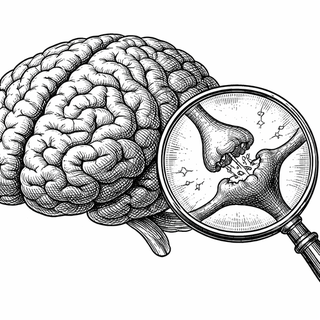
The original claim centered on PAK3, a protein involved in shaping synapses, the contact points where neurons pass information. Think of synapses as your brain’s texting app. PAK3 helps manage the architecture of those conversations. When that system goes sideways, learning and memory can take a hit. That matters because cranial irradiation - radiation delivered to the brain, often as part of cancer treatment - can leave some patients with lasting cognitive problems, including issues with memory, attention, and processing speed.[2,3]
So yes, the specific paper is retracted. But the larger mystery - why radiation can fog up cognition - is still very much open.
Why scientists care about “brain fog after treatment”
Radiation can be life-saving. Full stop. But the brain is not exactly thrilled when you blast tissue with ionizing energy. Radiation can trigger inflammation, damage blood vessels, alter the birth of new neurons in the hippocampus, and change how synapses function.[2-5] If the hippocampus is one of the brain’s librarians - the one trying to file memories where they belong instead of tossing them into a bin labeled “later, maybe” - radiation can make that librarian’s job a mess.
That is why researchers keep hunting for molecular players that might explain the damage. If a protein like PAK3 really were involved, it could point toward therapies that protect memory during or after treatment. That is the dream: treat the tumor without making the brain pay such a steep cover charge.
But here is where it gets weird
PAK3 is not some random biochemical extra wandering through the scene. It belongs to the p21-activated kinase family, proteins tied to synaptic structure and signaling. Variants in PAK3 have been linked to intellectual disability, which already tells us this protein matters for cognition.[6] So on paper, the hypothesis made sense. Radiation affects cognition. PAK3 affects synapses. Maybe one helps explain the other.
That is what makes retractions so maddening. They do not always mean the underlying idea is ridiculous. Sometimes they mean the evidence for that idea is not reliable enough to keep on the books.
And that distinction matters.
Science is not a vending machine where you insert funding and a clean truth drops out with a satisfying thunk. It is more like detective work conducted by sleep-deprived people staring at blots, behavior tests, and microscopy images while muttering, “Wait, why does lane 4 look suspiciously familiar?”
So what do we actually know?
We have strong evidence from broader research that cranial irradiation can impair cognition and alter brain biology in both animal models and human patients.[2-5] Reviews over the last few years point to several likely suspects:
- Neuroinflammation - the brain’s immune system gets jumpy and stays that way
- Reduced neurogenesis - fewer new neurons are born, especially in the hippocampus
- Vascular injury - blood vessel changes can hurt the brain’s support system
- Synaptic dysfunction - neurons may still be talking, but the conversation gets sloppy
Researchers are now exploring ways to reduce that damage, including anti-inflammatory strategies, better radiation targeting, and interventions aimed at preserving hippocampal function.[3-5]
In other words, the big story survives even when one paper does not.
Retractions are awkward - and also kind of healthy
Nobody throws a party for a retraction. They are messy. They can damage trust. They are also one of the ways science cleans its own kitchen.
A retracted paper should not be treated like settled evidence, cited as if nothing happened, or used to build bold claims about treatment. But the existence of a retraction is not proof that all related research is nonsense. It is proof that the system, imperfectly and sometimes painfully, noticed a problem.
Which is not glamorous. But honestly? In a field as high-stakes as neuroscience and cancer care, boring honesty beats flashy nonsense every time.
The real takeaway
The retracted paper does not give us a reliable answer about whether PAK3 downregulation causes cognitive impairment after cranial irradiation.[1] That specific claim needs independent, trustworthy evidence before anyone should lean on it.
What remains true is the bigger and more urgent problem: people who receive brain radiation can experience real cognitive side effects, and scientists are still trying to map the molecular chain of events behind them.[2-5] Somewhere in that chain may be proteins like PAK3. Or not. That is the whole point - we do not get to skip the evidence just because the story sounds neat.
The brain has enough drama already. It does not need us making up extra plot twists.
References
-
Retraction notice: Lee H, Kang H, Moon C, Youn B. Retraction: PAK3 downregulation induces cognitive impairment following cranial irradiation. eLife. 2024. doi: 10.7554/eLife.110771
-
Makale MT, McDonald CR, Hattangadi-Gluth JA, Kesari S. Mechanisms of radiotherapy-associated cognitive disability in patients with brain tumours. Nat Rev Neurol. 2017;13(1):52-64. doi: 10.1038/nrneurol.2016.185 | PMCID: PMC5514489
-
Surma-aho O, Niemelä M, Vilkki J, et al. Adverse long-term effects of brain radiotherapy in adult low-grade glioma patients. Neurology. 2001;56(10):1285-1290. doi: 10.1212/WNL.56.10.1285
-
Monje ML, Mizumatsu S, Fike JR, Palmer TD. Irradiation induces neural precursor-cell dysfunction. Nat Med. 2002;8(9):955-962. doi: 10.1038/nm749
-
Huo X, Sun H, Cao D, et al. Radiation-induced brain injury and relevant clinical and experimental research progress. Front Cell Neurosci. 2021;15:773428. doi: 10.3389/fncel.2021.773428 | PMCID: PMC8597935
-
Allen KM, Gleeson JG, Bagrodia S, et al. PAK3 mutation in nonsyndromic X-linked mental retardation. Nat Genet. 1998;20(1):25-30. doi: 10.1038/1685
Disclaimer: The image accompanying this article is for illustrative purposes only and does not depict actual experimental results, data, or biological mechanisms.