
What if every time you walked into an unfamiliar room, your brain threw the emergency stop before you even got through the door? Not because anything was wrong - just because the room was new. That is the daily reality for about 15% of the population, and a new meta-analysis just mapped exactly which circuits are pulling that brake lever.
The Temperament That Runs the Whole Shop
Let me show you something. Back in the 1980s, Harvard psychologist Jerome Kagan noticed that some babies absolutely lost it when shown a new toy - not with excitement, but with genuine distress. He called this trait "behavioral inhibition," and it turns out it does not just fade when kids grow up. It is a stable temperament: a factory-installed setting for fear, withdrawal, and hypervigilance toward anything unfamiliar. Children with high behavioral inhibition are nearly four times more likely to develop social anxiety disorder by adolescence (Fox et al., 2023). That is not a personality quirk. That is a wiring issue.
Putting the Brain on the Bench and Measuring Twice
Here is how it works. Gong and colleagues (2026) did something nobody had done properly before: they pulled together 18 fMRI studies covering 699 healthy people and ran a whole-brain meta-analysis using a method called anisotropic effect-size signed differential mapping (AES-SDM). Think of it like overlaying 18 different wiring diagrams on top of each other and looking for where the hot spots line up.
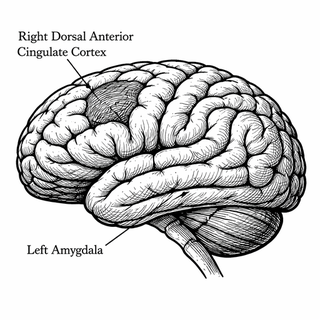
Here is what they found. Two regions ran hotter than expected: the right dorsal anterior cingulate cortex (dACC) and the left amygdala. If the brain were a workshop, the amygdala would be the smoke detector - it flags threats before you consciously register them. The dACC is the foreman standing next to it, deciding whether to call in the fire department or just open a window. In behaviorally inhibited people, both are working overtime, tripping alarms at stimuli that other brains wave right through (Clauss et al., 2011).
Some Circuits Are Running Cold
Here is why it matters. Three other regions showed decreased activation: the left inferior frontal gyrus, left middle temporal gyrus, and right insula. The inferior frontal gyrus is your brain's impulse control officer - it is the part that says "hold on, let me think about this." Less activity there suggests the inhibited brain may be worse at putting the brakes on its own alarm system. The insula normally integrates body signals with emotional awareness, and the middle temporal gyrus handles social perception. Turn those down, and you have a brain that is screaming "DANGER" while simultaneously being worse at reading the room and regulating the response.
That pattern - hot alarm system, cool control circuits - lines up with what we know from connectivity studies showing that behaviorally inhibited adults have weaker communication lines between the amygdala and prefrontal control regions (Roy et al., 2014).
The Sex Difference Nobody Expected
The meta-regression turned up something else. Studies with more women showed greater activation in the right supplementary motor area and the right inferior occipital gyrus. The supplementary motor area handles action preparation - getting ready to move, or more importantly, getting ready to not move. The occipital finding suggests women with this temperament may process visual threat cues differently. It is one data point, not a verdict, but it opens a door worth walking through.
Why This Wiring Diagram Matters
Here is what breaks. About 40% of kids with behavioral inhibition go on to develop anxiety disorders. The other 60% do not. Understanding why comes down to knowing which circuits are involved and how they interact. This meta-analysis gives researchers a clearer target map: the dACC-amygdala alarm network, the underperforming frontal control systems, and the insular integration gaps between them (Valadez et al., 2021).
If you can identify these patterns early, you can intervene before the wiring hardens. Cognitive behavioral therapy, attention bias modification, even targeted neurofeedback - all of these approaches get sharper when you know exactly which junction box to open. This is not about fixing a broken brain. It is about giving an overly cautious one a better set of tools.
The brain came with that wiring from the factory. The question is whether we can teach it some new circuits.
References
-
Gong, S., Huang, B., Pan, N., Kemp, G. J., Wang, S., Gao, B., & Gong, Q. (2026). Behavioral inhibition and brain function: A coordinate-based meta-analysis of task-related functional magnetic resonance imaging studies. Neuroscience and Biobehavioral Reviews, 106690. DOI: 10.1016/j.neubiorev.2026.106690 | PMID: 41990930
-
Fox, N. A., Zeytinoglu, S., Valadez, E. A., Buzzell, G. A., Morales, S., & Henderson, H. A. (2023). Annual Research Review: Developmental pathways linking early behavioral inhibition to later anxiety. Journal of Child Psychology and Psychiatry, 64(4), 537-561. DOI: 10.1111/jcpp.13702 | PMCID: PMC10690832
-
Clauss, J. A., Cowan, R. L., & Blackford, J. U. (2011). Expectation and temperament moderate amygdala and dorsal anterior cingulate cortex responses to fear faces. Cognitive, Affective, & Behavioral Neuroscience, 11(1), 13-21. DOI: 10.3758/s13415-010-0007-9 | PMCID: PMC3049952
-
Roy, A. K., Benson, B. E., Degnan, K. A., Perez-Edgar, K., Pine, D. S., Fox, N. A., & Ernst, M. (2014). Alterations in amygdala functional connectivity reflect early temperament. Biological Psychology, 103, 248-254. DOI: 10.1016/j.biopsycho.2014.09.007 | PMCID: PMC4356650
-
Valadez, E. A., Troller-Renfree, S. V., Buzzell, G. A., Henderson, H. A., Chronis-Tuscano, A., Pine, D. S., & Fox, N. A. (2021). Behavioral inhibition and dual mechanisms of anxiety risk: Disentangling neural correlates of proactive and reactive control. JCPP Advances, 1(2), e12022. DOI: 10.1002/jcv2.12022 | PMID: 34595482
Disclaimer: The image accompanying this article is for illustrative purposes only and does not depict actual experimental results, data, or biological mechanisms.