
A bat navigates pitch-black caves with echolocation, while an eagle spots a rabbit from two miles up. Both are masters of their environments, but their brains are wired completely differently for the job. Humans? We're somewhere in the middle - but here's the twist: babies might start out closer to the bat's approach than you'd think.
Scientists just discovered something wild about how our visual brain develops. Turns out, the visual cortex of sighted infants looks functionally more like the brain of a blind adult than a sighted adult. Let that sink in for a second.
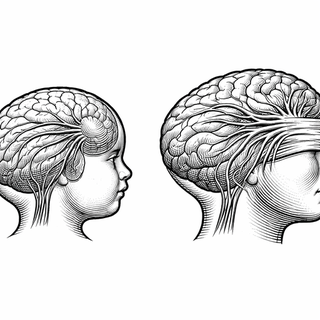
Your Brain's Networking Strategy Depends on What You've Seen
Here's what the research team found by comparing brain scans from 30 blind adults, 50 sighted adults, and a whopping 475 infants from the Developing Human Connectome Project. In sighted adults, the visual cortex is basically that friend who only talks to people at the gym - it couples strongly with sensory-motor networks (hearing, touch, movement) and keeps the intellectuals (prefrontal cortex) at arm's length.
But blind adults? Their visual cortex went full nerd. It ditched the sensory-motor crowd and became best friends with the prefrontal cortex - the brain's executive control center that handles planning, working memory, and all that high-level cognitive stuff.
And infants? Their visual cortex is already hanging out with the prefrontal cortex crowd, just like blind adults. The sensory-motor connections come later, once they've actually logged some serious visual experience.
The Plot Twist: Experience Rewires the Guest List
This isn't just some random developmental quirk. The researchers found that visual experience literally reshapes which brain networks become friends with your visual cortex. It's like your occipital lobe (that's the visual cortex's neighborhood) is throwing different parties depending on whether you've spent your life seeing or not seeing.
The data suggests that both vision AND blindness modify these connections through activity-dependent plasticity. Translation: your brain is constantly rewiring based on what's actually happening. Use it, lose it, or repurpose it - those are basically the options.
Why This Matters (Beyond Being Super Weird)
This research tackles a massive gap in our understanding of brain plasticity. Almost everything we know about how blindness affects the brain comes from adults. But brains don't spring into existence fully formed - they develop. And we've been flying blind (sorry) on when and how these connectivity differences emerge.
The finding that infant visual cortex looks more like blind adults than sighted adults suggests something profound: the default developmental program might be to wire up for cognitive processing first. The sensory-motor connections? Those might require visual experience to strengthen.
This flips our assumptions. We used to think blind people's brains reorganized away from some universal "normal" pattern. But what if sighted brains are the ones doing the reorganizing - away from a cognitive-heavy default and toward sensory-motor integration, all driven by visual input?
The Bigger Picture: Pluripotent Cortex
Recent work has shown that the developing cortex is functionally pluripotent - neuroscience speak for "it can become whatever it needs to be." In blind individuals, occipital cortex doesn't just sit around feeling sorry for itself. It processes language, math, memory, and even Braille reading at lightning speed.
But here's what's fascinating: even when blind people get their sight restored, some changes stick. Studies on cataract-reversal patients show that while higher-level visual areas can adapt reasonably well, the earliest visual cortex regions show lasting changes. The brain is plastic, but it's not infinitely elastic.
What Happens Next?
The longitudinal baby brain data opens up entirely new questions. When exactly do these connectivity patterns diverge between sighted and blind individuals? Is there a critical window? Can we predict developmental trajectories from early brain scans?
And here's the kicker for anyone thinking about interventions: if we understand the natural timeline of these changes, we might be able to work with the brain's developmental program instead of against it. Whether that's for helping blind children optimize their existing superpowers or supporting sighted kids with visual processing issues, knowing when and how these networks normally wire up is step one.
The human brain is basically running a continuous self-assembly program, and visual experience is one of its most important instruction sets. This research shows us that the program has a default mode - and it might not be what we expected.
References
-
Tian M, Xiao X, Hu H, Cusack R, Bedny M. Visual experience shapes functional connectivity between occipital and non-visual networks. eLife. 2026. DOI: 10.7554/eLife.93067
-
Deen B, Richardson H, Dilks DD, et al. Organization of high-level visual cortex in human infants. Nature Communications. 2022;13:7444. PMCID: PMC9674344
-
Bedny M. Developing cortex is functionally pluripotent: Evidence from blindness. Developmental Cognitive Neuroscience. 2024;65:10164. PMCID: PMC10899073
-
Abbondanza F, Beanato E, Porro GL. Anatomical and Functional Impacts of Congenital Bilateral Visual Deprivation on the Visual Pathway. Journal of Clinical Medicine. 2024;13(6):1775. DOI: 10.3390/jcm13061775
-
Vilachan JG, François M, Mignot C, et al. Impact of a transient neonatal visual deprivation on the development of the ventral occipito-temporal cortex in humans. Nature Communications. 2025;16:709. DOI: 10.1038/s41467-025-65468-7
-
Striem-Amit E, Ovadia-Caro S, Caramazza A, et al. Longitudinal stability of individual brain plasticity patterns in blindness. Proceedings of the National Academy of Sciences. 2024;121(18):e2320251121. DOI: 10.1073/pnas.2320251121
-
Jiao S, Wang K, Zhang L, et al. Developmental plasticity of the structural network of the occipital cortex in congenital blindness. Cerebral Cortex. 2023;33(24):11526-11540. DOI: 10.1093/cercor/bhad393
Disclaimer: The image accompanying this article is for illustrative purposes only and does not depict actual experimental results, data, or biological mechanisms.