
Think about the last time someone chewed with their mouth open near you. Annoying, right? Now imagine that annoyance cranked up to a full-blown fight-or-flight response - heart pounding, fists clenching, an overwhelming urge to either scream or flee the room. That's Tuesday for someone with misophonia. And then there's their neurological cousin, tinnitus - where your brain decides to generate its own personal soundtrack of ringing, buzzing, or hissing that literally nobody else can hear. One condition is set off by real sounds. The other invents sounds from scratch. So what could these two possibly have in common?
Turns out, quite a lot.
Your Brain's Alarm System Has Gone Rogue
A new review published in Neuroscience & Biobehavioral Reviews by Melanthiou and colleagues is the first to put misophonia and tinnitus side by side and really dig into their shared wiring problems (Melanthiou et al., 2026). The team proposes something called the Sensory-Salience Dysregulation Model, which is a fancy way of saying: both conditions involve your brain's "this is important, pay attention NOW" system going completely haywire.
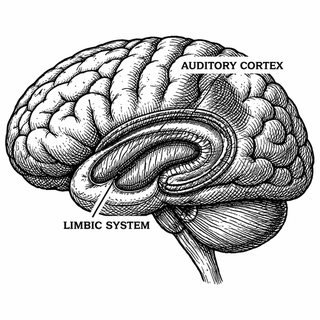
Here's the gist. Your brain has a salience network - think of it as the bouncer at a nightclub, deciding which sensory information gets VIP access to your conscious awareness and which gets left out in the cold. In both misophonia and tinnitus, that bouncer is wildly over-caffeinated, flagging things as urgent threats when they absolutely are not.
Neuroimaging studies show that both conditions feature hyperconnectivity between the auditory cortex (where sound gets processed) and the limbic system - specifically the amygdala and hippocampus, the brain regions that handle emotions and memory (Kumar et al., 2017). It's like your hearing centers and your panic centers have exchanged phone numbers and now they won't stop texting each other.
Same Wires, Different Short Circuits
The twist is how each condition exploits this shared vulnerability. Misophonia takes real sounds - your coworker's pen clicking, someone breathing a little too loudly - and routes them through the emotional panic highway. The anterior insular cortex, a brain region that sits at the crossroads of sensation and emotion, lights up like a pinball machine when someone with misophonia hears their trigger sound. Research has shown this comes with abnormal connections to the ventromedial prefrontal cortex, hippocampus, and amygdala - basically the whole emotional regulation neighborhood (Schröder et al., 2019).
Tinnitus, on the other hand, skips the "real sound" part entirely. When sensory input drops off (often from hearing damage), the auditory cortex starts generating its own phantom signals. The salience network picks them up, decides they're important, and - congratulations - you now have a permanent internal ringtone with no mute button. The anterior cingulate cortex and anterior insula keep this phantom percept locked in your conscious awareness, while the limbic system makes sure it comes with a side of emotional distress (Siepsiak et al., 2022).
Your Genes Might Be Partly to Blame
Both conditions also show hereditary influences, which means you can theoretically blame your parents. The review highlights that genetic factors play a role in the neural activity imbalances seen across the auditory cortex, amygdala, and anterior cingulate cortex in both disorders. Neuroplasticity - your brain's ability to rewire itself - drives the hyperconnectivity between auditory and limbic regions, but in these cases, the rewiring goes in a decidedly unhelpful direction.
And the autonomic nervous system gets dragged into the mess too. Both misophonia and tinnitus trigger heightened physiological arousal: increased heart rate, sweating, muscle tension. Your body literally acts as if it's under threat from... chewing noises. Or silence that's somehow too loud.
Why This Matters Beyond the Lab
Roughly 5-18% of the general population experiences significant misophonia symptoms, depending on which study you read, and about 15% of the global population deals with tinnitus. Among tinnitus patients, around 17% also show comorbid misophonia (Aryal & Bhatt, 2022). These aren't rare curiosities - they're conditions that wreck relationships, tank work performance, and send people into social isolation.
The Sensory-Salience Dysregulation Model proposed by Melanthiou and colleagues isn't just academic navel-gazing. If both conditions share a core mechanism - an overactive salience network misrouting sensory information through emotional processing highways - then treatments targeting that shared pathway could potentially help both. We're talking about the possibility of neurostimulation approaches, targeted therapies, or pharmacological interventions that address the root wiring problem rather than just managing symptoms.
Right now, neither condition has a standardized diagnostic framework, and treatment options remain limited. But understanding that your brain is running essentially the same error code in two different contexts? That's the kind of insight that changes how we approach the problem entirely.
Your brain is an absurdly complex organ that sometimes gets its own signals crossed. For people with misophonia and tinnitus, the crossing happens in eerily similar neighborhoods - it's just that one condition brings the noise from outside, and the other manufactures it in-house.
References
-
Melanthiou, D., Panayiotou, G., Paraskevopoulos, E., Chatzittofis, A., Koumas, M., Onisiforou, A., & Zanos, P. (2026). Linking misophonia and tinnitus: Common and divergent neurobiological mechanisms. Neuroscience & Biobehavioral Reviews, 183, 106584. https://doi.org/10.1016/j.neubiorev.2026.106584 | PubMed
-
Kumar, S., Tansley-Hancock, O., Sedley, W., Winston, J. S., Callaghan, M. F., Allen, M., Cope, T. E., Gander, P. E., Bamiou, D. E., & Griffiths, T. D. (2017). The brain basis for misophonia. Current Biology, 27(4), 527-533. https://doi.org/10.1016/j.cub.2016.12.048 | PMCID: PMC5321671
-
Schröder, A., van Wingen, G., Eijsker, N., San Giorgi, R., Vulink, N. C., Turbyne, C., & Denys, D. (2019). Misophonia is associated with altered brain activity in the auditory cortex and salience network. Scientific Reports, 9, 7542. https://doi.org/10.1038/s41598-019-44084-8 | PMCID: PMC6525165
-
Siepsiak, M., Rosenthal, M. Z., Engel, M., & Dragan, W. (2022). The neurobiology of misophonia and implications for novel, neuroscience-driven interventions. Frontiers in Neuroscience, 16, 893903. https://doi.org/10.3389/fnins.2022.893903 | PMCID: PMC9359080
-
Aryal, S., & Bhatt, J. M. (2022). Audiological and other factors predicting the presence of misophonia symptoms among a clinical population seeking help for tinnitus and/or hyperacusis. Frontiers in Neuroscience, 16, 900065. https://doi.org/10.3389/fnins.2022.900065 | PMCID: PMC9294447
Disclaimer: The image accompanying this article is for illustrative purposes only and does not depict actual experimental results, data, or biological mechanisms.