
The old theory began to wobble at the least glamorous moment possible: when the sequencing tables came back and the lateral habenula, long treated like one of stress biology's resident drama critics, looked relatively quiet, while the ventral tegmental area lit up with change in the animals that had stayed behaviorally resilient. Not the mice that buckled. The mice that adapted. Somewhere between those columns of gene counts, a shabby idea started to die - the idea that resilience is just what happens when stress fails to land a punch.
That is the central pleasure of this new Cell Reports paper by Minerva and colleagues: it suggests resilience is not a blank space where damage forgot to happen. It is labor. Molecular labor. The brain, that operatic little machine, appears to answer chronic social stress by remodeling the VTA - a midbrain hub famous for dopamine, motivation, reward, and all the reasons you checked your phone three times during breakfast - in ways that are stronger in resilient animals than in susceptible ones [1].
Not Stoicism - Renovation
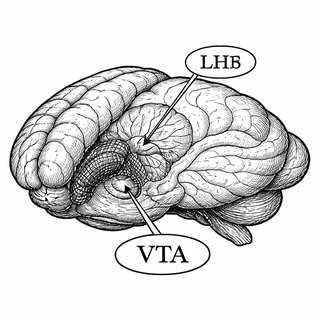
The researchers used single-nucleus RNA sequencing in mice exposed to chronic social stress, comparing animals that became susceptible with those that remained resilient. They looked in two places with serious reputations in mood and motivation research: the ventral tegmental area, or VTA, and the lateral habenula, or LHb. If the older cartoon version of the story were true, resilience might have looked like a milder version of susceptibility, a sort of neural shrug. Instead, the VTA showed widespread transcriptional remodeling in resilient animals, while the LHb showed relatively little gene-expression change in this dataset [1].
That matters because the VTA is not some decorative side corridor of the brain. It helps regulate how strongly the world feels worth pursuing, avoiding, learning from, or emotionally filing under "absolutely not" [2]. The habenula, meanwhile, is often framed as a kind of anti-reward switchboard, especially when outcomes go badly or expectations collapse [3]. So this paper gives us a delicious reversal: one region with the gloomy reputation does less transcriptional reshuffling here, while the reward-and-motivation hub seems to be out back rebuilding the scaffolding.
Scientists love a good passive explanation because it sounds tidy. Biology, naturally, prefers chaos with paperwork.
The Resilient Brain Does More, Not Less
Across VTA cell types, resilient mice showed increased expression of genes involved in intercellular signaling and neural communication, along with preserved receptor-ligand interaction strength [1]. In plain English: the resilient brains were not quietly enduring the stress. They seemed to be re-tuning how cells talk to each other. That is a very different vibe from "nothing happened."
The most prominent changes appeared in glutamatergic and dopaminergic neuron clusters, and the multivariate analyses suggested something especially interesting: susceptible and resilient neurons moved along a similar overall trajectory away from baseline, but resilient neurons moved farther [1]. Same road, different mileage. That sounds less like two separate species of stress response and more like one response in which some brains mount a bigger adaptive counter-move.
This fits a larger trend in the literature. Recent reviews argue that resilience is an active biological process involving plasticity, regulation, and compensation, not merely the absence of pathology [2]. Work in Molecular Psychiatry has also shown that stress can reshape VTA dopamine systems in developmentally sensitive ways [4]. And a 2024 Neuron study linked heightened LHb activity during stress to susceptibility, helping sharpen the contrast: if susceptibility can be pushed by maladaptive circuit activity, resilience may require equally real circuit-level correction rather than saintly vibes and a gratitude journal left open on the nightstand [5].
Why You Should Care, Even If You Are Not a Mouse
No, this does not mean your VTA has been caught doing Pilates. But it does mean stress outcomes may depend on whether the brain can actively reorganize communication inside key motivation circuits.
That is interesting for at least three reasons. First, it moves resilience away from moral language. We are often tempted to talk about resilient people as if they possess a superior character, like they were assembled from nicer screws. Neuroscience keeps ruining that sermon. Resilience may depend partly on whether certain circuits can adapt under pressure.
Second, it offers targets. If these molecular signatures hold up across labs and eventually connect to human data, researchers might look for biomarkers of adaptive stress responses or interventions that support the same signaling pathways. Not a pill labeled "cope harder," thankfully, but perhaps treatments that preserve flexible communication in reward and motivation networks [2,6].
Third, it addresses a real clinical problem. Stress-related disorders do not emerge uniformly. Two people can walk through similar adversity and end up in very different places. That variability has annoyed psychiatry for decades because it makes prediction difficult and treatment blunt. Papers like this one do not solve that problem, but they make it less mystical.
There are limits, and they matter. This is a mouse study. Gene-expression changes are not the same thing as proven causal mechanisms. The paper also narrows in on specific brain regions, while resilience in actual humans is almost certainly distributed across circuits, bodies, histories, and social environments. The brain is never a solo act. It is more like badly managed ensemble theater.
Still, the paper lands a sharp idea: resilience may look, at the cellular level, like an expensive rewrite rather than a lucky escape. The resilient brain is not untouched. It is busy.
References
-
Minerva AR, McMannon B, Lin R, Zhukovskaya A, Witten IB, Peña CJ. Stress resilience is associated with transcriptional remodeling in the VTA. Cell Reports. 2026;45(2):116867. DOI: https://doi.org/10.1016/j.celrep.2025.116867. PMCID: https://pmc.ncbi.nlm.nih.gov/articles/PMC12940535/
-
Kalisch R, Russo SJ, Müller MB. Neurobiology and systems biology of stress resilience. Physiological Reviews. 2024;104(3):1205-1263. DOI: https://doi.org/10.1152/physrev.00042.2023. PMCID: https://pmc.ncbi.nlm.nih.gov/articles/PMC11381009/
-
Zhang GM, Wu HY, Cui WQ, Peng W. Multi-level variations of lateral habenula in depression: A comprehensive review of current evidence. Frontiers in Psychiatry. 2022;13:1043846. DOI: https://doi.org/10.3389/fpsyt.2022.1043846. PMCID: https://pmc.ncbi.nlm.nih.gov/articles/PMC9649931/
-
Zhu X, Grace AA. Sex- and exposure age-dependent effects of adolescent stress on ventral tegmental area dopamine system and its afferent regulators. Molecular Psychiatry. 2023;28(2):611-624. DOI: https://doi.org/10.1038/s41380-022-01820-3. PMCID: https://pmc.ncbi.nlm.nih.gov/articles/PMC9918682/
-
Zhukovskaya A, Christopher Z, Willmore L, Pan Vazquez A, Janarthanan S, Falkner A, Witten I. Heightened lateral habenula activity during stress produces brainwide and behavioral substrates of susceptibility. Neuron. 2024;112(23):3940-3956.e10. DOI: https://doi.org/10.1016/j.neuron.2024.09.009. PMCID: https://pmc.ncbi.nlm.nih.gov/articles/PMC11825518/
-
Lupinsky D, Nasseef MT, Parent C, Craig K, Diorio J, Zhang TY, Meaney MJ. Resting-state fMRI reveals altered functional connectivity associated with resilience and susceptibility to chronic social defeat stress in mouse brain. Molecular Psychiatry. 2025;30(7):2943-2954. DOI: https://doi.org/10.1038/s41380-025-02897-2
Disclaimer: The image accompanying this article is for illustrative purposes only and does not depict actual experimental results, data, or biological mechanisms.