
Buried deep in a platform paper about standardized rodent phenotyping is a quietly radical idea: you can use genetics to tell whether your behavior classifier is any good. Not just accuracy metrics, not just cross-validation scores - actual heritability estimates that reveal whether the thing your algorithm claims to detect maps onto real biology. If the behavior your classifier spits out isn't heritable, maybe you're just measuring noise dressed up in a confusion matrix.
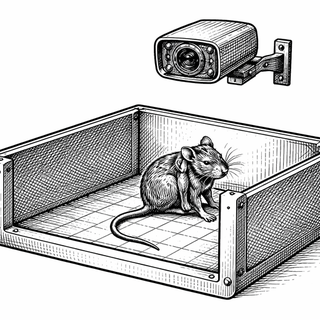
That insight sits at the core of JABS - the JAX Animal Behavior System - a new open-source platform from The Jackson Laboratory that wants to do for mouse behavior what assembly lines did for cars: standardize the whole pipeline from data collection to genetic analysis, and make it accessible to labs that don't have a computer science department down the hall (Choudhary et al., 2025).
The "We've Been Doing This by Hand?!" Problem
Here's the dirty secret of behavioral neuroscience: for decades, a staggering amount of mouse behavior data has been scored by graduate students watching video, clicking buttons, and slowly questioning their life choices. A mouse scratches its ear. Did that count as grooming or just a twitch? How long was that rear, really? Was the animal exploring or having an existential crisis in the corner?
Human observers disagree with each other. They disagree with themselves on different days. And they definitely can't score 2,457 mice across 168 strains - which is exactly the kind of dataset JABS was built to handle.
The field of computational ethology - using machine learning to automatically measure animal behavior - has exploded in recent years. Tools like DeepLabCut (Mathis et al., 2018) and SLEAP (Pereira et al., 2022) revolutionized pose estimation, tracking individual body parts with superhuman precision. But tracking where body parts are and knowing what the animal is doing are different problems. You can have a perfect skeleton and still not know if that particular limb configuration means "grooming" or "about to sneeze."
Three Modules, One Very Organized Mouse-Watching Operation
JABS tackles this with a three-part system that's less "Swiss Army knife" and more "entire Swiss Army kitchen."
JABS-DA (Data Acquisition) handles the hardware side - standardized 3D-printed arena designs and infrared cameras that work identically whether it's 2 PM or 2 AM. Mice are nocturnal, so if your setup only works in visible light, congratulations, you've been studying mice trying to nap.
JABS-AL (Active Learning) is where the machine learning happens. Researchers annotate examples of behaviors, train classifiers, and validate them - all through a graphical interface that doesn't require you to know what a convolutional neural network is. The active learning approach is clever: instead of labeling thousands of frames, the system asks you to label the ones it's most confused about, making your labeling effort count.
JABS-AI (Analysis & Integration) is the sharing and genetics layer. Train a grooming classifier in your lab? Upload it. Someone in Tokyo can apply it to their mice tomorrow. This is where things get genuinely cool: the platform includes curated datasets spanning 168 genetically diverse mouse strains, enabling heritability and genetic correlation analyses right out of the box.
The Ethograph: Your Behavior's Social Network
The team also introduces something called an "ethograph" - a graph-based framework for comparing different behavior classifiers bout by bout. Think of it as a way to ask: "When Classifier A says 'grooming,' does Classifier B agree? And when they disagree, where exactly does the confusion live?" It's the behavioral equivalent of a Venn diagram, but useful.
This matters because the Kumar Lab's earlier work showed that automated grooming detection across 62 mouse strains could reveal the genetic architecture of self-directed behavior, with links to human psychiatric traits (Geuther et al., 2021). If your classifier is slightly off, those genetic signals vanish into statistical noise.
Why This Matters Beyond the Mouse Room
The promise here isn't just efficiency (though processing thousands of hours of video without a single existential crisis is nice). It's reproducibility. When Lab A and Lab B use different arenas, different cameras, different lighting, and different grad students doing the scoring, comparing results is like comparing apples to some fruit you've never seen before.
JABS offers a shared language for behavior. Standardized hardware means standardized data. Shared classifiers mean the same behavioral definitions across labs. And genetic validation means you can check whether what you're measuring actually means something biologically - not just statistically.
For a field where the replication crisis has hit hard, that's not a small thing. It's the difference between everyone shouting their results into the void and actually building on each other's work.
References
-
Choudhary, A., Geuther, B.Q., Sproule, T.J., Beane, G., Kohar, V., Trapszo, J., & Kumar, V. (2025). JAX Animal Behavior System (JABS), a genetics-informed, end-to-end advanced behavioral phenotyping platform for the laboratory mouse. eLife, 14, e107259. DOI: 10.7554/eLife.107259 | PubMed
-
Mathis, A., Mamidanna, P., Cury, K.M., Abe, T., Murthy, V.N., Mathis, M.W., & Bethge, M. (2018). DeepLabCut: markerless pose estimation of user-defined body parts with deep learning. Nature Neuroscience, 21, 1281-1289. DOI: 10.1038/s41593-018-0209-y | PubMed
-
Pereira, T.D., Tabris, N., Matsliah, A., Turner, D.M., Li, J., Ravindranath, S., et al. (2022). SLEAP: A deep learning system for multi-animal pose tracking. Nature Methods, 19, 486-495. DOI: 10.1038/s41592-022-01426-1 | PubMed
-
Geuther, B.Q., Peer, A., He, H., Sabber, S., Bhatt, D.K., & Kumar, V. (2021). Action detection using a neural network elucidates the genetics of mouse grooming behavior. eLife, 10, e63207. DOI: 10.7554/eLife.63207 | PubMed
Disclaimer: The image accompanying this article is for illustrative purposes only and does not depict actual experimental results, data, or biological mechanisms.