
Monday: Normal worm, doing worm things. Tuesday: Still normal, maybe ate some algae. Wednesday: Surprise - turns out this tiny creature has been laying eggs through its mouth and scientists are just now figuring out how gloriously weird that is.
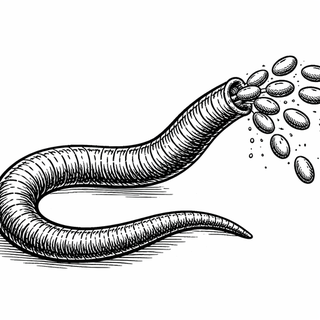
Meet Hofstenia miamia, a microscopic acoel worm that's been quietly breaking all the rules of reproductive biology while floating around in the ocean. These little guys are barely 2 millimeters long, but they pack more biological surprises than seems physically possible for something you'd need a microscope to appreciate.
The Worm That Rewrites the Manual
Here's where it gets fun. Researchers spent months watching these worms do their thing, and what they found was basically a highlight reel of "wait, that's not how that's supposed to work." First up: the egg-laying situation. Most animals have a pretty standard setup - eggs come out one end, food goes in the other, everyone's happy. H. miamia looked at that plan and said "nah."
These worms load their eggs into their pharynx (think of it as a muscular throat-tube) and then just... spit them out through their mouth. It's like if you gave birth by coughing. The researchers documented this using confocal microscopy and found reproductive organs that had never been described in acoels before (Chandra et al., 2025).
But wait, there's more. These worms can lay viable eggs for months after a single mating session. The kicker? They don't have a sperm storage organ. Somehow they're keeping sperm alive and functional without the biological equivalent of a storage unit. Oh, and they can also fertilize their own eggs without mating at all, which suggests they're pulling off self-fertilization when the dating scene gets rough.
Size Matters (To Internal Organs)
The really elegant part of this study comes from watching what happens when these worms regenerate or starve. Acoels are famous for their regeneration abilities - cut one in half and you get two worms, like a biological photocopier. But nobody had really mapped out what happens to reproductive organs during this process.
Turns out, reproductive organs follow the same growth-and-shrinkage rules whether the worm is regenerating, starving, or just developing normally. The organs emerge in a specific sequence as the worm gets bigger, like unlocking achievements in a video game based on body size (Chandra et al., 2025).
This is actually a big deal. It suggests there's some kind of size-sensing program running in the background, coordinating organ development with overall body size. Scientists have long wondered how organ size is controlled during development and regeneration, and these worms might be giving us clues. It's like the worm's body is constantly asking "how big am I?" and adjusting its reproductive toolkit accordingly.
Why This Tiny Worm Matters
Beyond the sheer entertainment value of mouth-birthing worms, H. miamia is becoming a rockstar model organism for developmental biologists. These acoels represent one of the earliest branches of bilateral animals - creatures with a left side and a right side, which includes everything from worms to humans. They're like a living time capsule from when bilateral symmetry was still a fresh evolutionary idea.
Previous work has shown that Hofstenia embryos are excellent for studying development, and the species is genetically tractable, meaning researchers can actually tinker with genes and see what happens. That's rare for organisms this evolutionarily ancient.
The reproductive weirdness documented in this study adds another layer. Understanding how these worms coordinate organ growth during regeneration could inform everything from tissue engineering to regenerative medicine. If we can figure out how a worm knows to rebuild its reproductive organs at exactly the right size relative to its body, maybe we can apply those principles to helping humans regrow damaged tissues.
The Bigger Picture
There's something almost poetic about discovering that an animal this small, this simple, has a reproductive strategy this unconventional. It's a reminder that evolution doesn't follow anyone's rulebook. Need to lay eggs but don't have a dedicated exit? Use your mouth. Need to store sperm but don't have storage organs? Figure it out anyway. Need to coordinate organ development across wildly different contexts like growth, starvation, and regeneration? Run the same size-based program for all of them.
The researchers followed these worms from zygote to adulthood, mapping out a complete life history that had never been documented for acoels. They showed that active processes of growth and destruction ensure coordinated organ development - nothing is left to chance. Every organ appears when it's supposed to, scales appropriately, and can even rebuild itself if things go wrong.
For an organism that doesn't even have a proper gut (food just gets absorbed directly into their tissues), they've figured out a remarkably sophisticated approach to reproduction. And we're just starting to understand how they pull it off.
References
Chandra, V., Tseng, S. E., Kann, A. P., Bolanos, D. M., & Srivastava, M. (2025). Developmental, regenerative, and behavioral dynamics in acoel reproduction. eLife, 14, e105712. https://doi.org/10.7554/eLife.105712 | PMID: 41860972
Fincher, C. T., Barker, A. J., Gulati, R., Kaul, V., Belzunce, A., Sun, R., ... & Srivastava, M. (2021). Embryonic development in the acoel Hofstenia miamia. Development, 148(13), dev188656. https://doi.org/10.1242/dev.188656 | PMCID: PMC8276984
Raz, A. A., Srivastava, M., Salvamoser, R., & Reddien, P. W. (2021). What determines organ size during development and regeneration? Development, 148(1), dev196063. https://doi.org/10.1242/dev.196063 | PMID: 33431590
Disclaimer: The image accompanying this article is for illustrative purposes only and does not depict actual experimental results, data, or biological mechanisms.