
The problem with studying how the brain filters information is that everything happens at once, everywhere, all the time. It's like trying to figure out which security guard at a concert is keeping out the rowdy drunks versus which one is redirecting people to the right entrance - while the music is blasting and thousands of neurons are moshing simultaneously.
But here's the thing: your brain has basically solved a coordination problem that would make any logistics company weep with envy.
Two Kinds of Quiet
Pyramidal neurons - the workhorses of your cortex that handle pretty much all the heavy thinking - don't operate alone. They're surrounded by inhibitory interneurons, specialized cells whose entire job is to tell other neurons to pipe down. Think of them as the brain's professional shushers.
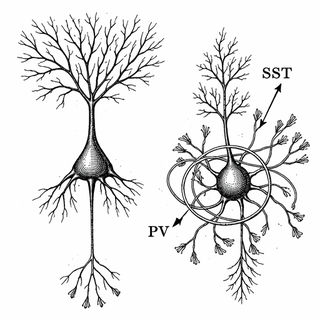
What makes this genuinely interesting is that these inhibitory neurons come in flavors. Parvalbumin-positive (PV) interneurons target the cell body and nearby regions - the "perisomatic" zone where action potentials get initiated. Somatostatin-positive (SST) interneurons, meanwhile, wrap their connections around distant dendritic branches - the tree-like structures where incoming signals first arrive.
A new study in eLife by Headley and colleagues asked a deceptively simple question: does the rhythm of inhibition matter as much as where it lands?
The Gamma-Beta Divide
The answer, it turns out, is a resounding yes - and the relationship is weirdly specific.
Using a detailed computational model of a layer 5 pyramidal neuron (complete with realistic dendritic structures and the ion channels that let dendrites generate their own local spikes), the researchers found that inhibitory rhythms have "preferred" locations:
Gamma oscillations (40-80 Hz) - those fast, buzzy rhythms associated with attention and perception - work best when delivered to the cell body region. Perisomatic gamma inhibition modulated whether the neuron could fire an action potential at all, essentially controlling the final output gate.
Beta oscillations (12-35 Hz) - the slower rhythms linked to motor control and "maintaining the status quo" - proved most effective when targeting distal dendrites. Beta-frequency inhibition entrained dendritic spikes, essentially deciding when inputs from far-flung sources could successfully drive the cell.
The mismatch didn't work nearly as well. Gamma at the dendrites? Beta at the soma? Much weaker effects. It's as if the brain's timing and location systems were designed to work together from the start.
Why the Division of Labor?
This finding slots neatly into something neuroscientists have suspected for a while: different interneuron types seem preferentially associated with different rhythms. PV interneurons, which target perisomatic regions, are known generators of gamma oscillations. SST interneurons, which target dendrites, have been implicated in beta rhythms.
The study suggests this isn't coincidental architecture - it's functional specialization. Gamma-frequency perisomatic inhibition acts like a fast veto on neuronal output, determining whether the cell fires during a given oscillatory cycle. Beta-frequency dendritic inhibition, meanwhile, controls the integration window for incoming signals, essentially deciding which inputs get counted together.
The practical upshot? Your brain has separate "channels" for controlling different aspects of neural computation. One system (gamma + perisomatic) handles the fast, moment-to-moment decisions about output. Another (beta + dendritic) manages the slower process of integrating information from diverse sources.
When the Bouncers Go Rogue
This division of labor has implications beyond basic neuroscience. Disrupted gamma oscillations show up consistently in schizophrenia, where PV interneuron function appears compromised. Abnormal beta rhythms plague Parkinson's disease, interfering with movement initiation. Understanding how rhythm and location interact could eventually help explain why these disorders affect cognition and behavior so differently.
There's also a subtler point worth appreciating. Pyramidal neurons receive roughly 30,000 excitatory inputs each - a fire hose of information that somehow needs filtering into coherent signals. The finding that rhythmic inhibition can selectively control either the timing of dendritic integration or the probability of output suggests the brain has more precise tools for this filtering than we'd assumed.
Your neurons aren't just deciding what to say. They're using oscillatory rhythms to control when and whether different types of input get heard - and they've assigned different frequencies to different jobs.
Not bad for three pounds of electric jelly.
References
-
Headley DB, Latimer B, Aberbach A, Nair SS. Spatially targeted inhibitory rhythms differentially affect neuronal integration. eLife. 2024;13:e95562. DOI: 10.7554/eLife.95562
-
Veit J, Hakim R, Jadi MP, Bhattacharya S, Bhattacharyya A. Distinct inhibitory circuits orchestrate cortical beta and gamma band oscillations. Neuron. 2017;96(6):1403-1418.e6. PMID: 29268099
-
Tukker JJ, Beed P, Schmitz D, Larkum ME, Bhattacharya A. Parvalbumin and somatostatin interneurons contribute to the generation of hippocampal gamma oscillations. J Neurosci. 2020;40(40):7668-7687. DOI: 10.1523/JNEUROSCI.0261-20.2020
-
Ribary U. The gamma rhythm as a guardian of brain health. eLife. 2024;13:e100238. DOI: 10.7554/eLife.100238
-
Spruston N. Pyramidal neurons: dendritic structure and synaptic integration. Nat Rev Neurosci. 2008;9(3):206-221. DOI: 10.1038/nrn2286
Disclaimer: The image accompanying this article is for illustrative purposes only and does not depict actual experimental results, data, or biological mechanisms.