
Late at night, while you're sleeping off that third cup of coffee, your body runs a tight cleanup operation. Cells sweep debris, recycle junk, and keep the machinery humming. But what happens when the cleanup crew shows up to a disaster zone - say, a stroke - and starts making things worse? A new study just caught one of the key troublemakers red-handed: a protein called Galectin-3 that turns helpful immune cells into tiny wrecking balls.
The Good Guys Who Sometimes Aren't
When a stroke hits, your brain sends out distress signals like a sinking ship firing flares. Among the first responders are monocyte-derived macrophages (MDMs) - immune cells that rush in from the bloodstream to help. Think of them as those well-meaning relatives who show up after a house fire. Some bring casseroles and help rebuild. Others rearrange your surviving furniture without asking and accidentally knock over a load-bearing wall.
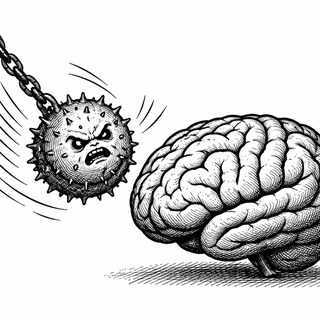
That's the maddening paradox researchers have been wrestling with for years: these same cells can protect damaged brain tissue and make the injury worse (Blank-Stein & Mass, 2023). The trick is figuring out which molecular switch flips them from helpful to harmful - and this study, published in The Journal of Clinical Investigation, found one.
Meet Galectin-3: The Instigator
Galectin-3 (GAL3 to its friends, if it had any) is a sugar-binding protein that shows up everywhere inflammation does. It's been linked to heart disease, fibrosis, Alzheimer's, and now, acute stroke injury (Lozinski et al., 2024). In the brain, it's the protein equivalent of that one coworker who escalates every minor disagreement into a full departmental crisis.
Wang, Huang, and colleagues discovered that after a stroke in mice, GAL3 levels skyrocket - specifically inside those invading macrophages. Not in the brain's resident immune cells (microglia), not in neurons, but in the reinforcements that just arrived from the bloodstream. The newcomers, it turns out, are carrying the matches.
Lysosomes Gone Wrong (Or: When the Recycling Bin Explodes)
Here's where the molecular plot thickens. Every cell has lysosomes - little compartments stuffed with digestive enzymes that break down cellular waste. Imagine a trash compactor that runs 24/7. Normally, very useful. But GAL3 does something nasty: it triggers these lysosomes to spring leaks.
When lysosomes lose their membrane integrity, their caustic contents - especially enzymes called cathepsins - spill into the cell's interior like acid from a cracked battery. This sets off the inflammasome, a molecular alarm system that cranks out inflammatory signals and sends the whole neighborhood into panic mode (García-Revilla et al., 2022). The macrophages, originally dispatched to help, are now pumping out inflammatory molecules and killing nearby neurons. Classic overreaction.
The Clever Experiment (and the Drug That Worked)
The research team didn't stop at identifying the culprit. They built an impressive case using bone marrow chimera mice (where you can swap out blood-cell populations like trading cards) and mice with GAL3 knocked out specifically in myeloid immune cells. Both approaches pointed to the same conclusion: GAL3 in macrophages drives acute brain damage after stroke.
But the real headline? A drug called TD139, a cell-permeable GAL3 inhibitor originally developed for pulmonary fibrosis (Mariño et al., 2023), worked when given systemically during the acute injury window. Brief, early treatment reduced brain infarcts, dialed down neuroinflammation, and - here's the kicker - improved long-term neurological outcomes in mice. Not just a short-term patch, but lasting benefit from temporary intervention.
Why This Could Actually Matter
Stroke is the leading cause of long-term disability worldwide, and current treatments are essentially a race against the clock: dissolve the clot or pull it out before too much brain tissue dies. There's almost nothing in the clinical toolkit for the inflammatory damage that cascades through the brain in the hours and days after.
What makes GAL3 particularly interesting as a drug target is where it sits. Unlike brain-resident proteins that require drugs to cross the blood-brain barrier (a notoriously picky bouncer), GAL3 operates in blood-derived macrophages. That means a peripheral drug - something injected into the bloodstream - can potentially reach it. No need to sneak past the velvet rope.
It's worth noting the complexity here. Global GAL3 knockout reduced infarcts initially but didn't sustain long-term benefits, suggesting GAL3 has helpful roles elsewhere or at later time points. The precision matters: targeting GAL3 in macrophages, during the acute phase, with a temporary treatment, was the winning combination. Sledgehammer bad, scalpel good.
The Bottom Line
Your brain's emergency response system is a double-edged sword, and this study identifies one of the sharpest edges. By showing exactly how GAL3 turns incoming macrophages into neurotoxic agents through lysosomal sabotage and inflammasome activation, the research opens a specific, druggable path to better stroke outcomes. The fact that TD139 already exists and works systemically means this isn't just a "maybe someday" finding - it's a "let's talk about clinical trials" finding.
For anyone who's ever watched a loved one struggle through stroke recovery, that distinction matters a lot.
References
-
Wang M, Huang Z, Du Z, et al. Galectin-3 mediates lysosome-related inflammation within monocyte-derived macrophages in a mouse model of ischemic brain injury. The Journal of Clinical Investigation. 2025. DOI: 10.1172/JCI194139. PMID: 41701549
-
Lozinski BM, Ta K, Dong Y. Emerging role of galectin 3 in neuroinflammation and neurodegeneration. Neural Regeneration Research. 2024;19(9):2004-2009. DOI: 10.4103/1673-5374.391181. PMID: 38227529. PMCID: PMC11040290
-
Blank-Stein N, Mass E. Macrophage and monocyte subsets in response to ischemic stroke. European Journal of Immunology. 2023;53(10):e2250233. DOI: 10.1002/eji.202250233. PMID: 37467166
-
García-Revilla J, Boza-Serrano A, Espinosa-Oliva AM, et al. Galectin-3, a rising star in modulating microglia activation under conditions of neurodegeneration. Cell Death & Disease. 2022;13(7):628. DOI: 10.1038/s41419-022-05058-3. PMID: 35859075. PMCID: PMC9300700
-
Mariño KV, Cagnoni AJ, Croci DO, Rabinovich GA. Targeting galectin-driven regulatory circuits in cancer and fibrosis. Nature Reviews Drug Discovery. 2023;22:295-316. DOI: 10.1038/s41573-023-00636-2. PMID: 36759557
Disclaimer: The image accompanying this article is for illustrative purposes only and does not depict actual experimental results, data, or biological mechanisms.