Dear parietal cortex,
We need to talk about what you've been doing with prefrontal. Specifically, the whole "feedforward signaling" thing. Turns out when you two stop talking during a math problem, everything falls apart. And honestly? Same.
New research from Tübingen has caught your neurons in the act of either cooperating beautifully or completely fumbling the handoff - and that difference might explain why sometimes you nail mental arithmetic and other times you stare at a restaurant check like it's written in hieroglyphics.
The Brain's Counting Squad Has Communication Issues
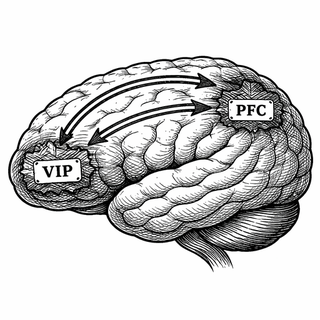
Researchers Tobias Machts and Andreas Nieder (the latter being basically the godfather of "number neurons" research) stuck electrodes into two brain regions of macaque monkeys and watched what happened when the animals counted dots on a screen. The regions in question: the ventral intraparietal area (VIP) - located in that wrinkly bit on the side of your brain - and the prefrontal cortex (PFC), which handles all your executive decisions and probably judges your Netflix choices.
Here's what they found: when monkeys got the answer right, these two regions were basically finishing each other's sentences. The VIP would fire up first, sending signals forward to the PFC in a coordinated neural cascade. Sustained correlations between the regions were driven by neurons specifically tuned to recognize numerosity - the number of items in a set.
But when the monkeys made errors? The communication basically turned into two people talking over each other on a bad Zoom call. The correlations weakened, the feedforward signaling from VIP to PFC dropped off, and there were actual "transient breakdowns" during the working memory period when the monkey was supposed to be holding the number in mind.
Why Your Brain Regions Need to Stay on Speaking Terms
This isn't just monkeys being bad at counting (though let's be honest, most of us aren't great at it either). The findings tap into something fundamental about how brains - including yours - process abstract concepts like quantity.
The intraparietal sulcus has long been known as the brain's number-crunching hub. Damage to this region causes acalculia, where people literally cannot tell which of two numbers is bigger. But the new research shows that having good number-processing hardware isn't enough. The regions need to talk to each other with precise timing.
Think of it like a relay race where VIP runs the first leg and needs to hand off the baton to PFC. When the handoff is clean - strong feedforward signaling right after seeing the numbers - you get accurate judgments. When VIP fumbles the pass or PFC isn't paying attention at the right moment, errors happen.
The Working Memory Plot Twist
The really interesting bit happens during what neuroscientists call the "delay period" - that stretch of time after you've seen the numbers but before you have to respond. This is working memory doing its thing, holding information online like RAM in a computer that's trying really hard not to crash.
During correct trials, the VIP-to-PFC correlation stayed strong throughout this period. But on error trials, there were these conspicuous "transient breakdowns" late in the working memory phase. It's like the brain started strong but then got distracted by its own neural equivalent of checking Instagram.
This finding jibes with recent work showing that the direction of brain communication matters for different types of errors. Disrupted feedback causes one kind of mistake; disrupted feedforward causes another. Machts and Nieder's work adds numerical cognition to the list of skills that depend on getting this directional flow right.
What This Means for Your Counting Brain
You might be wondering why any of this matters outside a monkey lab. Fair question.
First, this research contributes to a growing understanding that cognition isn't about individual brain regions being "smart" - it's about networks communicating dynamically. When researchers have artificially synchronized activity between frontal and parietal regions, people actually perform better on difficult memory tasks. The brain's rhythm section matters.
Second, understanding where numerical cognition breaks down could eventually help people with dyscalculia or those recovering from strokes affecting these regions. If we know the problem is signal transmission rather than signal generation, that changes the therapeutic playbook.
And third - look, it's just wild that we can now watch individual neurons in two separate brain regions coordinating in real-time to produce something as abstract as "that's four dots." The fact that this coordination fails in predictable ways when mistakes happen suggests there's a kind of neural choreography underlying even simple mental acts.
Your brain's counting network isn't just counting. It's conducting a precisely-timed conversation between distant regions, and whether you get the right answer depends on how well they're listening to each other.
References:
-
Machts, T., & Nieder, A. (2026). Coordinated parieto-frontal neuronal communication is critical for abstract quantity judgments in primates. Cell Reports. DOI: 10.1016/j.celrep.2026.117147
-
Blohm, G., et al. (2017). Computational Architecture of the Parieto-Frontal Network Underlying Cognitive-Motor Control in Monkeys. eNeuro. PMCID: PMC5329620
-
Nieder, A. (2016). The neuronal code for number. Nature Reviews Neuroscience. DOI: 10.1038/nrn.2016.40
-
Lara, A.H., & Wallis, J.D. (2015). The Role of Prefrontal Cortex in Working Memory: A Mini Review. Frontiers in Systems Neuroscience. PMCID: PMC4577153
-
Brincat, S.L., et al. (2024). Effective connectivity of working memory performance: a DCM study of MEG data. Frontiers in Human Neuroscience. DOI: 10.3389/fnhum.2024.1339728
Disclaimer: The image accompanying this article is for illustrative purposes only and does not depict actual experimental results, data, or biological mechanisms.