
Step 1: a nerve fiber sends a signal to your thymus. Step 2: your thymus produces T cells that keep you healthy. Step 3: you age, and apparently the whole operation falls apart in ways we've been misunderstanding for decades.
The thymus has always been something of an odd duck in immunology circles. This small, butterfly-shaped gland tucked behind your breastbone is where T cells - the special forces of your immune system - go to train before being deployed throughout your body. Like a military academy that only accepts students until puberty, the thymus does most of its heavy lifting early in life, then begins a slow, steady decline that immunologists rather elegantly call "involution." By middle age, much of your thymus has been replaced by fat, prompting the entirely reasonable question: if the organ is shrinking anyway, does anything else about it really matter?
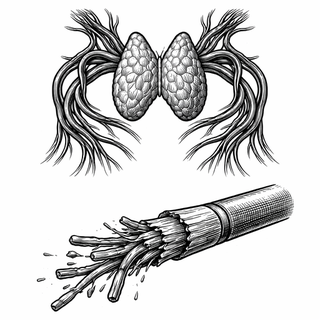
The Nerves Had It All Along
A new study from Carpenter and colleagues, published in Cell Reports, suggests we've been asking the wrong questions entirely. Using advanced whole-tissue imaging techniques, the research team created detailed three-dimensional maps of sympathetic nerve fibers - the same nerves that govern your fight-or-flight response - throughout the thymus. What they found contradicts decades of received wisdom.
Previous studies had suggested that nerve fiber density actually increases in the aging thymus. This seemed counterintuitive but was explained away as a mathematical artifact: as the thymus shrinks, the same number of nerves occupy a smaller space, creating the illusion of denser innervation. Rather like claiming a party got more crowded because half the guests left but someone also removed most of the furniture.
The new research tells a different story. By examining actual nerve structure rather than simply counting density, Carpenter's team found profound deterioration of thymic sympathetic innervation with age. The nerves weren't just passively sitting there in a shrinking organ - they were actively falling apart. Axons were collapsing, fraying, losing their connections with blood vessels, and shedding the synapses that allow them to communicate with immune cells.
Why Your Immune System Cares About Nerve Health
The sympathetic nervous system's relationship with the thymus turns out to be rather more intimate than a casual acquaintance. These nerve fibers don't just pass through on their way to somewhere more interesting - they directly influence how the thymus functions, including how efficiently it produces new T cells.
To test this, the researchers conducted two elegantly brutal experiments. First, they surgically removed the sympathetic nerves supplying the thymus (sympathectomy) and watched what happened. Thymic function declined. Then they gave aged mice a drug that mimics sympathetic nerve activity (a β3-adrenergic receptor agonist, for those keeping score at home), and observed the opposite: thymic function improved, with increased numbers of thymocytes and early thymic progenitors.
The implications are quietly extraordinary. The age-related decline in thymic function - long assumed to be an inevitable consequence of the organ's involution - may be at least partially driven by deteriorating nerve supply. And unlike thymic involution itself, nerve function is theoretically something we might be able to influence.
The Bigger Picture: Neuroimmune Aging
This research fits into a broader pattern emerging from studies of how the autonomic nervous system changes with age. The sympathetic nervous system becomes progressively more hyperactive in older adults, yet its connections to immune organs paradoxically deteriorate. It's rather like a manager who sends increasingly frantic emails while simultaneously losing the ability to actually reach anyone on their team.
What makes the thymus findings particularly striking is the contrast with previous assumptions. A comprehensive review published earlier this year in Frontiers in Immunology noted that most prior research had found apparent increases in thymic innervation with age - but acknowledged this might reflect artifacts of tissue shrinkage rather than genuine nerve growth. The new imaging data suggests those concerns were well-founded.
What This Means for the Rest of Us
The practical applications remain speculative but intriguing. If sympathomimetic drugs can partially restore thymic function in aged mice, might similar approaches work in humans? Could maintaining nerve health become a strategy for preserving immune function with age? The thymus's early decline has long been treated as immunology's fait accompli - something we simply accept and work around. This research suggests there may be more options on the table than we'd assumed.
For now, the findings serve as a useful reminder that the body's systems are considerably more interconnected than our disciplinary silos suggest. The immune system doesn't operate in isolation; it's wired - quite literally - into the nervous system, and that wiring matters more than we knew. The thymus, it turns out, was never just quietly shrinking in the corner. It was losing its nerve, and taking some of our immune capacity with it.
References
-
Carpenter RS, Begum F, Lagou MK, et al. Aging disrupts sympathetic innervation of the thymus. Cell Reports. 2026;117126. DOI: 10.1016/j.celrep.2026.117126
-
Carpenter RS, et al. Neural regulation of the thymus: past, current, and future perspectives. Frontiers in Immunology. 2025;16:1552979. PMC11880003
-
Caravaca AS, et al. Autonomic nervous system imbalance during aging contributes to impair endogenous anti-inflammaging strategies. GeroScience. 2024;46:507-526. PMC10828245
-
Thomas R, et al. Age-related thymic involution: Mechanisms and functional impact. Aging Research Reviews. 2022;79:101681. PMC9381902
-
Coder B, et al. Contributions of Age-Related Thymic Involution to Immunosenescence and Inflammaging. Immunity & Ageing. 2020;17:2. DOI: 10.1186/s12979-020-0173-8
Disclaimer: The image accompanying this article is for illustrative purposes only and does not depict actual experimental results, data, or biological mechanisms.