
Of all the unsolved puzzles in neuroscience, here's one that's been hiding in plain sight: why do older adults fare so much worse after traumatic brain injury? We're not talking a little worse. Adults over 65 account for nearly 40% of all TBI-related deaths in the United States, and the hospitalization rate from falls alone in the 75-plus crowd is more than triple that of any other age group (Flanagan et al., 2008; Hasan et al., 2024). Clinicians have known this for decades. But the why behind it? That's been maddeningly vague - until now.
Your Brain's Immune Cells Pick Sides With Age
A team led by Peipei Gong just dropped a study in The Journal of Clinical Investigation that finally puts a molecular face on this age gap, and the culprit is your brain's own cleanup crew: microglia (Lu et al., 2025).
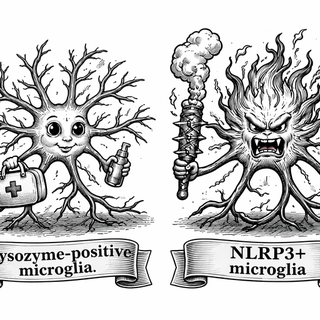
Think of microglia as your brain's resident security guards. When you're young and you take a hit to the head, these cells mostly show up wearing their "helper" badge - specifically, they're loaded with Lysozyme, a protein associated with debris cleanup and tissue repair. Lysozyme-positive microglia are basically the EMTs of the brain: they rush in, stabilize the scene, and help neurons survive the aftermath.
But in older brains? Same injury, completely different response. Instead of those helpful Lysozyme+ cells, aged brains flood with NLRP3+ microglia - the type that shows up not with a first-aid kit but with a flamethrower. NLRP3 is the centerpiece of the inflammasome, a molecular alarm system that, when activated, unleashes waves of pro-inflammatory signals (Irrera et al., 2020). In a young brain, that alarm gets pulled briefly and then shut off. In an old brain, it's like someone glued the fire alarm switch in the "on" position.
The Metabolism Plot Twist
Here's where it gets really interesting. The researchers didn't just catalog these two microglial types - they went full detective mode with multi-omics profiling to figure out why old microglia go rogue.
The answer? Sugar. Sort of.
NLRP3+ microglia are metabolic sugar addicts. They've shifted their energy production toward glycolysis - the quick-and-dirty way cells burn glucose without bothering with the more efficient mitochondrial pathway. This metabolic switch isn't just a side effect; it actively rewires the epigenetic landscape of these cells, opening up chromatin regions that promote inflammatory gene expression (Cheng et al., 2024). It's a vicious feedback loop: inflammation drives glycolysis, glycolysis reshapes the genome's accessibility, and the newly accessible genome cranks out more inflammatory signals.
And the mastermind behind it all? A transcription factor called ELF1 - a member of the ETS family that's normally involved in innate immune regulation in myeloid cells (Goller et al., 2025). In aged, injured brains, ELF1 essentially flips the switch that transforms microglia from healers into destroyers. When the researchers knocked out ELF1, those angry old microglia calmed down. TBI outcomes improved. Mortality dropped.
A Diabetes Drug to the Rescue
Now for the part that makes this more than an academic exercise.
The team screened for drugs that could inhibit ELF1 and landed on Imeglimin - a diabetes medication already approved for clinical use in treating type 2 diabetes. Imeglimin works by improving mitochondrial function and can cross the blood-brain barrier, which is the biological equivalent of having a VIP pass to the one venue that matters most (Lachaux et al., 2024; Yamada et al., 2025).
When aged TBI mice got Imeglimin, the results were striking. The drug inhibited ELF1, reversed the pro-inflammatory microglial phenotype, reduced acute mortality, and improved functional recovery. That's a diabetes pill doing neurosurgery's heavy lifting.
Why This Matters Beyond the Lab Bench
Repurposing existing drugs is the fastest path from bench to bedside - no decade-long development cycle, no billion-dollar Phase I trial. If Imeglimin's effects in mice translate to humans, we could be looking at a game-changing therapeutic for one of the most vulnerable patient populations in neurotrauma. Falls are the number-one cause of TBI in older adults, and with the global population aging rapidly, this problem isn't shrinking anytime soon (Flanagan et al., 2008).
The bigger scientific takeaway is equally compelling: your immune cells don't just age - they age differently. And those differences can mean the gap between recovery and catastrophe after the same injury. Understanding that metabolic rewiring drives epigenetic changes in microglia opens up an entirely new axis for intervention, not just in TBI but potentially in neurodegenerative diseases where NLRP3-driven inflammation plays a starring role (Zhang et al., 2023).
Your brain's security guards aren't getting lazy with age. They're getting radicalized. And now, for the first time, we might know how to talk them down.
References:
-
Lu, Z., Shuai, Y., Wang, C., et al. (2025). Aging-dependent microglial heterogeneity worsens outcomes in models of traumatic brain injury. The Journal of Clinical Investigation. DOI: 10.1172/JCI196112. PMID: 41926211.
-
Flanagan, S. R., Hibbard, M. R., & Gordon, W. A. (2008). Traumatic brain injury in older adults: Epidemiology, outcomes, and future implications. Journal of the American Geriatrics Society. PMCID: PMC2367127.
-
Hasan, M. J., et al. (2024). Traumatic brain injury in elderly population: A global systematic review and meta-analysis. Ageing Research Reviews. DOI: 10.1016/j.arr.2024.102365.
-
Lv, J., et al. (2022). Microglia and neuroinflammation: Crucial pathological mechanisms in traumatic brain injury-induced neurodegeneration. Frontiers in Aging Neuroscience. PMCID: PMC8990307.
-
Cheng, J., et al. (2024). Fueling neurodegeneration: Metabolic insights into microglia functions. Journal of Neuroinflammation. DOI: 10.1186/s12974-024-03296-0.
-
Goller, M. L., et al. (2025). The myeloid transcription factor Elf1 regulates genes with function in innate immunity. Experimental Hematology. DOI: 10.1016/j.exphem.2025.104768.
-
Lachaux, M., et al. (2024). Exploring new mechanisms of Imeglimin in diabetes treatment: Amelioration of mitochondrial dysfunction. Biomedicine & Pharmacotherapy. DOI: 10.1016/j.biopha.2024.116911.
-
Yamada, M., et al. (2025). Effects of imeglimin on mitochondrial functions and ischemic brain damage in young and aging rats. Journal of Atherosclerosis and Thrombosis. DOI: 10.5551/jat.65819.
-
Zhang, W., et al. (2023). Microglia in neurodegenerative diseases: Mechanism and potential therapeutic targets. Signal Transduction and Targeted Therapy. DOI: 10.1038/s41392-023-01588-0.
Disclaimer: The image accompanying this article is for illustrative purposes only and does not depict actual experimental results, data, or biological mechanisms.