Some people walk into a room full of strangers and instinctively mirror the crowd's energy, laughing at jokes they barely heard, nodding along to opinions they haven't fully processed. Others seem almost immune to this gravitational pull, maintaining their quirky opinions about pineapple on pizza regardless of social pressure. The difference, it turns out, isn't just personality - it's written into the wiring of specific brain circuits that process social information. And here's where things get interesting: those same circuits appear to malfunction in predictable ways across a range of psychiatric conditions.
Your Brain's Built-In Peer Pressure Detector
Picture your brain as a prediction machine that's constantly running simulations. It builds internal models of how the world works, then updates them when reality doesn't match expectations. When the group around you disagrees with your opinion, your brain registers this as a prediction error - essentially a neurological "wait, something's off here" signal.
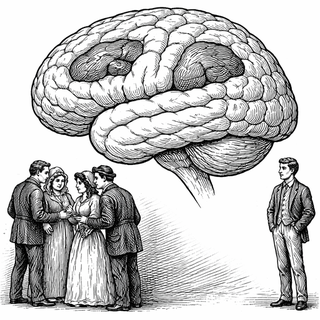
The rostral cingulate zone lights up like a disagreement detector, while the ventral striatum and nucleus accumbens - regions typically associated with reward processing - show decreased activity during social conflict. Your brain, in other words, treats being the odd one out as mildly punishing. That sinking feeling when everyone loves a movie you thought was terrible? That's neurobiology, not just insecurity.
The medial prefrontal cortex appears to be the decision-maker in chief, weighing whether to update your beliefs or stand firm. When researchers temporarily dialed down activity in this region, people became less likely to change their minds to match the group - suggesting this area actively pushes us toward conformity rather than simply registering the conflict.
The Chemical Cocktail of Going Along
The story gets stranger when you look at neurotransmitters. Serotonin, that molecule we associate with mood regulation, also appears to promote conformity - higher levels correlate with greater alignment with group judgments. Oxytocin, sometimes oversimplified as the "love hormone," acts more like a tribal loyalty switch: it increases conformity to in-group opinions while actually reducing the influence of outsiders. Dopamine joins the party too, with methylphenidate (better known as Ritalin) shown to increase conformity tendencies.
Your brain has essentially evolved a sophisticated chemical system for calibrating how much you care about what others think. This makes evolutionary sense - our ancestors who failed to read social cues probably didn't last long in environments where group cooperation meant survival.
When the Conformity Circuits Go Haywire
Here's where a new framework published in Biological Psychiatry gets genuinely useful. Researchers propose that psychiatric disorders characterized by abnormal social behavior might share underlying computational problems with conformity processing. Think of it as running faulty prediction software.
In autism spectrum disorder, the brain regions responsible for inferring others' mental states show reduced activity - like having an underpowered social antenna. In paranoid schizophrenia, these same attribution processes run hot, generating excessive inferences about what others are thinking and intending. Two very different presentations, but potentially two variations on the same underlying computational theme.
The researchers frame this using "active inference" - a theory suggesting our brains constantly generate predictions and then act to minimize surprise. When this system works well, we calibrate our social behavior appropriately. When it doesn't, we might either fail to pick up on social cues entirely or see meaningful patterns in social noise that don't actually exist.
From Lab Bench to Treatment Room
The clinical implications here are genuinely promising. If we understand which specific circuits drive conformity and how they malfunction in different conditions, we can potentially develop more targeted interventions. The framework points toward possibilities including precisely targeted pharmacotherapy (perhaps modulating serotonin, oxytocin, or dopamine systems in specific ways) and neurostimulation techniques like transcranial magnetic stimulation that could recalibrate these circuits.
Group therapy, it turns out, might work partly by harnessing healthy conformity processes - using positive social influence to shift maladaptive patterns. Understanding the neurobiology could help us design group interventions that maximize beneficial social learning while minimizing unhelpful peer pressure.
The Bigger Picture
There's something quietly profound about recognizing that our drive to fit in isn't a character flaw or a sign of weakness - it's a fundamental feature of how human brains process social information. We're prediction machines that treat social disagreement as a kind of error signal demanding resolution.
This doesn't mean conformity is always good, obviously. History offers plenty of examples where going along with the crowd led somewhere terrible. But understanding the machinery gives us better leverage for intervention - both in treating psychiatric conditions and in designing social environments that harness conformity for good rather than ill.
The brain regions involved in processing "do I agree with the group?" overlap substantially with those involved in processing rewards, punishments, and predictions about social outcomes. We're not just choosing to care about what others think. At a deep neurobiological level, we're built for it.
References:
-
Li Y, Pan Y, Zhao D. Understanding the Neurobiology and Computational Mechanisms of Social Conformity: Implications for Psychiatric Disorders. Biological Psychiatry. 2025. DOI: 10.1016/j.biopsych.2025.05.011
-
Stallen M, Sanfey AG. The neuroscience of social conformity: implications for fundamental and applied research. Frontiers in Neuroscience. 2015;9:337. PMCID: PMC4585332
-
Behavioral and Biological Bases of Herding and Conformity. PLOS ONE. 2024. PMCID: PMC11565668
-
Wu H, Luo Y, Feng C. Neural signatures of social conformity: A coordinate-based activation likelihood estimation meta-analysis of functional brain imaging studies. Neuroscience & Biobehavioral Reviews. 2016;71:101-111. DOI: 10.1016/j.neubiorev.2016.08.038
Disclaimer: The image accompanying this article is for illustrative purposes only and does not depict actual experimental results, data, or biological mechanisms.