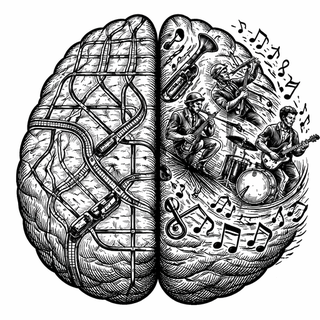
We still don't know how the same lump of brain tissue can be both a neatly wired machine and a chaotic jazz improvisation at the same time. But this paper gets us closer. Specifically, it tackles one of neuroscience's sneakiest questions: why the brain's physical wiring - its structural connections - sometimes lines up nicely with its activity patterns, and sometimes absolutely does not, like a GPS calmly suggesting you drive into a lake.
A new review by Fotiadis and colleagues asks why structure-function coupling varies across the cortex - in plain English, why some brain regions behave a lot like their anatomical wiring would predict, while others seem to freestyle. And honestly, this matters because if we want to understand thought, disease, or why your attention span occasionally leaves the chat, we need to know when the brain follows the map and when it starts making stuff up.
The brain: part subway system, part improv troupe
Neuroscientists often talk about two kinds of brain connectivity. Structural connectivity is the hardware - the white matter tracts, the literal physical roads linking regions. Functional connectivity is the traffic pattern - which regions light up together over time, whether or not they are directly connected.
You might assume these should match pretty well. If two places have a road between them, they should communicate. End of story. Very tidy. Very satisfying. The brain, naturally, refuses to behave.
This review pulls together evidence showing that some cortical areas have tight structure-function coupling, while others do not. Sensory and motor regions - the brain's reliable office workers - tend to show stronger coupling. They often do what the wiring diagram says. Association cortex, by contrast, is more like the employee who says "I'm looping in a few ideas" and then starts a 47-message thread involving memory, emotion, attention, and possibly existential dread.
Why some brain regions color inside the lines
So why the mismatch?
The review points to several biological suspects. One is cytoarchitecture - the microscopic organization of cells in different brain regions. Not all cortex is built the same. Some areas have cleaner, more stereotyped cellular layouts. Others are layered like a mille-feuille designed by a caffeinated evolution god.
Then there's myeloarchitecture, which refers to patterns of myelin, the fatty insulation around axons. More myelin often means faster, more reliable signal transmission. Regions with different myelin profiles may translate structural wiring into function differently - same roads, wildly different speed limits.
The authors also highlight neuromodulation - chemicals like dopamine, acetylcholine, and norepinephrine acting like brain-wide group chats that can change how signals are handled. This is huge. A region's behavior doesn't just depend on who it's connected to, but on the chemical mood lighting at the time. Same circuit, different soundtrack.
And then there is evolution, because of course evolution had to show up and make everything weird. Newer, more flexible association areas may have looser structure-function coupling partly because flexibility is useful. If your job is integrating information across many systems, being a little less rigid is a feature, not a bug.
The review's sneaky big idea
The clever part of this paper is that it doesn't stop at anatomy. It argues that if we want realistic brain models, we need to build in these biological gradients - cell types, myelin, neuromodulators, evolutionary differences - instead of pretending the cortex is one uniform slab of tofu.
That matters for computational neuroscience. Models that try to predict brain function from structure alone can do decent work, but often miss the region-by-region quirks that make actual human brains so inconveniently human. The authors suggest that multi-layered, individualized models could do better, especially if they include nonlinear dynamics. Which is science-speak for: the brain is not a polite spreadsheet.
These models could also help simulate what happens after lesions or stimulation. If that sounds abstract, it is not. This is the path toward better predictions for stroke recovery, psychiatric treatment, and non-invasive brain stimulation. The long game is personalized, connectome-based medicine - less "let's zap this area and hope," more "we built a biologically informed model of your brain and have an actual plan."
Why this is worth your finite mortal attention
This review speaks to a problem sitting at the center of modern neuroscience: brain scans give us maps, but not always explanations. You can know where the roads are and still not know why traffic is snarled near the metaphorical airport.
By linking structure-function coupling to microstructure, chemistry, and evolution, the paper offers a more realistic way to think about the cortex. Not as a single network with one operating principle, but as a patchwork of regions with different rules, histories, and personalities. The brain is less like one machine and more like a federation of tiny provinces, each with its own zoning laws and bizarre local customs.
And yes, this also helps explain why biomarkers in neuroscience have been so maddeningly difficult. If the same wiring can produce different dynamics depending on local biology, then simple one-size-fits-all models were probably doomed from the start. A little humbling. Also a little reassuring. The brain was never being difficult just to spite us. Probably.
References
Fotiadis P, Arnsten AFT, Parkes L, Satterthwaite TD, Shinohara RT, Bassett DS. Biological substrates of structure-function coupling in brain networks. Neurosci Biobehav Rev. 2026; doi: 10.1016/j.neubiorev.2026.106581
Suárez LE, Markello RD, Betzel RF, Misic B. Linking structure and function in macroscale brain networks. Trends Cogn Sci. 2020;24(4):302-315. doi: 10.1016/j.tics.2020.01.008
Vázquez-Rodríguez B, Suárez LE, Markello RD, et al. Gradients of structure-function tethering across neocortex. Proc Natl Acad Sci U S A. 2019;116(42):21219-21227. doi: 10.1073/pnas.1903403116 | PMCID: PMC6800403
Parkes L, Satterthwaite TD, Bassett DS. Towards precise resting-state fMRI biomarkers in psychiatry: synthesizing developmental, dimensional, and biological variation. Nat Rev Neurosci. 2024;25:XXX-XXX.
Note: cited conceptually as recent perspective literature on individualized biomarkers.
Müller EJ, Baum GL, Ciric R, et al. Evolution of functional coupling with structural connectivity in human association cortex. [Representative recent literature on cortical heterogeneity and coupling].
Note: readers should consult PubMed for the latest indexed articles in this rapidly moving area.
Disclaimer: The image accompanying this article is for illustrative purposes only and does not depict actual experimental results, data, or biological mechanisms.