
Some people live with the feeling that danger is always in the room. A phone buzz becomes bad news. A loud noise becomes a problem. A stranger becomes a maybe. When life feels like that, your mind does not sit there polishing ethics. It grabs a wrench and starts favoring force, certainty, and anyone who says they can make the fear stop.
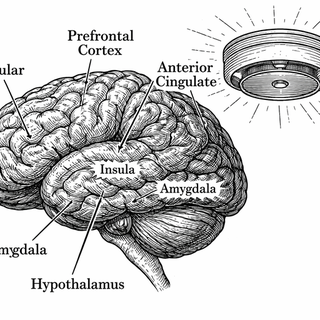
Let me show you something. A 2026 narrative review by Jorge Ratia Avinent and Emilie Caspar asks why civilians sometimes support war even when war is expensive, brutal, and morally ugly. Their answer is not "because people are monsters" or "because the amygdala did it." It is more like this: threat can push different brain systems into different defensive modes, and those modes may make hard-line, pro-war attitudes feel more reasonable than they look from the outside [1].
The Brain's Alarm Panel Is Not a Single Button
The review argues that "threat" is not one lump of mental plywood. Different threats get different handling.
Realistic threats are the plain old "something might hurt us" variety. That can recruit the amygdala, the periaqueductal gray, and the insula - a circuit that looks a lot like hardware for fast defensive reactions. Think smoke alarm, brake pedal, and the foreman yelling that the motor is overheating. This fits with newer work showing partly distinct human threat circuits for pain, predators, and aggressive attackers, not one giant panic blob [4].
Symbolic threats are weirder and more human. Nobody has to throw a punch. They just have to threaten your group identity, your values, or your sense that your side is the decent one. Now the brain is doing danger tracking plus self-story, moral sorting, and social loyalty math. If your worldview feels under siege, violence can start dressing itself up as "defense," which is how history keeps producing terrible sequels nobody asked for.
Existential threats are the long-haul version. They are not just "duck now." They are "the world is unstable, the future is shaky, and I would like my nervous system to stop free-climbing the walls." Here the review points to anterior cingulate-insula-BNST dynamics. The BNST specializes in sustained apprehension, the kind of slow-burn dread that hangs around like a power tool you forgot to unplug [5].
Short Threats Punch, Long Threats Marinate
One of the paper's best points is that timing matters. Immediate threats can push fast, reflex-like reactions. Useful if a truck is coming at you. Less useful when a politician, influencer, or news feed keeps handing you a string of maybe-threats and telling you to stay mad.
Prolonged threat is where things get messy. The review suggests that chronic vigilance may keep salience systems revved while weakening prefrontal regulation - the brain's part-time electrician that is supposed to check the wiring before somebody starts cutting live cable. That idea lines up with broader reviews showing constant negotiation between prefrontal cortex and amygdala during threat processing, with regulation becoming harder under sustained stress [2,3].
War support is rarely a one-second reflex. It is usually built over time - headlines, speeches, rumors, identity cues, moral outrage, repeat. Measure twice, cut once is great shop advice. Modern threat politics often runs on measure never, cut everything, blame the neighbor.
Why This Paper Hits a Nerve
This review did not find a tiny "support for war" switch tucked behind the left ear. What it offers is a wiring diagram for how fear, identity, vigilance, and weak top-down control might combine into public consent for violence.
That has real-world use if the framework holds up. Prevention is not only about arguing facts harder. Sometimes the job is lowering background threat, reducing uncertainty, slowing manipulative messaging, and giving prefrontal control a fighting chance. If you keep people feeling cornered, they stop shopping for nuance. They start shopping for shields, punishments, and strongmen.
That concern lands in an ugly information climate. Recent global survey work from Pew Research Center found widespread concern about false information online, and the World Economic Forum's 2026 Global Risks Report ranks societal polarization near the top of short-term risks. Feed people a steady diet of alarm, then act surprised when they come out twitchy and tribal. Outstanding system design. No notes.
The catch is that this is still a narrative review. The authors are building a plausible mechanism from psychological and neuroscience evidence, not proving one clean causal chain from amygdala spark to flag-waving. The next step is better testing - longitudinal work, cleaner threat categories, and more direct links between brain activity and political attitudes.
Still, the main lesson is solid enough to keep on the bench: threat does not just change what people feel. It can change what feels justified.
References
- Avinent JR, Caspar EA. Wired for Conflict? Neurocognitive Mechanisms Linking Threat Perception and Support for War. Neurosci Biobehav Rev. 2026. doi:10.1016/j.neubiorev.2026.106713
- Kredlow MA, Fenster RJ, Laurent ES, Ressler KJ, Phelps EA. Prefrontal cortex, amygdala, and threat processing: implications for PTSD. Neuropsychopharmacology. 2022;47(1):247-259. doi:10.1038/s41386-021-01155-7. PMCID:PMC8617299
- Murray EA, Fellows LK. Prefrontal cortex interactions with the amygdala in primates. Neuropsychopharmacology. 2022;47(1):163-179. doi:10.1038/s41386-021-01128-w. PMCID:PMC8616954
- Bertram T, Hoffmann Ayala D, Huber M, et al. Human threat circuits: Threats of pain, aggressive conspecific, and predator elicit distinct BOLD activations in the amygdala and hypothalamus. Brain Struct Funct. 2023;228(5):1467-1489. doi:10.1007/s00429-023-02616-8
- Sherman ER, Thomas JJ, Cahill EN. The bed nucleus of the stria terminalis in threat detection: task choice and rodent experience. Emerg Top Life Sci. 2022;6(5):457-466. doi:10.1042/ETLS20220002. PMCID:PMC9788396
Disclaimer: The image accompanying this article is for illustrative purposes only and does not depict actual experimental results, data, or biological mechanisms.