
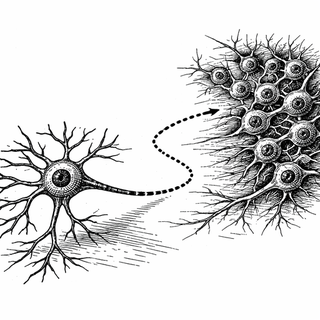
Picture a single cell. One lonely, microscopic speck. Now give it roughly nine months and some truly spectacular math, and that cell will build a human brain - 86 billion neurons, each one parked in precisely the right spot, wired to exactly the right neighbors. It's the biological equivalent of assembling IKEA furniture in the dark, except the furniture is conscious and occasionally writes poetry.
For decades, scientists have had a pretty tidy explanation for how developing cells figure out where to sit. Back in 1969, Lewis Wolpert proposed what's now called the French Flag Problem: cells read concentration gradients of signaling molecules called morphogens, which diffuse outward from a source like perfume from someone who overdid it at the department store. High concentration? You're close. Low concentration? You're far away. Cells use these chemical GPS signals to decide their identity and location.
It's an elegant system. It also has a pretty serious flaw.
The "Shouting Across a Stadium" Problem
Morphogen gradients work brilliantly - in small tissues. A diffusing molecule can reliably tell a few hundred cells where they are relative to each other. But brains don't stay small. A mouse brain grows by orders of magnitude from its earliest cell divisions to its final form. A human brain? Even more so. Asking a diffusing molecule to maintain a reliable signal across that distance is like trying to give someone directions by shouting across a football stadium. At some point, the message just doesn't carry.
This is the scaling problem, and it's been a quiet headache in developmental biology for years (Simsek & Özbudak, 2022). Researchers have proposed various molecular workarounds - feedback loops, opposing gradients, sink mechanisms - but they all feel a bit like duct-taping a fundamentally limited system.
What If Cells Just... Inherited Their Address?
A new study published in Neuron takes a refreshingly different approach. Stan Kerstjens, working with Florian Engert at Harvard and Anthony Zador at Cold Spring Harbor Laboratory, asked a question that sounds almost too simple: what if cells don't need to receive positional information from the outside at all? What if they inherit it from their parents?
Think about how human populations settle across a country over generations. Your grandparents lived somewhere, your parents probably grew up nearby, and there's a decent chance you're not too far from where the family tree planted its roots. Descendants cluster around their ancestors, and large-scale geographic patterns emerge without anyone sending a memo.
Kerstjens and colleagues argue that something remarkably similar happens in the developing brain. When a progenitor cell divides, its daughters don't wander off to random zip codes. They stay close. And as those daughters divide again and again, the resulting cluster of related cells naturally forms a neighborhood - no diffusing molecules required. As Kerstjens put it: "The only thing a cell 'sees' is itself and its neighbors. But its fate depends on where it sits."
The Evidence: Thousands of Genes, Two Species, One Pattern
Here's where it gets properly impressive. The team analyzed brain-wide gene expression data across developing mouse and larval zebrafish brains. They looked at what they call "principal eigengenes" - essentially, the dominant co-expression patterns that emerge when you analyze thousands of genes simultaneously. Think of eigengenes as the greatest hits album of gene expression: the patterns that explain the most variation across the entire tissue.
What they found was striking. These eigengene patterns formed smooth gradients spanning multiple spatial scales, from broad brain-region boundaries down to finer local organization. The patterns remained stable across different developmental time points. And - perhaps most remarkably - they were conserved between mice and zebrafish, two species separated by roughly 450 million years of evolution (Shainer et al., 2023).
Even better, the team showed that small subsets of genes could effectively "decode" these eigengene patterns, providing multi-scale positional information. In other words, cells don't need to read the entire genetic encyclopedia to know where they are. A few well-chosen chapters will do.
Why This Actually Matters
This isn't just a clever theoretical exercise. The lineage-based model solves the scaling problem in a way that morphogen gradients simply can't. Because positional information is passed from parent to daughter at each cell division, the system scales naturally with tissue growth. No molecular signals need to travel farther as the brain gets bigger. The pattern just... grows with it.
Recent work mapping clonal relationships in the mouse brain has already shown that cells sharing common ancestors do, in fact, cluster together spatially (Ratz et al., 2022). The new model gives those observations a theoretical backbone.
The researchers are careful to note this isn't an either-or situation. Morphogen gradients still do important work, particularly for fine-tuning local cell identities. But for the large-scale architecture - the broad strokes of brain organization that need to work across orders of magnitude of size - lineage may be doing the heavy lifting that diffusion-based signals were never really built for.
And there's a bigger question lurking behind all of this. As Kerstjens noted: "The brain somehow makes us intelligent. How did it manage to accumulate this capability?" Understanding how the brain's architecture bootstraps itself from a single cell is one piece of that puzzle - and it turns out the answer might be less about complex signaling cascades and more about the beautifully simple principle that children tend to stay close to home.
References
-
Kerstjens, S., Engert, F., Douglas, R. J., & Zador, A. M. (2026). A lineage-based model of scalable positional information in vertebrate brain development. Neuron. DOI: 10.1016/j.neuron.2025.12.043 | PubMed
-
Simsek, M. F., & Özbudak, E. M. (2022). Patterning principles of morphogen gradients. Open Biology, 12(10), 220224. DOI: 10.1098/rsob.220224 | PMCID: PMC9579920
-
Ratz, M., von Berlin, L., Larsson, L., Martin, M., Westholm, J. O., La Manno, G., Lundeberg, J., & Frisén, J. (2022). Clonal relations in the mouse brain revealed by single-cell and spatial transcriptomics. Nature Neuroscience, 25(3), 285-294. DOI: 10.1038/s41593-022-01011-x | PMCID: PMC8904259
-
Shainer, I., Kuehn, E., Laurell, E., Al Kassar, M., Mokayes, N., Sherman, S., Larsch, J., Kunst, M., & Baier, H. (2023). A single-cell resolution gene expression atlas of the larval zebrafish brain. Science Advances, 9(8), eade9909. DOI: 10.1126/sciadv.ade9909 | PMCID: PMC9946346
Disclaimer: The image accompanying this article is for illustrative purposes only and does not depict actual experimental results, data, or biological mechanisms.