
The problem with studying how brains work is that we've been doing it backwards. For decades, neuroscientists have been poking around in circuits trying to figure out what each wire does, like reverse-engineering an iPhone without knowing what phones are for. We've mapped connections, labeled regions, and cataloged neurotransmitters with the dedication of stamp collectors. But here's the thing: your brain wasn't designed by an engineer sitting at a drafting table. It was hacked together by evolution, which is less like Apple's design team and more like a billion years of duct tape and "let's see if this works."
A new perspective published in Cold Spring Harbor Perspectives in Biology argues that if we really want to understand how brains work, we need to stop treating them like static machines and start treating them like what they are: the products of evolutionary tinkering. The authors call it "evolutionary systems neuroscience," which sounds fancy but basically means "let's use evolution as a cheat sheet for understanding neural circuits."
Evolution: The World's Sloppiest (and Most Successful) Engineer
Here's what makes evolution so useful for neuroscience: it's constantly running experiments for us. When a fruit fly develops a new courtship dance, or a mouse evolves a different communication style, evolution has essentially modified the brain's circuitry while keeping the thing running. It's like swapping out parts of an engine while the car is moving - except the car has been moving for millions of years and somehow hasn't exploded.
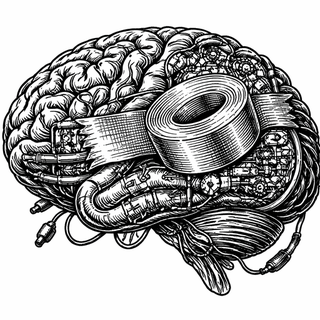
The really clever bit is that evolution tends to preserve the stuff that works while tweaking things just enough to create new behaviors. Your brain's basic architecture - the deep circuitry handling essential functions like breathing, moving, and not falling over - is ancient and conserved. But layered on top of that are all these modifications that make you, well, you. Different species can have wildly different behaviors driven by surprisingly small circuit changes, like installing a new app on old hardware.
When Different Brains Solve the Same Problem (Spoiler: They Cheat Off Each Other)
This is where things get interesting. When you study convergent evolution - cases where totally unrelated species independently evolve similar solutions - you start seeing patterns. Take vision, for example. Insects and vertebrates split from their common ancestor something like 600 million years ago, yet both evolved similar solutions for processing visual motion. They're using different hardware (compound eyes vs. camera eyes) but arrived at comparable computational tricks.
The same thing happens with smell. Both insects and vertebrates organize their olfactory systems into structures called glomeruli - little processing units that sort odors. This likely evolved independently in each lineage, which means it's probably a really good solution to the problem of "how do you organize smell information." When evolution independently invents the same solution twice, that's usually a hint that there aren't many other ways to do it well.
This is what the authors mean by finding "deep homologies" in neural circuits - the idea that beneath all the surface differences, there might be fundamental computational principles that work so well that evolution keeps discovering them. It's like how every civilization independently invented the wheel. Some things are just good ideas.
The Other Side: How to Remix a Brain Without Breaking It
But convergent evolution is only half the story. The equally fascinating part is divergent evolution - how species with similar starting points end up with totally different behaviors. Consider rodent communication: some species evolved elaborate ultrasonic vocalizations for social bonding, while others kept it simple. The neural circuits underlying these behaviors are related (they share a common ancestor), but they've been modified in specific ways that enable new tricks without disrupting the basics.
This is the evolutionary equivalent of a cover song. You keep the chord structure, maybe the melody, but you change the arrangement, add new instruments, speed it up or slow it down. The result can be surprisingly different from the original, but it's all built on the same foundation. Recent research on acoustic communication circuits shows that hindbrain and limbic regions involved in vocalization are highly conserved across species, while forebrain regions have diverged significantly. Translation: the basic machinery for making sounds is ancient, but the decision-making about when and how to use those sounds is where evolution gets creative.
Studies of courtship behavior in insects have revealed that neural circuits controlling mating rituals have a modular organization - you've got discrete chunks that handle different parts of the behavior. This modular setup makes it way easier for evolution to tinker with one piece without screwing up the whole system. Want to add a new dance move to the courtship routine? Just tweak the module that controls that behavior. The rest of the circuit carries on like nothing happened.
Why This Actually Matters (Besides Being Cool)
The practical upside of this evolutionary approach is that it gives neuroscientists a roadmap. Instead of randomly testing which brain region does what, you can use evolution's experiments to guide you. Comparing circuits across species that have evolved different solutions to the same problem - or similar solutions to different problems - reveals which features are essential and which are optional add-ons.
Modern tools like optogenetics, genome editing, and large-scale brain recording now let researchers investigate the causal chain from genes to circuits to behavior with ridiculous precision. This perspective argues that when you combine these tools with an evolutionary framework, you get something more powerful than either approach alone. You're not just describing circuits - you're understanding why they evolved the way they did, which tells you something fundamental about how they work.
The authors suggest this framework could reveal general principles of neural computation, much like how evolutionary developmental biology (evo-devo) discovered that wildly different animals use the same genetic toolkits to build their bodies. Flies and humans look nothing alike, but they both use a set of ancient "master control genes" to lay out their body plans. Could something similar be true for brains? Are there universal circuit motifs that keep showing up because they're just really good at solving certain computational problems?
The Bigger Picture: It's Not Just About Brains
Here's the kicker: this approach might tell us something useful beyond neuroscience. Complex adaptive systems - whether they're brains, ecosystems, or markets - often face similar design challenges. How do you build a system that's stable enough to function reliably but flexible enough to adapt to new situations? How do you add new features without breaking existing ones? Evolution has been solving these problems for billions of years, and the solutions encoded in neural circuits might have broader implications for understanding any system that has to balance reliability with adaptability.
So the next time someone tells you the brain is like a computer, you can politely inform them that it's actually nothing like a computer. It's more like a computer that's been upgraded, patched, and repurposed continuously for hundreds of millions of years, with each upgrade designed to work with all the previous versions. And somehow, improbably, it runs better than anything we've ever built on purpose.
References
Banerjee, A., Phelps, S. M., & Kebschull, J. M. (2026). The Unusual Effectiveness of Evolution in Systems Neuroscience. Cold Spring Harbor Perspectives in Biology, 18(3), a041510. https://doi.org/10.1101/cshperspect.a041510
Strausfeld, N. J., & Hirth, F. (2016). Introduction to 'Homology and convergence in nervous system evolution'. Philosophical Transactions of the Royal Society B, 371(1685). PMC4685576
Barkan, C. L., & Kelley, D. B. (2022). Convergent and divergent neural circuit architectures that support acoustic communication. Frontiers in Neural Circuits, 16. PMC9712726
The Transmitter. (2025). Systems and circuit neuroscience need an evolutionary perspective. Retrieved from https://www.thetransmitter.org/systems-neuroscience/systems-and-circuit-neuroscience-need-an-evolutionary-perspective/
Disclaimer: The image accompanying this article is for illustrative purposes only and does not depict actual experimental results, data, or biological mechanisms.