
The Three-Act Play Inside Your Skull
Step 1: You're sitting at your desk, staring at a spreadsheet. Step 2: Your eyes are open, your coffee is warm, and by every measurable standard you are awake. Step 3: Your brain quietly slips into a dream.
No, you haven't fallen asleep. No, you're not hallucinating. According to a new study from the Paris Brain Institute, your wide-awake brain can produce the exact same mental states as your sleeping one - and it does this more often than anyone realized.
The Experiment That Blurred the Line
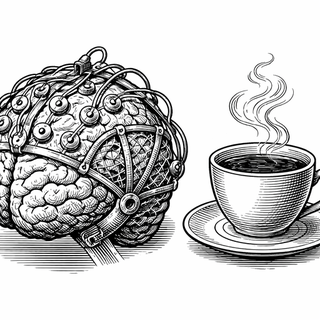
A research team led by Nicolas Decat and Delphine Oudiette recruited 92 people, hooked them up to EEG caps, and gave them the simplest possible instructions: relax. Twice during the day, participants lay down and let their minds wander while the researchers recorded their brain activity. Every so often, the participants were interrupted and asked to describe what was happening inside their heads. They also rated their mental experience on four dimensions: how bizarre it was, how fluid the imagery felt, how spontaneous the thoughts were, and whether they still felt awake (Decat et al., 2026).
Here's where it gets interesting. When the team fed those 375 mental experience reports into a clustering algorithm, four distinct types of mental states popped out - each with its own personality, if you will. Some were grounded and logical (your brain doing its boring spreadsheet thing). Others were fluid and strange, the kind of narrative-defying weirdness you'd normally blame on deep sleep.
The kicker? All four mental states showed up across wakefulness, light sleep (N1), and deeper sleep (N2). The dream-like state didn't wait politely for you to fall asleep. It just... happened. While you were technically awake.
Your Brain Doesn't Respect the On/Off Switch
For decades, the assumption was clean and tidy: awake brain does awake things, sleeping brain does sleeping things. Consciousness had a light switch, and it was either on or off. This study throws a wrench into that metaphor with the enthusiasm of someone who really enjoys wrenches.
The EEG data revealed that what determines your mental state isn't whether you're awake or asleep in the traditional sense. Instead, it's the fine-grained dynamics of your brain activity - patterns of spectral power, neural complexity, and connectivity - that shape what you're actually experiencing. Two people could both be in N1 sleep, and one might be having a perfectly mundane thought about grocery lists while the other is riding a giant fish through a purple canyon.
This lines up with a growing body of evidence that the wake-sleep transition isn't an "all-or-none" event. A major review in Trends in Neurosciences described sleep onset as a period of remarkable complexity, marked by fluctuations between various transient neural patterns with enormous variability between and within individuals (Lacaux et al., 2024). Your brain doesn't flip a switch. It fiddles with a mixing board.
Why This Twilight Zone Matters
This fuzzy boundary between waking and sleeping isn't just a curiosity for neuroscientists with too much EEG equipment. It turns out to be genuinely useful territory.
The same Paris Brain Institute group previously demonstrated that the first moments of sleep onset - that drowsy twilight called N1 - tripled participants' ability to crack a hidden math problem. Spending just 15 seconds in this state was enough to supercharge creative insight. Go deeper into sleep, though, and the magic vanished (Lacaux et al., 2021). Salvador Dali and Thomas Edison both exploited this trick, dozing off with objects in hand that would clatter to the floor and wake them the moment they crossed into sleep - a technique that now has actual peer-reviewed backing.
But the same threshold comes with a cost. Research from the team has also shown that memories formed during N1 tend to evaporate, suggesting the brain trades encoding stability for creative flexibility during this window (Lacaux et al., 2022). You might have your best idea right as you're drifting off, only to forget it by the time you reach for your phone.
So What Does This Change?
The new study's most provocative finding is straightforward: the mental states we call "dreaming" aren't locked behind the gate of sleep. Your brain can generate bizarre, fluid, spontaneous experiences while you're sitting upright with your eyes open. The traditional sleep staging system - wake, N1, N2, N3, REM - tells us about the brain's general operating mode but misses the finer story of what's actually happening in your conscious experience.
For clinicians, this matters because conditions like narcolepsy, ADHD, and dissociative disorders all involve intrusions of sleep-like states into wakefulness. Understanding that the boundary was always blurrier than we thought could reshape how we think about these conditions.
For the rest of us, it's a satisfying reminder that your brain is considerably weirder than its owner. Right now, sitting wherever you are, your neural machinery has the full capacity to generate dream-level strangeness - and sometimes, when you're staring at that spreadsheet and your mind goes somewhere genuinely odd, it's not distraction. It's your waking brain borrowing from the dream playbook.
References
-
Decat, N., Le Coz, A., Senechal, J., Scellier-Dekens, I., de Verville, H., Herzog, R., Lejeune, F.-X., Arnulf, I., Andrillon, T., & Oudiette, D. (2026). Dream-like mental states can occur during wakefulness. Cell Reports, 44(4), 117237. DOI: 10.1016/j.celrep.2026.117237 | PubMed
-
Lacaux, C., Strauss, M., Bekinschtein, T. A., & Oudiette, D. (2024). Embracing sleep-onset complexity. Trends in Neurosciences, 47(4), 273-288. DOI: 10.1016/j.tins.2024.02.002 | PubMed
-
Lacaux, C., Andrillon, T., Bastoul, C., Iber, Y., Daskalou, A., Skandrani, N., Arnulf, I., & Oudiette, D. (2021). Sleep onset is a creative sweet spot. Science Advances, 7(50), eabj5866. DOI: 10.1126/sciadv.abj5866 | PubMed
-
Lacaux, C., Andrillon, T., Arnulf, I., & Oudiette, D. (2022). Memory loss at sleep onset. Cerebral Cortex Communications, 3(4), tgac042. DOI: 10.1093/texcom/tgac042 | PubMed
Disclaimer: The image accompanying this article is for illustrative purposes only and does not depict actual experimental results, data, or biological mechanisms.