
You know that moment in the grocery store when you're staring at two identical light bulbs - one with a little green "Energy Star" sticker and one without - and your hand hovers between them like you're defusing a bomb? That tiny internal standoff is, it turns out, a full-blown neurological event. Multiple brain regions are firing, arguing, and negotiating like a committee that can't agree on where to go for lunch.
Welcome to environmental decision neuroscience - a field that barely existed a decade ago and is now telling us something genuinely useful about why we're so spectacularly inconsistent about saving the planet we live on.
Three Brain Systems Walk Into a Climate Crisis
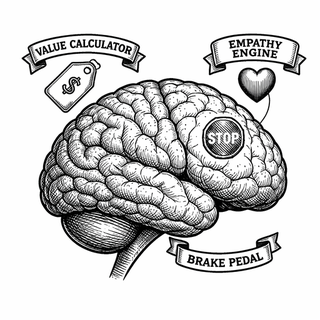
In a new perspective piece in Nature Reviews Neuroscience, Daria Knoch and Annika Wyss from the University of Bern lay out the case that three core neural mechanisms drive our environmental choices (Knoch & Wyss, 2026). Think of them as the angel, the devil, and the accountant sitting on your shoulders.
First up: the value calculator. Your ventromedial prefrontal cortex (vmPFC) acts like an internal price tag generator, constantly weighing how much you personally value one option over another. When you see that eco-labeled product, your nucleus accumbens - the brain's "ooh, shiny" center - actually lights up. One fMRI study found that Energy Star labels triggered reward-system activation that predicted whether people would actually buy the sustainable option, not just say they would on a survey (Sawe et al., 2022). Your brain literally gets a little dopamine hit from going green. Who knew recycling and slot machines had something in common?
Second: the empathy engine. This is where things get philosophically wild. The temporoparietal junction (TPJ) and dorsomedial prefrontal cortex help you imagine what it's like to be someone else - including people who don't exist yet. When researchers used brain stimulation to boost TPJ activity, participants made more sustainable choices in tasks where their decisions affected future generations (Langenbach et al., 2022). Essentially, zapping a brain region made people care more about their great-grandchildren's weather. As interventions go, that's pretty remarkable - though perhaps tricky to scale at airport security.
Third: the brake pedal. The dorsolateral prefrontal cortex (dlPFC) is your self-control headquarters. It's the part that stops you from eating the entire cake, and apparently also the part that helps you choose the pricier sustainable option when every fiber of your wallet is screaming otherwise. People with thicker cortex in these prefrontal regions tend to behave more sustainably, suggesting that the hardware for climate-friendly choices may be partly structural (Guizar Rosales et al., 2022).
Why Your Brain Treats 2050 Like a Foreign Country
Here's the real kicker. Our brains evolved to handle immediate threats - a predator behind that bush, a rival eyeing your food. Climate change is the opposite of that. It's slow, abstract, and affects people we'll never meet. Neuroimaging shows that when you think about your future self, your medial prefrontal cortex activates less than when you think about present-you, and the further out in time you go, the weaker that signal gets. Your brain basically treats future-you like a stranger, and future generations like characters in a novel it hasn't read.
This is why Knoch and Wyss argue that understanding these neural bottlenecks isn't just academic navel-gazing - it's actionable intelligence. If we know that perspective-taking circuits drive sustainable choices, we can design interventions that specifically engage those circuits. A broader framework for exactly this kind of neuroscience-to-policy pipeline has already been proposed (Doell et al., 2023).
So What Do We Actually Do With This?
The practical upshot is surprisingly concrete. Ecolabels work not because people read the fine print, but because they trigger reward signals. Brain stimulation studies show that perspective-taking capacity is malleable, not fixed. And the fact that inhibiting certain prefrontal regions can sometimes increase sustainable behavior - because for many people, the green choice is already the default preference their self-control circuits are overriding - suggests we've been thinking about the problem backwards (Wyss et al., 2024).
The brain didn't evolve for the climate crisis. But it's not hopeless wiring, either. It's a system with identifiable levers - valuation, empathy, control - and environmental decision neuroscience is finally giving us the manual.
Now if you'll excuse me, I have a staring contest with some light bulbs to finish.
References
-
Knoch, D., & Wyss, A. M. (2026). Environmental decision neuroscience connects the brain to climate action. Nature Reviews Neuroscience, 27(3), 151-152. https://doi.org/10.1038/s41583-026-01026-4
-
Sawe, N., Srirangarajan, T., Sahoo, A., Tang, G. S., & Knutson, B. (2022). Neural responses clarify how ecolabels promote sustainable purchases. NeuroImage, 263, 119668. https://doi.org/10.1016/j.neuroimage.2022.119668
-
Langenbach, B. P., Savic, B., Baumgartner, T., Wyss, A. M., & Knoch, D. (2022). Mentalizing with the future: Electrical stimulation of the right TPJ increases sustainable decision-making. Cortex, 146, 227-237. https://doi.org/10.1016/j.cortex.2021.11.006
-
Guizar Rosales, E., Baumgartner, T., & Knoch, D. (2022). Interindividual differences in intergenerational sustainable behavior are associated with cortical thickness of the dorsomedial and dorsolateral prefrontal cortex. NeuroImage, 264, 119664. https://doi.org/10.1016/j.neuroimage.2022.119664
-
Doell, K. C., Berman, M. G., Bratman, G. N., Knutson, B., Kühn, S., Lamm, C., Pahl, S., Sawe, N., Van Bavel, J. J., White, M. P., & Brosch, T. (2023). Leveraging neuroscience for climate change research. Nature Climate Change, 13(12), 1288-1297. https://doi.org/10.1038/s41558-023-01857-4
-
Wyss, A. M., Baumgartner, T., Guizar Rosales, E., Soutschek, A., & Knoch, D. (2024). Cathodal HD-tDCS above the left dorsolateral prefrontal cortex increases environmentally sustainable decision-making. Frontiers in Human Neuroscience, 18. https://doi.org/10.3389/fnhum.2024.1395426
Disclaimer: The image accompanying this article is for illustrative purposes only and does not depict actual experimental results, data, or biological mechanisms.