
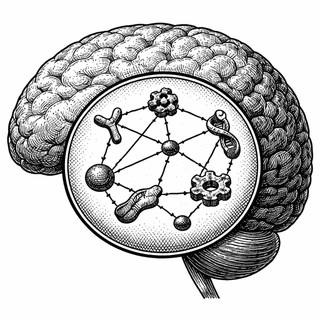
Imagine a circle. Now put a smaller circle inside it. The big circle is the brain, which is already rude enough in its complexity, and the smaller circle is one tiny neighborhood inside a cell where the really juicy gossip happens. Proximity labeling is what happens when scientists stop trying to interrogate the whole city and instead bug one apartment for ten minutes to find out who came by, who texted whom, and which proteins were loitering suspiciously near the synapse.
Tiny molecular paparazzi
The paper by Gao and colleagues is a 2026 review, not a single experiment, but that is part of the appeal. It surveys a fast-growing toolkit called proximity labeling, or PL, that lets researchers tag molecules that hang out near a chosen protein, cell compartment, or cell-cell interface inside living systems. Instead of grinding up tissue and hoping the important interactions survive the blender experience, PL labels nearby molecules in place and then fishes them out for analysis by mass spectrometry or sequencing (Gao et al., 2026; PMCID: PMC12853706).
That matters because the nervous system is basically a nightclub with terrible lighting, multiple floors, and no one wearing name tags. A lot of the most important molecular interactions in neurons are fleeting, weak, or stuck in awkward little microdomains that standard methods tend to flatten, miss, or accidentally destroy. PL is useful precisely because it catches those blink-and-you-miss-it encounters.
The review walks through the big players. BioID and TurboID use engineered biotin ligases to label nearby proteins. APEX2 uses a peroxidase and works much faster, though it comes with chemistry that can be harsher on cells. Newer light-activated and photocatalytic systems promise tighter control in both space and time, which is scientist-speak for "we want fewer false positives and less molecular collateral damage, please."
Why neuroscientists are suddenly acting like this is the hot table at the bar
This is not happening in a vacuum. Spatial proteomics was named Nature Methods' 2024 Method of the Year, which is a polite editorial way of saying the field has become impossible to ignore (Nature Methods, 2024). And a 2025 review in Experimental & Molecular Medicine makes the same basic point from another angle: PL is becoming a serious way to map neural circuits, synapses, glia-neuron interactions, and disease-linked protein networks that older methods handle badly or not at all (Lee et al., 2025).
If you want one concrete example, a 2022 PNAS study used in situ proximity labeling in human brain tissue to examine Lewy pathology, the protein clumps associated with Parkinson's disease and related disorders. Instead of treating those aggregates like inert blobs, the study mapped nearby molecular interactions and found enrichment in pathways involving mitochondrial and protein handling machinery, giving researchers a more grounded picture of what is happening around the pathology in actual human tissue (Killinger et al., 2022; PMCID: PMC8812572).
Another 2024 paper in JACS introduced a tyrosinase-based PL method that avoids hydrogen peroxide and can work fast in living cells, then used it to probe neurotransmitter receptor neighborhoods in the live mouse brain. Translation: the toolkit is not just expanding, it is getting less clunky and more brain-compatible, which in neuroscience is half the battle and three-quarters of the headache (Zhu et al., 2024).
So what could this actually do for real patients?
The big promise is precision neurology. That phrase can sound like a biotech intern made it in Canva, but the underlying goal is solid: identify molecular signatures that distinguish one disease process from another, one vulnerable cell population from another, or one treatment target from the pile of expensive disappointments.
Neurodegenerative diseases are especially hungry for this kind of tool. Alzheimer's, Parkinson's, ALS, frontotemporal dementia - these conditions do not just "damage the brain" in one generic way. They scramble specific cell types, pathways, organelles, and protein networks over time. If PL can map which molecules cluster around pathology, which proteins change at synapses, or which cell-cell contacts go sideways first, that opens the door to better biomarkers and more believable drug targets.
Not magic. Not next Tuesday. But better than the classic strategy of staring at one protein really hard and hoping it confesses.
The catch, because of course there is one
PL is powerful, but it is not a truth serum. "Nearby" does not always mean "directly interacting." Some enzymes label fast but can stress cells. Others are gentler but slower or noisier. Different methods hit different amino acids, different radii, and different subcellular environments. That means results can be messy, method-dependent, and a little too easy to oversell if your inner hype goblin gets loose.
Gao and colleagues are clear about that. The field still needs better temporal control, cleaner chemistry, stronger validation pipelines, and tighter integration with single-cell and multi-omics data. In other words, PL can tell you who was hanging around backstage, but you still need follow-up experiments to figure out who was actually in the band.
That is why this review is interesting. It is less "here is the final answer" and more "here is the upgraded listening device." In brain science, that matters. The brain has spent a long time acting like the world's most overbooked jazz club, all overlapping signals, improvised chaos, and no clean separation between the soloist and the rhythm section. Proximity labeling gives researchers a better seat, a sharper ear, and maybe, finally, a fighting chance to hear which molecular instrument is playing out of tune.
References
Gao X, Lu J, Chen P, Wang X, Zheng L, Shao Y, Shen H, Yang Q. Proximity labeling in neuroscience: decoding molecular landscapes for precision neurology. Transl Neurodegener. 2026;15:1. doi:10.1186/s40035-026-00534-8. PMCID: PMC12853706
Lee JG, Jeong I, Kim KE. Bridging molecular and cellular neuroscience with proximity labeling technologies. Exp Mol Med. 2025;57:1492-1505. doi:10.1038/s12276-025-01491-4
Killinger BA, Marshall LL, Chatterjee D, Chu Y, Bras J, Guerreiro R, Kordower JH. In situ proximity labeling identifies Lewy pathology molecular interactions in the human brain. Proc Natl Acad Sci U S A. 2022;119(5):e2114405119. doi:10.1073/pnas.2114405119. PMCID: PMC8812572
Zhu H, Oh JH, Matsuda Y, Mino T, Ishikawa M, Nakamura H, Tsujikawa M, Nonaka H, Hamachi I. Tyrosinase-Based Proximity Labeling in Living Cells and In Vivo. J Am Chem Soc. 2024;146(11):7515-7523. doi:10.1021/jacs.3c13183
Timalsina B, Lee S, Kaang BK. Advances in the labelling and selective manipulation of synapses. Nat Rev Neurosci. 2024;25:668-687. doi:10.1038/s41583-024-00851-9
Method of the Year 2024: spatial proteomics. Nat Methods. 2024;21:2195-2196. doi:10.1038/s41592-024-02565-3
Disclaimer: The image accompanying this article is for illustrative purposes only and does not depict actual experimental results, data, or biological mechanisms.