
You know that moment when you take a painkiller and feel better before it could possibly have kicked in? That's not you being gullible. That's your brain running one of the most sophisticated pharmaceutical operations in the known universe - and it doesn't even need a prescription.
A sweeping new review in Pharmacological Reviews digs into something that's been hiding in plain sight for decades: the placebo effect isn't just "all in your head" in the dismissive way your uncle says it. It's literally in your head - running on the same chemical machinery as actual painkillers. And for the roughly 1.5 billion people worldwide living with chronic pain, this could be a much bigger deal than anyone's given it credit for.
Your Brain on Fake Drugs (Spoiler: It's Doing Real Chemistry)
Back in 1978, researchers pulled off one of neuroscience's great mic-drop moments. They gave people a placebo, watched their pain decrease, then administered naloxone - a drug that blocks opioid receptors. The pain came roaring back. The implication was wild: when you believe you're getting pain relief, your brain starts pumping out its own opioids. Endorphins, enkephalins, the whole endogenous cocktail. Your neurons aren't falling for a trick. They're launching a targeted pharmacological response.
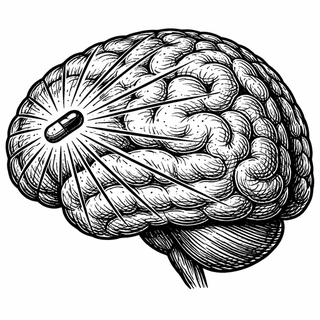
Since then, brain imaging has painted an increasingly detailed picture. When placebo analgesia kicks in, a network lights up like a concert venue: the prefrontal cortex (your brain's strategic planner), the anterior cingulate cortex (the emotional regulator who takes everything personally), the periaqueductal gray (the brainstem's bouncer who decides what pain signals get through), and the nucleus accumbens (the reward center that basically runs on dopamine and enthusiasm). These regions coordinate a top-down pain suppression system that, in many ways, mirrors what happens when you take morphine.
A 2024 study in Nature Communications added an interesting wrinkle: placebos don't seem to dampen the raw, nociceptive "ouch" signal traveling up from your nerve endings. Instead, they dial down the emotional and cognitive amplification of pain - the catastrophizing, the dread, the way chronic pain convinces you everything is terrible and will stay terrible forever. Your brain, it turns out, can't fake-drug the pain signal itself, but it can absolutely change how much you care about it.
Chronic Pain: When the Alarm System Won't Shut Up
Here's where it gets clinically urgent. Chronic pain isn't just acute pain that overstayed its welcome. It involves genuine rewiring - neural circuits that get stuck in amplification mode, immune cells that won't stop releasing inflammatory signals, and stress hormones that keep the whole system marinating in misery. It's like a car alarm that's been going off so long the neighbors have moved away, but the alarm is also somehow getting louder.
The review by Boorman and colleagues makes a pointed observation: almost everything we know about placebo analgesia comes from studies on acute, experimental pain in healthy volunteers. Zap someone's arm with a laser, give them a sugar pill, measure the response. That's great for understanding basic mechanisms, but chronic pain patients are dealing with a fundamentally different beast - altered brain connectivity, disrupted endogenous opioid systems, and the psychological weight of months or years of suffering. The neuropharmacology of placebo in that context? Barely studied.
Open-Label Placebos: The Weirdest Plot Twist in Medicine
Perhaps the most counterintuitive finding in this field is that placebos can work even when patients know they're taking them. In a landmark trial, chronic low back pain patients given pills explicitly labeled "placebo" - no deception, full transparency - reported 30% reductions in pain and disability compared to treatment-as-usual. A five-year follow-up found these improvements persisted, and pain medication use dropped from 87% to 38%.
Let that sink in. People took pills they knew contained nothing, and got better. The leading explanation involves conditioned responses and the therapeutic power of the clinical ritual itself - the act of taking a pill, the attention from a provider, the narrative of "doing something" about the pain. Your brain, apparently, cares less about what's in the pill and more about the story surrounding it.
So What Do We Actually Do With This?
The review argues that placebo mechanisms represent "a largely underused yet promising approach" to chronic pain management. The possibilities include using expectancy modulation during routine treatments (essentially, being more intentional about how clinicians frame therapies), pharmacological conditioning protocols that pair real drugs with placebos to extend therapeutic effects while reducing doses, and yes, prescribing open-label placebos as add-on treatments.
None of this replaces actual medication for people who need it. But in a world where chronic pain affects nearly a quarter of adults and our best pharmaceutical options come with side effects, dependency risks, and diminishing returns, learning to harness the brain's own pain-control system isn't alternative medicine. It's pharmacology we haven't fully exploited yet.
The real punchline? The most powerful pharmacy you'll ever visit has been between your ears this whole time. It just needs the right prescription - even if that prescription is nothing at all.
References:
-
Boorman DC, Crawford LS, Siddiqi Z, Martin LJ, Henderson LA, Keay KA. The neuropharmacological basis of placebo analgesia: Mechanisms and clinical applications in the context of chronic pain. Pharmacological Reviews. 2026;78(2):100111. DOI: 10.1016/j.pharmr.2025.100111
-
Zunhammer M, Spisák T, Wager TD, Bingel U. Placebo treatment affects brain systems related to affective and cognitive processes, but not nociceptive pain. Nature Communications. 2024;15:6017. DOI: 10.1038/s41467-024-50103-8
-
Carvalho C, Caetano JM, Cunha L, Rebouta P, Kaptchuk TJ, Kirsch I. Open-label placebo treatment in chronic low back pain: a randomized controlled trial. Pain. 2016;157(12):2766-2772. PMCID: PMC5113234
-
Zubieta JK, Bueller JA, Jackson LR, et al. Placebo effects mediated by endogenous opioid activity on μ-opioid receptors. Journal of Neuroscience. 2005;25(34):7754-7762. PMCID: PMC6725254
-
Colloca L, Barsky AJ. Placebo and nocebo effects. New England Journal of Medicine. 2020;382:554-561. DOI: 10.1056/NEJMra1907805
Disclaimer: The image accompanying this article is for illustrative purposes only and does not depict actual experimental results, data, or biological mechanisms.