
You're sitting in a cinema, thoroughly convinced the kindly shopkeeper is just a kindly shopkeeper. Then the narrator drops the twist: she's been a robot the entire time. Suddenly, every scene you just watched reshuffles like a deck of cards - that odd pause when she handed over change? Robot processing delay. The way she never blinked? Definitely robot. Your brain just rewrote the entire film while the credits haven't even started rolling.
Turns out, this mental gymnastics routine isn't just you being clever. It's your brain doing something rather remarkable: completely reorganizing how it stores and represents information about a story you've already heard. And now, researchers at Dartmouth have caught this process in action, one neural pattern at a time.
The Twist That Keeps on Twisting
Emily Finn and her team did something delightfully devious. They made people listen to the same story twice - a narrative with a whopping plot twist in the middle. The first time through, listeners built one version of reality in their heads. The second time, armed with knowledge of the twist, they built an entirely different one. Same words, same narrator, same ears. Completely different brain activity.
The clever bit? By comparing brain scans from listen one versus listen two, the researchers could pinpoint exactly which brain regions were busy revising their interpretations of specific story elements. They weren't looking at what changed in the story (nothing did). They were looking at what changed in people's understanding of it.
Think of it like watching "The Sixth Sense" twice. The first viewing, you're tracking a psychologist helping a troubled boy. The second viewing - well, you're tracking something rather different, aren't you?
Three Flavors of Reinterpretation
The researchers separated the narrative into three levels: the overall story model (the big-picture framework), individual episodes (specific scenes and events), and characters (the poor shopkeeper-slash-robot). Crucially, these weren't arbitrary divisions - they represent genuinely different ways your brain organizes narrative information.
When the twist hit, different brain regions lit up depending on which element people were rethinking. Temporal regions (near your ears, roughly speaking) handled character reinterpretations. Parietal areas (top and back of your head) dealt with episodes. Prefrontal cortex (behind your forehead, where the "executive decisions" happen) helped coordinate the overall narrative model. Some regions pitched in for multiple elements, creating a sort of overlapping Venn diagram of reinterpretation.
The key finding: your brain doesn't just store stories as a transcript of what happened. It stores them according to what those events mean - and when the meaning changes, the neural representation changes too, even if the actual words don't.
Your Brain: The World's Most Persistent Fact-Checker
Here's where it gets interesting. That default mode network - the one that switches on when you're daydreaming or letting your mind wander - turns out to be deeply involved in narrative comprehension. Recent work shows it's not just idly wandering; it's maintaining what researchers call a "situation model," essentially your brain's running interpretation of what's happening and why.
When you hear "Lucy handed over the change with a mechanical smile," your temporoparietal junction might be thinking about Lucy's mental state (is she tired? distracted?). But when you learn Lucy is a robot, that same region recalibrates - no mental state to track, just programming. The neural representation shifts, even though the sentence describing Lucy's behavior stays exactly the same.
This maps onto what cognitive scientist Vera Tobin calls the brain's predictable blind spots. We get distracted, forget how we know things, and see patterns that aren't there - which is precisely why plot twists work so reliably. Your brain is a prediction machine, constantly filling in gaps based on past experience. Give it a robot disguised as a shopkeeper, and it'll happily predict "human behavior" right up until the reveal.
Why Your Brain Bothers
One might reasonably ask: why go to all this trouble? Why not just tack the new information onto the old and call it a day?
Turns out your brain is rather committed to internal consistency. It wants a coherent model of the world, not a jumble of contradictory facts. When a plot twist introduces information that contradicts your existing framework, your anterior cingulate cortex signals "something's wrong," and your prefrontal cortex scrambles to integrate the new data. The result? You don't just add "Lucy is a robot" to your mental file. You go back and reinterpret every previous Lucy-related memory through that lens.
This has rather profound implications beyond movie night. Recent research from Liu et al. in eLife (2024) found that brain state dynamics during narrative comprehension predict how well you'll remember the story later. The better your brain integrates information across its various processing networks, the stronger your memory. Which suggests that plot twists might not just be entertaining - they might actually boost memory by forcing your brain to actively reconstruct the narrative.
The Real-World Plot Twist
Here's the bit that matters outside of neuroscience journals: this research illuminates how we update our beliefs about anything, not just fictional shopkeepers. Your brain uses the same machinery to interpret real-world events, other people's behavior, and new information that contradicts what you thought you knew.
Emily Finn's work explicitly connects this to understanding misinformation and polarization. If different people's brains organize the same information using different conceptual frameworks - and those frameworks are sticky, resistant to change - it helps explain why presenting someone with contradictory facts often doesn't flip their interpretation the way a well-crafted plot twist does.
The difference? Plot twists are designed to be satisfying - surprising and, in retrospect, inevitable. They give you a better framework, not just a contradictory one. Real-world belief change rarely feels that tidy.
What Comes Next
Finn's lab is asking increasingly specific questions about individual differences in narrative interpretation. Why do some people catch onto twists early while others remain gobsmacked? How much of that comes down to brain connectivity, prior knowledge, or simply which details you happened to attend to?
There's also the question of what happens with truly ambiguous narratives - the ones that don't hand you a neat resolution. Films like "Inception" or "Mulholland Drive" actively resist a single coherent interpretation. Do some brains tolerate that ambiguity better than others? Does the same neural machinery activate, just without settling on one solution?
And perhaps most intriguingly: if we better understand how brains resist reinterpretation, could we design better ways to help people update their beliefs when it genuinely matters?
For now, though, the finding stands: your brain doesn't store stories (or experiences) as fixed recordings. It stores them as interpreted models - and when the interpretation changes, the brain rewrites the whole thing. Lucy the shopkeeper becomes Lucy the robot, and your temporal cortex quietly updates her file accordingly.
The next time you gasp at a plot twist, spare a thought for your heteromodal cortex, frantically reorganizing its filing system while you sit there eating popcorn. It's doing actual work, even if the story isn't.
References
-
Sava-Segal, C., Grall, C., & Finn, E.S. (2025). Narrative "twist" shifts within-individual neural representations of dissociable story features. Proceedings of the National Academy of Sciences, 122(4). https://doi.org/10.1073/pnas.2512071123 | PMC11761699
-
Liu, J., et al. (2024). Cognitive and neural state dynamics of narrative comprehension. eLife, 13:RP99997. Full Text PDF
-
Thye, M., et al. (2025). Functional connectivity of semantic and default mode networks during narrative comprehension. Cerebral Cortex, 35(11). https://doi.org/10.1093/cercor/bhaf289
-
Simony, E., Honey, C.J., et al. (2016). Dynamic reconfiguration of the default mode network during narrative comprehension. Nature Communications, 7:12141. https://doi.org/10.1038/ncomms12141
-
Tobin, V. (2018). Elements of Surprise: Our Mental Limits and the Satisfactions of Plot. Harvard University Press. Discussion
-
NPR Hidden Brain. (2019). Why We Love Surprises: The Psychology Of Plot Twists. https://www.npr.org/2019/12/18/789441553/spoiler-alert-the-psychology-of-surprise-endings
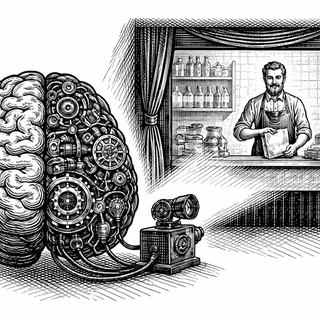
Disclaimer: The image accompanying this article is for illustrative purposes only and does not depict actual experimental results, data, or biological mechanisms.