
People who study monkeys in a lab see animals pressing buttons and staring at screens, their heads bolted in place, performing the same task a thousand times like furry little factory workers. People who study monkeys in the wild see grooming, fighting, flirting, scheming, and the kind of social drama that would make reality TV producers weep with envy. For decades, neuroscience picked door number one and assumed that was enough. Spoiler: it wasn't.
The "Studying Fish on Land" Problem
Here's the thing about traditional primate neuroscience: we've been recording brain activity from animals in conditions so artificial they might as well be on another planet. Strap a monkey into a chair, stick a probe in its brain, flash some dots on a screen, and call it a day. We learned a ton from this approach (seriously, a ton), but a new review in Trends in Cognitive Sciences by Felipe Parodi, Konrad Kording, and Michael Platt argues we've been studying only a sliver of what primate brains actually do (Parodi et al., 2025).
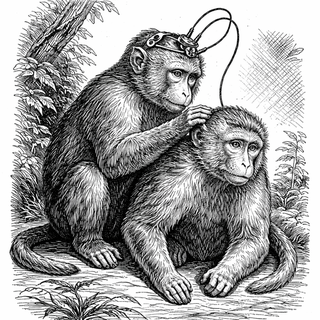
It's a bit like trying to understand how cars work by only studying them parked in a garage. Sure, you'll figure out the paint job, but you'll miss the whole "driving" part.
Tinbergen Walks into a Neuroscience Lab
The paper organizes its argument around Niko Tinbergen's four big questions - the ones every biologist learns in school and then promptly forgets. What does a behavior do (function)? How does it work (mechanism)? How does it develop? And how did it evolve? These questions were laid out back in 1963, and neuroscience has mostly only bothered with question number two, mechanism, while ignoring the rest like unread emails.
Parodi and colleagues make the case that a full neuroethological approach - studying brains while animals actually behave like animals - can tackle all four. And recent technology finally makes this possible without, you know, running extension cords through the jungle.
Wireless Brains and Robot Eyes
The game-changer is wireless neural recording. Tiny, implantable devices now let researchers track brain activity while monkeys roam freely, groom each other, and navigate actual social relationships instead of cartoon versions of them. One particularly impressive device, weighing about as much as a paper clip, can record brain signals for over a month while monkeys do their thing (Oh et al., 2025).
Pair that with AI-powered computer vision that can automatically track and classify dozens of natural behaviors (grooming, aggression, play, suspiciously prolonged eye contact), and you've got a setup that would have seemed like science fiction a decade ago.
A landmark 2024 study in Nature used exactly this approach: wireless recordings from pairs of freely socializing macaques revealed that prefrontal and temporal cortex neurons encode at least 24 different natural behaviors. Even wilder, the monkeys' brains were keeping a running tally of social debts - who groomed whom, who owed whom a favor - like some kind of neural spreadsheet for primate politics (Testard et al., 2024).
Why Your Therapist (and Your Robot Arm) Should Care
This isn't just about making monkeys more comfortable (though that's nice too). When you record from restrained animals doing repetitive tasks, you get a very specific picture of what neurons do. When you record from freely behaving animals, you discover that neural activity is tangled up with movement, emotional state, and social context in ways the lab bench never revealed.
That matters for brain-machine interfaces. If you're building a prosthetic arm controlled by brain signals, you probably want to understand what those signals look like when someone is reaching for a coffee while talking to a friend, not just when they're sitting alone in a quiet room staring at a target. It also matters for neurological and psychiatric disorders - conditions like autism and depression don't happen in a vacuum, they happen in the messy, noisy, social real world (Testard et al., 2021).
The Part Where Everything Gets Harder (But Better)
There's a catch, naturally. Natural behavior is, well, natural - meaning it's messy, variable, and hard to control. You can't exactly ask a monkey to repeat that one specific grooming bout seventeen more times for statistical power. The data is higher-dimensional, noisier, and requires serious computational muscle to analyze.
But that's kind of the point. The brain didn't evolve to handle tidy laboratory tasks. It evolved to handle chaos, complexity, and that one troop member who keeps stealing your food. By studying the brain in the context it was built for, we're not making neuroscience harder. We're finally making it honest.
References
-
Parodi, F., Kording, K. P., & Platt, M. L. (2025). Primate neuroethology: a new synthesis. Trends in Cognitive Sciences. DOI: 10.1016/j.tics.2025.09.002 | PubMed
-
Testard, C., Tremblay, S., Parodi, F., DiTullio, R. W., Acevedo-Ithier, A., Gardiner, K. L., Kording, K., & Platt, M. L. (2024). Neural signatures of natural behaviour in socializing macaques. Nature, 628(8007), 381-390. DOI: 10.1038/s41586-024-07178-6 | PubMed
-
Oh, S., Jekal, J., Won, J., et al. (2025). A stealthy neural recorder for the study of behaviour in primates. Nature Biomedical Engineering, 9(6), 882-895. DOI: 10.1038/s41551-024-01280-w | PubMed
-
Testard, C., Tremblay, S., & Platt, M. L. (2021). From the field to the lab and back: neuroethology of primate social behavior. Current Opinion in Neurobiology, 68, 76-83. DOI: 10.1016/j.conb.2021.01.005 | PMCID: PMC8243779
-
Bateson, P., & Laland, K. N. (2019). Tinbergen's challenge for the neuroscience of behavior. Proceedings of the National Academy of Sciences, 116(20), 9737-9738. DOI: 10.1073/pnas.1903589116 | PMCID: PMC6525541
Disclaimer: The image accompanying this article is for illustrative purposes only and does not depict actual experimental results, data, or biological mechanisms.