
For decades, scientists tried to pin bipolar disorder on one thing. One gene. One neurotransmitter. One brain region having a bad day. Turns out, that's like blaming a single player for losing the Super Bowl when the whole team forgot the playbook.
A new review in The American Journal of Psychiatry pulls together years of fragmented research and basically says: bipolar disorder isn't a single-bug problem. It's a whole-system meltdown happening across genetics, inflammation, circadian rhythms, energy metabolism, and brain wiring - all at the same time (Soliman et al., 2026).
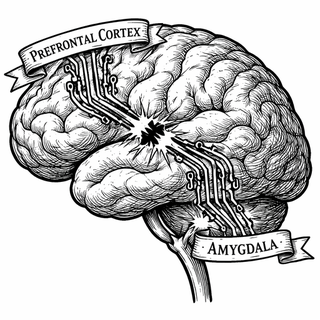
Your Brain's Most Dysfunctional Group Chat
Here's the thing. Your brain runs on circuits - networks of regions that are supposed to talk to each other like a well-oiled Slack workspace. In bipolar disorder, the prefrontal cortex (your brain's project manager) and the amygdala (the coworker who treats every email like a five-alarm fire) stop communicating properly.
During mania, the amygdala goes full send while the prefrontal cortex basically clocks out. During depression, your dorsolateral prefrontal cortex - the region handling executive decisions - goes into power-saving mode. It's like your brain switches between "reply all to everything" and "mark all as read and lie down" (Scaini et al., 2020).
The review introduces two frameworks to make sense of this chaos: the "desynchrony cascade" and the "Nexus" model. Both argue that bipolar disorder emerges when multiple biological systems fall out of sync - genetics loads the gun, but inflammation, broken circadian rhythms, and mitochondrial dysfunction pull the trigger together.
The Genetics Are Wild (and Wildly Complicated)
Bipolar disorder is one of the most heritable psychiatric conditions, with genetics accounting for 70 to 93 percent of risk. But before you start side-eyeing your family tree, know this: researchers have identified 64 genetic loci involved, and none of them are individually responsible (Oliva et al., 2024). It's not a single villain. It's more like a heist crew where everyone brings a small, weird skill.
One of the most compelling genetic threads involves calcium channels - specifically a gene called CACNA1C. These voltage-gated calcium channels control how neurons fire, and when they malfunction, everything downstream gets wobbly. This discovery has "rekindled attempts" at targeted therapies that could go beyond managing symptoms to actually fixing broken machinery (Harrison et al., 2018).
Inflammation: Your Immune System Being Way Too Extra
Look. Your immune system is supposed to fight infections. But in bipolar disorder, it apparently didn't get the memo to stand down. Elevated levels of inflammatory markers like IL-6, TNF-alpha, and C-reactive protein show up consistently in patients across mood states. It's like your body is perpetually preparing for a battle that never comes, and the collateral damage hits your brain.
This chronic neuroinflammation contributes to progressive cortical thinning and gray matter loss - particularly in prefrontal and temporal regions. Translation: the brain regions you need most for emotional regulation are slowly getting chipped away (Scaini et al., 2020).
Lithium: The OG That Still Slaps
With all this cutting-edge neurobiology, you'd think treatment has undergone a revolution. Not quite. Lithium, a drug we've been using since the 1940s, remains the gold standard. It's got anti-suicidal properties, neuroprotective effects, and it works across mania, depression, and maintenance. Scientists now understand it inhibits GSK-3-beta, protects mitochondria, reduces neuroinflammation, and promotes autophagy - basically, it's running cleanup on multiple systems simultaneously.
The bad news? Only five medications are FDA-approved for bipolar depression. Seven years is the average diagnostic delay. Half of all patients don't stick with their meds. And even between episodes, many people still experience symptoms and functional impairment (Nierenberg et al., 2023). Current treatments manage the condition; they don't cure it.
The Next Level: Precision Psychiatry and Digital Biomarkers
The review highlights emerging tools that could change the game. Blood tests like EDIT-B are being developed to distinguish bipolar from unipolar depression. AI-driven acoustic analysis could spot mood shifts before patients notice them. Smartphone-based digital phenotyping and actigraphy could provide real-time mood tracking without a single questionnaire.
And on the treatment frontier? Ketamine shows rapid antidepressant effects for treatment-resistant bipolar depression. Neuromodulation techniques like deep TMS and even deep brain stimulation are being investigated. The era of one-size-fits-all mood stabilizers may finally be winding down.
Why This Matters Right Now
Bipolar disorder affects over 1% of the global population, and its prevalence has increased nearly 60% since 1990. Suicide attempt rates hover between 30 and 50 percent over a lifetime. This isn't a niche problem - it's a public health emergency hiding in plain sight.
What Soliman and colleagues have done is stitch together a roadmap that shows why single-target thinking failed and what a multi-system approach to treatment could look like. The brain isn't crashing because of one bug. It's a cascading system failure. And fixing it will require interventions that are just as interconnected as the problem itself.
References
-
Soliman MA, Khafif T, Sylvia L, Nierenberg AA. Bipolar Disorder: An Update on Neurobiology and Treatment. Am J Psychiatry. 2026;183(3):159-168. doi: 10.1176/appi.ajp.20260051
-
Oliva V, Fico G, De Prisco M, et al. Bipolar disorders: an update on critical aspects. Lancet Reg Health Eur. 2024;48:101135. doi: 10.1016/j.lanepe.2024.101135. PMCID: PMC11732062
-
Scaini G, Valvassori SS, Diaz AP, et al. Neurobiology of bipolar disorders: a review of genetic components, signaling pathways, biochemical changes, and neuroimaging findings. Braz J Psychiatry. 2020;42(5):536-551. doi: 10.1590/1516-4446-2019-0732. PMCID: PMC7524405
-
Harrison PJ, Geddes JR, Tunbridge EM. The Emerging Neurobiology of Bipolar Disorder. Trends Neurosci. 2018;41(1):18-30. doi: 10.1016/j.tins.2017.10.006. PMCID: PMC5755726
-
Nierenberg AA, Agustini B, Köhler-Forsberg O, et al. Diagnosis and Treatment of Bipolar Disorder: A Review. JAMA. 2023;330(14):1370-1380. doi: 10.1001/jama.2023.18588
Disclaimer: The image accompanying this article is for illustrative purposes only and does not depict actual experimental results, data, or biological mechanisms.