
Your brain is roughly 60% fat by dry weight. Go ahead, let that sink in. The organ you use to feel superior to other animals is basically a glorified lump of lard wrapped in a skull. But here's the thing: those lipids aren't just sitting around. They're doing everything - building cell membranes, insulating nerve fibers, shuttling signals between cells, and apparently, when things go wrong, contributing to some of the most devastating diseases we know.
A sweeping new review from researchers at the University of Lausanne pulls back the curtain on how every major cell type in your brain handles fat, and what happens when the whole system breaks down (Petrelli et al., 2026).
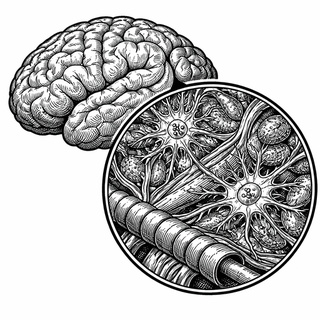
Your Brain Cells Have Very Different Relationships With Fat
Think of your brain's cell types as roommates with wildly different approaches to the shared kitchen.
Astrocytes are the responsible ones. They take up fatty acids, synthesize cholesterol, and package everything into tidy lipoproteins for delivery to other cells. They're basically the meal-prep friends of the brain, assembling APOE-containing lipid care packages and shipping them to neurons that can't be bothered to make their own cholesterol (Smolič et al., 2022).
Oligodendrocytes are single-minded in the best way. Their entire personality is myelin - that fatty insulation wrapping your nerve fibers so electrical signals don't fizzle out like a phone dying at 3%. Making myelin requires obscene amounts of lipid synthesis, and these cells deliver.
Neurons, for all their fame, are surprisingly bad at managing fat. They generally avoid storing it, preferring to outsource their lipid waste to neighboring glia. (Classic management behavior.) When neurons get stressed, they generate toxic fatty acids and basically hand the problem to astrocytes to deal with.
Microglia - the brain's immune cells - eat lipid debris the way a college student eats leftover pizza: eagerly, but sometimes to their own detriment. More on that in a moment.
Neural stem cells use fatty acids as fuel, burning them through a process called fatty acid oxidation to maintain their stem-cell-ness. Block that fuel line, and they start differentiating prematurely, like an intern who gets promoted before they're ready (Knobloch, 2017).
Lipid Droplets: The Storage Units Nobody Paid Attention To
For years, lipid droplets were the overlooked closets of cell biology - just little blobs of stored fat wrapped in a single-layer membrane. Boring. Except (plot twist) they turn out to be incredibly important for brain health.
These tiny fat storage units are now recognized as dynamic organelles that protect cells from lipid toxicity by safely sequestering dangerous fatty acid buildup. When the system works, neurons generate excess lipids under stress, shuttle them to astrocytes, and astrocytes tuck them safely into lipid droplets. It's a surprisingly elegant buddy system.
When it doesn't work? Things get ugly fast.
When Brain Fat Goes Rogue: The Alzheimer's Connection
Here's where it gets personal. The strongest genetic risk factor for Alzheimer's disease is a variant of the APOE gene called APOE4. And a 2024 study in Nature showed that APOE4 is directly linked to pathological lipid droplet accumulation in microglia (Haney et al., 2024). Basically, these immune cells gorge on lipids, become bloated and sluggish, and then - here's the kicker - start releasing substances that trigger tau phosphorylation and neuron death.
Even more unsettling: lipid droplet accumulation in the brain appears before the amyloid plaques and tau tangles that have dominated Alzheimer's research for decades (Zhao et al., 2023). The fat problem might be upstream of everything else we've been staring at.
And your sleep matters here, too. Research has shown that glia clear accumulated lipids during sleep through a metabolic cycle that depends on (you guessed it) APOE. A full night's sleep is required for this lipid housekeeping to actually finish. So every time you scroll your phone at 2 AM, you're potentially leaving little piles of neural fat unattended.
Why This Review Matters
The Petrelli et al. review is the kind of paper that connects dots across an entire field. By mapping out how each brain cell type handles lipids - from uptake to synthesis to storage to breakdown to the increasingly important intercellular transfer between neurons and glia - it builds a framework for understanding why lipid dysfunction hits the brain so hard.
It also points toward something exciting: if we can figure out how to restore lipid balance in specific cell types, we might have a whole new angle on treating neurodegenerative diseases. Not by chasing plaques or tangles, but by fixing the fat.
Your brain's relationship with lipids is complicated. But for once, understanding the fat might actually save the whole organ.
References:
-
Petrelli, F., Gilardi, C., Igelbüscher, C.M., Panfilova, D., Rey, A., Paolicelli, R.C., & Knobloch, M. (2026). Cellular mechanisms of brain lipid metabolism in health and disease. Nature Cell Biology, 28(3), 421-435. DOI: 10.1038/s41556-026-01880-5 | PubMed
-
Haney, M.S., Pálovics, R., Munber, C.N., et al. (2024). APOE4/4 is linked to damaging lipid droplets in Alzheimer's disease microglia. Nature, 628, 154-161. DOI: 10.1038/s41586-024-07185-7
-
Zhao, X., Zhang, S., Sanders, A.R., & Duan, J. (2023). Brain Lipids and Lipid Droplet Dysregulation in Alzheimer's Disease and Neuropsychiatric Disorders. Complex Psychiatry, 9(1-4), 154-171. DOI: 10.1159/000535131 | PMCID: PMC10697751
-
Smolič, T., Zorec, R., & Bhatt, D.K. (2022). Lipid metabolism and storage in neuroglia: role in brain development and neurodegenerative diseases. Cell & Bioscience, 12, 106. DOI: 10.1186/s13578-022-00828-0
-
Knobloch, M. (2017). The Role of Lipid Metabolism for Neural Stem Cell Regulation. Brain Plasticity, 3(1), 61-71. DOI: 10.3233/BPL-160035 | PMCID: PMC5928532
Disclaimer: The image accompanying this article is for illustrative purposes only and does not depict actual experimental results, data, or biological mechanisms.