
What if the electrical signals rippling through your brain right now weren't just flickering randomly, but were moving in elaborate patterns - spirals, expanding rings, sweeping planes - like some kind of microscopic stadium crowd doing coordinated choreography? And what if those patterns changed depending on whether you were memorizing a phone number or trying to remember where you parked?
That's basically what a team of researchers just discovered, and honestly, it's making the brain look less like a supercomputer and more like a very opinionated lava lamp.
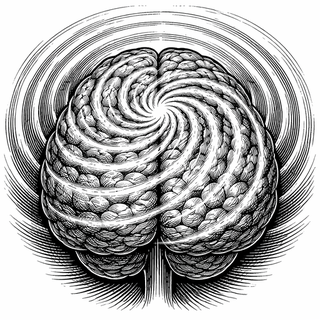
The Brain's Secret Dance Moves
For years, neuroscientists have known that brain oscillations - those rhythmic electrical pulses your neurons produce - don't just sit still. They travel. Like a wave rippling across a pond, these oscillations sweep across the cortical surface, and previous research from the same lab showed that the direction of travel matters: waves roll from back to front when you're encoding a memory, and reverse course when you're trying to recall one (Das et al., 2024).
But here's the thing - everyone was mostly looking at simple, straight-line waves. Plane waves. The vanilla ice cream of brain dynamics. Anup Das, Erfan Zabeh, Bard Ermentrout, and Joshua Jacobs decided to ask a much spicier question: what if the brain is also producing spirals, expanding rings, and other wild geometric patterns? And what if those patterns actually mean something?
Spirals, Sources, and Sinks (Oh My)
Using direct brain recordings from epilepsy patients performing memory tasks - spatial navigation in one experiment, verbal working memory in another - the team developed a flexible analytical framework to classify traveling wave patterns into distinct types. What they found was a whole zoo of wave geometries:
- Plane waves: your straightforward, marching-in-a-line oscillations
- Spiral waves: rotating patterns that swirl around a central point, like a neural hurricane
- Sources: waves radiating outward from a central point, like dropping a pebble in water
- Sinks: the opposite - waves converging inward, like a neural drain
And these weren't just curiosities. Each pattern showed up at different moments during memory tasks. Complex wave patterns - spirals and concentric waves - were strongest during the distractor period of spatial memory tasks, when the brain was presumably working hard to maintain information despite interference. In the spatial task, sources dominated (78% of concentric waves), while the verbal task favored sinks (68%). The brain apparently has opinions about which plumbing direction suits which type of thinking.
Reading Memories from Brain Ripples
The real showstopper? The team could actually decode which specific item a person was remembering based on the spatial pattern of their traveling waves. Not just "are they encoding or retrieving," but "they're thinking about that particular word." That's like reading someone's grocery list by watching the ripples in their coffee.
This builds on a growing body of work showing that traveling waves aren't just neural background noise. A landmark 2018 study established that theta and alpha oscillations (2-15 Hz) form traveling waves moving at about 0.25-0.75 m/s across the cortex (Zhang et al., 2018). And a 2023 study using fMRI found spiral wave patterns at boundaries between functional brain networks, acting as bridges for inter-regional communication (Xu et al., 2023). The current study pushes this further by showing that the geometry of the wave - not just its direction or frequency - carries meaningful information about what your brain is up to.
Why This Matters (Beyond Being Extremely Cool)
Understanding these wave patterns could reshape how we think about brain-computer interfaces. If different wave shapes correspond to different cognitive states - and even specific memories - that's a potential new channel for neural decoding that nobody was tapping into. It also opens doors for understanding what goes wrong in conditions where neural coordination breaks down, from epilepsy to Alzheimer's disease.
There's something deeply satisfying about the idea that your brain coordinates itself through traveling waves with specific shapes. It suggests the cortex isn't just a collection of regions firing independently - it's a surface alive with organized, moving patterns, each one carrying meaning. Your neurons aren't just chatting. They're choreographing.
So next time you're trying to remember where you left your keys, know this: somewhere in your cortex, a tiny spiral is spinning, a wave is radiating outward, and your brain is doing its own very private, very elaborate wave.
References
-
Das, A., Zabeh, E., Ermentrout, B., & Jacobs, J. (2026). Planar, spiral, and concentric traveling waves distinguish behavioral states in human memory. Nature Communications. DOI: 10.1038/s41467-026-71386-z | PubMed
-
Das, A., Zabeh, E., Bhattacharjee, T., Ermentrout, B., & Jacobs, J. (2024). The direction of theta and alpha travelling waves modulates human memory processing. Nature Neuroscience. DOI: 10.1038/s41593-024-01588-x | PubMed
-
Zhang, H., Watrous, A. J., Patel, A., & Jacobs, J. (2018). Theta and alpha oscillations are traveling waves in the human neocortex. Neuron, 98(6), 1269-1281.e4. DOI: 10.1016/j.neuron.2018.05.019 | PubMed
-
Xu, Y., Long, X., Feng, J., & Gong, P. (2023). Interacting spiral wave patterns underlie complex brain dynamics and are related to cognitive processing. Nature Human Behaviour, 7, 1196-1210. DOI: 10.1038/s41562-023-01626-5 | PubMed
-
Moldakarimov, S., Bhattacharjee, T., & Bhalla, U. S. (2022). Traveling waves in the prefrontal cortex during working memory. PLOS Computational Biology, 18(1), e1009827. DOI: 10.1371/journal.pcbi.1009827 | PubMed
Disclaimer: The image accompanying this article is for illustrative purposes only and does not depict actual experimental results, data, or biological mechanisms.