
Think of your brain's language system like a well-run restaurant kitchen. For decades, neuroscientists assumed all the real cooking happened upstairs in the cerebral cortex, that wrinkly outer layer hogging all the credit. The left frontal and temporal lobes were the head chefs, plating sentences and seasoning them with meaning. Meanwhile, the cerebellum - that fist-sized lump tucked underneath everything - was treated like the dishwasher. Sure, it kept your hands steady and your balance intact, but nobody thought it was writing the menu.
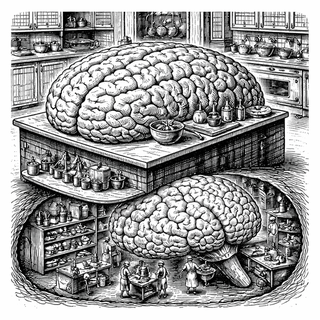
Turns out? The dishwasher has been running a whole satellite kitchen this entire time.
The Little Brain That Could (and Did)
A massive new study from MIT's McGovern Institute just dropped in Neuron, and it's basically a love letter to the cerebellum's linguistic talents. Colton Casto, Evelina Fedorenko, and their team sifted through 15 years of precision fMRI data from over 800 people to map exactly how the cerebellum handles language (Casto et al., 2025).
Here's what they found: four distinct spots in the cerebellum light up when you process language - reading, listening, the whole deal. But one of those regions is the real showstopper. A patch spanning Crus I, Crus II, and lobule VIIb in the right posterior cerebellum does something wild: it responds only to language. Not math. Not music. Not looking at faces. Just language.
"For a long time, people weren't interested in the cerebellum in language," Casto told The Transmitter. "This shows that language researchers need to be more seriously considering the cerebellum."
Yeah, no kidding.
A Mirror in the Basement
Here's where it gets really interesting. This language-exclusive cerebellar region doesn't just respond to words - it behaves almost identically to the cortical language network upstairs. It kicks in during both comprehension and production. It works harder when sentences get tricky or surprising. It even processes social and nonsocial language alike.
Fedorenko put it pretty clearly: "This is the first time we see an area outside of the core left-hemisphere language areas that behaves so similarly to those core areas."
The other three cerebellar language zones? They're more like generalists - multitasking across language and other cognitive demands. The team suspects they act as integration hubs, pulling together information from different cortical networks. Think of them as the sous chefs who also handle pastry and prep work, while that Crus I/II/VIIb region is the dedicated saucier who only does sauces and does them perfectly.
Why We Missed This for So Long
The cerebellum has been neuroscience's most underestimated organ for decades. Historically, researchers focused on its role in motor coordination - keeping you from face-planting when you walk, calibrating your golf swing, that sort of thing. But evidence has been quietly stacking up that it does way more.
Schmahmann's work on cerebellar cognitive affective syndrome showed that cerebellar damage doesn't just mess with your balance - it can wreck your verbal fluency, grammar processing, and abstract reasoning (Hoche et al., 2018). And Fedorenko's lab has spent years building increasingly detailed maps of the brain's language network using individual-level functional localization rather than the old-school approach of averaging brain scans together and hoping for the best (Lipkin et al., 2022).
That precision methodology is what made this discovery possible. When you actually look at each person's cerebellum individually instead of smearing everyone's data into one blurry average, the language signal jumps right out.
So What Does This Mean for Actual Humans?
Beyond being a satisfying "we told you so" moment for cerebellum enthusiasts (they exist, and they're thrilled), this has real clinical potential. The cerebellum sits right at the back of the skull, making it relatively accessible for non-invasive brain stimulation techniques like transcranial magnetic stimulation.
For people recovering from stroke-induced aphasia - where damage to the cortical language areas leaves them struggling to speak or understand language - this cerebellar region could be a brand new therapeutic target. Instead of trying to stimulate damaged cortical tissue directly, clinicians might be able to boost recovery through the cerebellum's back door.
The study also raises questions about language development. If the cerebellum is this tightly wired into the language network, it might play a bigger role in how kids acquire language than anyone realized.
The Bottom Line
Your brain's language system is bigger than we thought, and the cerebellum has been doing way more than keeping you upright. One specific region acts as a near-perfect satellite copy of the cortical language network, and the implications for understanding - and treating - language disorders could be significant. The dishwasher wasn't just cleaning plates. It was writing poetry back there.
References
-
Casto, C., Poliak, M., Tuckute, G., Small, H., Sherlock, P., Wolna, A., Lipkin, B., D'Mello, A. M., & Fedorenko, E. (2025). The cerebellar components of the human language network. Neuron. https://doi.org/10.1016/j.neuron.2025.12.030 PMID: 41576956
-
Hoche, F., Guell, X., Vangel, M. G., Sherman, J. C., & Schmahmann, J. D. (2018). The cerebellar cognitive affective/Schmahmann syndrome scale. Brain, 141(1), 248-270. https://doi.org/10.1093/brain/awx317 PMCID: PMC5837248
-
Lipkin, B., Tuckute, G., Affourtit, J., Small, H., Mineroff, Z., Kean, H., ... & Fedorenko, E. (2022). Probabilistic atlas for the language network based on precision fMRI data from >800 individuals. Scientific Data, 9, 529. https://doi.org/10.1038/s41597-022-01645-3
-
Fedorenko, E., Blank, I. A., Siegelman, M., & Mineroff, Z. (2024). The language network as a natural kind within the broader landscape of the human brain. Nature Reviews Neuroscience. PMID: 38609551
-
Hoche, F., Guell, X., Sherman, J. C., Vangel, M. G., & Schmahmann, J. D. (2019). The cerebellar cognitive affective/Schmahmann syndrome: a task force paper. The Cerebellum, 18(3), 1098-1125. https://doi.org/10.1007/s12311-019-01068-8 PMCID: PMC6978293
Disclaimer: The image accompanying this article is for illustrative purposes only and does not depict actual experimental results, data, or biological mechanisms.