
You know that one enzyme in your mitochondria that quietly recycles carbon atoms like some kind of molecular Marie Kondo? Turns out it's been moonlighting as a bodyguard for your brain's most vulnerable neurons, and when it clocks out early, things go sideways fast.
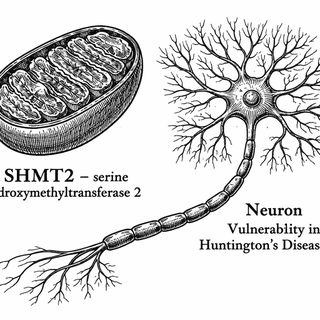
A team led by Mingqin Lu and colleagues just published a study in The Journal of Clinical Investigation that traces a surprising chain of metabolic dominoes in Huntington's disease (HD) - one that starts with a sleepy enzyme, passes through a toxic amino acid, and ends with your DNA losing its ability to regulate itself properly. It's the kind of biological Rube Goldberg machine that makes you wonder how anything in your body works at all.
The Enzyme That Could
The star of this story is SHMT2 - serine hydroxymethyltransferase 2, for those who enjoy tongue-twisters. It lives in your mitochondria and works the one-carbon metabolism beat, transferring single carbon units from serine to tetrahydrofolate like a biochemical postal worker. This pathway is essential for DNA synthesis, amino acid balance, and keeping your epigenetic landscape tidy (Ducker & Rabinowitz, 2017). Think of one-carbon metabolism as your cell's internal recycling program - folate goes in, methylation comes out, and everyone stays happy.
Except in Huntington's disease, SHMT2 levels drop. Significantly. The researchers found this by running RNA sequencing and metabolomics on HD models and discovering that one-carbon metabolism was basically falling apart. In both human striatal organoids grown from HD patient stem cells and in YAC128 mice (a go-to HD mouse model), SHMT2 was substantially downregulated. The postal worker had gone on strike.
When the Recycling Stops, the Trash Piles Up
Here's where it gets interesting. When SHMT2 goes quiet, homocysteine starts accumulating. Homocysteine is an amino acid that, in reasonable amounts, is just part of normal metabolism. But let it build up and it becomes the neurological equivalent of that one coworker who replies-all to every email - disruptive, toxic, and impossible to ignore.
Elevated homocysteine is already a known risk factor for Alzheimer's and Parkinson's disease, where it overstimulates NMDA receptors and ramps up oxidative stress (Lionaki et al., 2022). But this study reveals something new: the homocysteine accumulation interacts with AARS1 (alanyl-tRNA synthetase 1) and suppresses histone lactylation.
Lactylation: The New Kid on the Epigenetic Block
Histone lactylation was only discovered in 2019, when Zhang and colleagues showed that lactate - yes, the same molecule your muscles produce when you exercise - can stick to histones and directly flip genes on (Zhang et al., 2019). It was a revelation: metabolism wasn't just fueling gene expression, it was literally rewriting the instructions.
In HD, that rewriting gets erased. The homocysteine buildup squelches lactylation marks on histones, which scrambles transcriptional regulation in medium spiny neurons - the very cells that HD targets first. These neurons, which make up about 95% of the striatum and coordinate movement, are already living on the edge in HD. Losing their epigenetic regulation is like taking the guardrails off a mountain road.
Proof It Matters (Both Ways)
The researchers didn't just observe the problem - they tested it from every angle. Blocking or deleting SHMT2 made things worse: more mutant huntingtin protein clumps, more neuron death, worse motor function. Boosting SHMT2 expression did the opposite - it protected neurons in human organoids and improved how YAC128 mice moved.
And then there's the plot twist. Haloperidol, a first-generation antipsychotic already used to manage HD chorea, turns out to modulate SHMT2 expression and restore histone lactylation. An old drug, doing new tricks. It's not a cure, but it suggests this metabolic-epigenetic axis isn't just academically interesting - it's pharmacologically accessible.
Why Your Neurons Should Care
Huntington's disease affects roughly 30,000 people in the United States alone, with another 200,000 at genetic risk. Despite decades of research, there is no treatment that slows its progression. The metabolic vulnerabilities of HD - from energy deficits to disrupted glucose handling - have been documented extensively (Singh & Agrawal, 2022; Chang et al., 2024), but the one-carbon metabolism angle has been largely overlooked.
What this study offers is a new map of the terrain. It connects a mitochondrial enzyme to a toxic metabolite to an epigenetic modification to neuronal death - and shows that intervening at the top of the cascade can protect neurons downstream. That's the kind of upstream target that drug developers dream about.
There's a certain elegance to it, too. The same metabolic pathways that help a cell build DNA and maintain its identity are the ones that, when disrupted, let that identity unravel. Your neurons aren't just starving for energy in HD - they're losing the chemical Post-it notes that tell their genes what to do.
The ecosystem of a single cell, it turns out, is as interconnected and fragile as any forest. Pull one thread - one quiet enzyme doing its carbon-shuffling work - and the whole canopy starts to thin.
References:
-
Lu, M., Li, K., Wu, S., Zheng, Z., Li, X., Wang, S., Yu, H., Liu, C., Jiang, Y., Song, X., Liu, Y., & Guo, X. (2025). SHMT2 deficiency disrupts transcriptional regulation through homocysteine-mediated suppression of histone lactylation in Huntington's disease models. The Journal of Clinical Investigation. DOI: 10.1172/JCI196094
-
Ducker, G. S., & Rabinowitz, J. D. (2017). One-carbon metabolism in health and disease. Cell Metabolism, 25(1), 27-42. DOI: 10.1016/j.cmet.2016.08.009. PMCID: PMC5353360
-
Lionaki, E., Ploumi, C., & Tavernarakis, N. (2022). One-carbon metabolism: Pulling the strings behind aging and neurodegeneration. Cells, 11(2), 214. DOI: 10.3390/cells11020214. PMCID: PMC8773781
-
Zhang, D., Tang, Z., Huang, H., Zhou, G., Cui, C., Weng, Y., Liu, W., Kim, S., Lee, S., Perez-Neut, M., Ding, J., Czyz, D., Hu, R., Ye, Z., He, M., Zheng, Y. G., Shuman, H. A., Dai, L., Ren, B., Roeder, R. G., Becker, L., & Zhao, Y. (2019). Metabolic regulation of gene expression by histone lactylation. Nature, 574(7779), 575-580. DOI: 10.1038/s41586-019-1678-1. PMCID: PMC6818755
-
Singh, A., & Agrawal, N. (2022). Metabolism in Huntington's disease: A major contributor to pathology. Metabolic Brain Disease, 37(6), 1757-1771. DOI: 10.1007/s11011-021-00844-y. PMID: 34704220
-
Chang, C.-P., Wu, C.-W., & Chern, Y. (2024). Metabolic dysregulation in Huntington's disease: Neuronal and glial perspectives. Neurobiology of Disease, 201, 106672. DOI: 10.1016/j.nbd.2024.106672
Disclaimer: The image accompanying this article is for illustrative purposes only and does not depict actual experimental results, data, or biological mechanisms.