
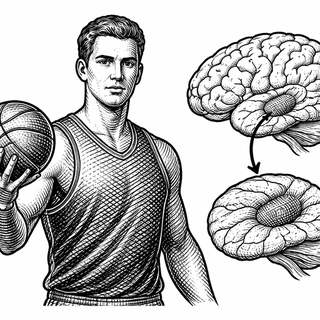
Think of your brain's emotional circuitry like a championship basketball team. You've got the amygdala playing power forward - big, aggressive, handling the heavy emotional rebounds. The cingulate cortex is running point guard, coordinating motor expressions of feeling (the clenched fist, the ugly cry, the victory dance). The insula? That's your center, quietly reading the body's internal state like a veteran reading the defense. They're all elite players. But every great team needs a coach calling the plays - and it turns out the medial pulvinar, a small thalamic nucleus most of us have never heard of, has been drawing up the X's and O's this whole time.
A new study published in Cell Reports by Feng and colleagues used a genuinely cool technique - shooting tiny pulses of infrared light into monkey brains while recording activity with ultra-powerful 7T MRI scanners - to reveal how this unsung brain region orchestrates emotional processing with startling precision (Feng et al., 2026).
Shining a (Literal) Light on Brain Wiring
Here's the problem with mapping how deep brain structures talk to each other: most of our tools are either too blunt or too invasive. Electrical stimulation activates everything in the neighborhood - imagine trying to text one friend but accidentally group-messaging your entire contacts list. Traditional tract tracing requires, well, sacrificing the brain you're studying.
Enter infrared neural stimulation, or INS. Developed and refined by Anna Wang Roe's lab, INS uses a hair-thin optical fiber to deliver focused infrared laser pulses that activate neurons in a tiny spot - we're talking fractions of a millimeter (Xu et al., 2019). Pair that with a 7T MRI scanner (the kind that makes radiologists swoon) and you can watch, in real time, which distant brain regions light up in response. It's like tapping one player on the shoulder and seeing exactly who they pass to.
The Medial Pulvinar: Tiny Region, Huge Job
The medial pulvinar sits in the posterior thalamus and makes up a surprisingly large chunk of it - about 40% in humans. Despite its size, it's been somewhat overlooked compared to flashier structures like the amygdala. Previous work established that the medial pulvinar connects to emotional processing regions and plays a role in directing attention to threatening or emotionally charged stimuli through a rapid subcortical route (Kragel et al., 2021). It's also been implicated in ADHD, autism, and schizophrenia, hinting that when this region goes sideways, so does a lot of higher-order emotional functioning (Homman-Ludiye & Bourne, 2019).
But nobody had mapped its connections at the millimeter scale. Until now.
Mesoscale: The Goldilocks Zone
When the team stimulated sequential spots within the medial pulvinar, they found something beautiful: the connections weren't random or diffuse. Each stimulation site activated specific, patchy, millimeter-sized zones within the cingulate cortex, insula, and amygdala. Move the stimulation fiber over by a millimeter, and a different patch lights up. There's a topographic map - an orderly, point-to-point correspondence - between the pulvinar and each of these limbic regions.
This is the "mesoscale" the researchers keep emphasizing, and it matters enormously. Too zoomed out and you miss the specificity. Too zoomed in and you're counting individual synapses without seeing the pattern. At the mesoscale, the limbic system looks less like the chaotic emotional soup it's often caricatured as and more like a precisely wired switchboard.
The three target regions each handle a different emotional "axis": the cingulate manages motor expression of emotion (think facial expressions, body language), the insula handles interoception (your awareness of what's happening inside your body), and the amygdala processes the emotional significance of what you're experiencing (Rolls, 2019). The medial pulvinar appears to coordinate all three, selectively routing information to the right players at the right time.
Why Your Psychiatrist Should Care
This isn't just an anatomy lesson. Precision psychiatry - the idea that we can treat mood and anxiety disorders by stimulating exact brain circuits rather than flooding the whole brain with medication - depends entirely on knowing where those circuits are. Current deep brain stimulation for depression targets structures like the subcallosal cingulate, but results are mixed partly because we're still aiming with relatively coarse resolution.
If the limbic system really is organized at the millimeter scale, then treatments need to match that precision. A millimeter off and you might be stimulating the "body awareness" channel instead of the "emotional processing" channel. That's like a coach calling a play for the wrong player - technically basketball, but not going to win the game.
The Feng et al. study suggests the medial pulvinar could be a therapeutic target worth investigating, and more broadly, that the tools to map these circuits at the right resolution finally exist (Shi et al., 2021). The emotional brain isn't a messy tangle of feelings. It's a precision instrument - we just needed a sharper lens to see it.
References
-
Feng Y, Ping A, Yao S, et al. Infrared neural stimulation with fMRI in primates reveals mesoscale limbic organization linked to the medial pulvinar. Cell Reports. 2026;44(4):117209. doi: 10.1016/j.celrep.2026.117209. PMID: 41936050
-
Xu AG, Qian M, Tian F, et al. Focal infrared neural stimulation with high-field functional MRI: A rapid way to map mesoscale brain connectomes. Science Advances. 2019;5(4):eaau7046. doi: 10.1126/sciadv.aau7046. PMID: 31032400
-
Kragel PA, Čeko M, Theriault J, et al. A human colliculus-pulvinar-amygdala pathway encodes negative emotion. Neuron. 2021;109(15):2404-2412.e5. doi: 10.1016/j.neuron.2021.06.001. PMID: 34166604
-
Homman-Ludiye J, Bourne JA. The medial pulvinar: function, origin and association with neurodevelopmental disorders. Journal of Anatomy. 2019;235(3):507-520. doi: 10.1007/s00429-019-01916-7. PMCID: PMC6704239
-
Rolls ET. The cingulate cortex and limbic systems for emotion, action, and memory. Brain Structure and Function. 2019;224(9):3001-3018. doi: 10.1007/s00429-019-01945-2. PMID: 31451898
-
Shi S, Xu AG, Rui YY, et al. Infrared neural stimulation with 7T fMRI: A rapid in vivo method for mapping cortical connections of primate amygdala. NeuroImage. 2021;231:117818. doi: 10.1016/j.neuroimage.2021.117818. PMID: 33548458
Disclaimer: The image accompanying this article is for illustrative purposes only and does not depict actual experimental results, data, or biological mechanisms.