
Sorry to be the one to tell you this, but your brain has been running a faulty sleep program since before you took your first breath. At least, that's the case if you're among the growing number of people identified with FOXP1 syndrome, a rare neurodevelopmental condition where the blueprint for restful sleep gets scrambled during fetal development. And a new study just figured out why, using the unlikeliest of insomnia patients: fruit flies.
What Even Is FOXP1 Syndrome? (Glad You Asked)
FOXP1 is a transcription factor, which is a fancy way of saying it's a protein that tells other genes when to shut up and when to speak. It belongs to the FOXP family, whose most famous member, FOXP2, earned the nickname "the language gene" back when scientists discovered that mutations in it wrecked people's ability to form words (Lozano et al., 2021). FOXP1 is FOXP2's less famous sibling, but it turns out it's been quietly running the show behind the scenes.
When FOXP1 goes haywire, the result is FOXP1 syndrome: intellectual disability, speech delays, ADHD, anxiety, and autism-like features (Trelles et al., 2021). But one of the most common complaints from families? Sleep. Specifically, the kind of sleep where you wake up at 4:30 AM staring at the ceiling like you've been personally summoned by the void.
The Numbers Don't Lie (and Neither Do Exhausted Parents)
A team led by Mireia Coll-Tane and colleagues at Radboud University decided to actually quantify this misery. They assessed sleep in individuals with FOXP1 syndrome and found that 71% experienced early waking before 5 AM, 57% reported repeated night waking, and the majority had trouble falling asleep in the first place. Perhaps the most telling statistic: 80% of family members reported their own sleep was disrupted too (Coll-Tane et al., 2025).
If you've ever lived with someone who wakes up at 4 AM every single day, you know this isn't just a medical problem. It's a household-wide hostage situation.
Enter the Fruit Flies (As One Does)
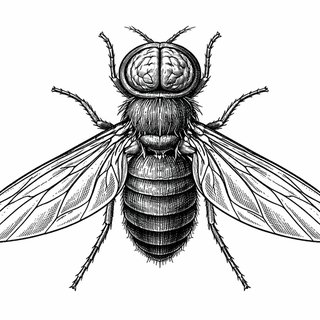
To figure out what's actually going wrong at the molecular level, the researchers turned to Drosophila melanogaster, those tiny flies you've been unsuccessfully swatting near your bananas. Flies have their own version of FOXP, and when the team knocked it out, the results were remarkably familiar: severely fragmented sleep, reduced total sleep time, and circadian rhythms that looked like a shuffled playlist.
Here's where it gets really interesting. The flies' brains contain a set of clock neurons that produce a neuropeptide called pigment dispersing factor (PDF), which is basically the fly equivalent of your brain's internal alarm system. In normal flies, these neurons physically reshape themselves throughout the day, spreading out their connections in the morning and retracting them at night. In FoxP mutants? The neurons barely budged. They were stuck, like a clock whose hands got glued down (Dubowy & Sehgal, 2017).
The Plot Twist: It's a Developmental Thing
The team's cleverest experiment involved a genetic on/off switch. They could knock down FoxP only during development or only during adulthood. When they silenced it in adult flies, nothing happened. Sleep was fine. But when they silenced it during development only, the adult flies had terrible, fragmented sleep for the rest of their lives.
Let that sink in. The damage was done before the flies were even "born" (or, technically, before they eclosed from their pupal case, but that's less dramatic). FOXP1 isn't needed to maintain sleep in real-time. It's needed to build the sleep machinery correctly in the first place.
Hugin: The Tiny Signal That Wrecks Everything
Digging into which genes FoxP controls, the team found a neuropeptide called hugin (whose human equivalent is neuromedin U). FoxP is normally expressed in hugin-producing neurons during a specific larval stage, and when they knocked down FoxP in just those cells, it was enough to produce sleep fragmentation in adults. These hugin neurons connect directly to the PDF clock neurons, suggesting a developmental wiring problem that echoes across the animal's entire life.
It's a bit like discovering that the electrician who wired your house 30 years ago crossed two wires in the breaker box, and that's why your bedroom light has always flickered at 3 AM.
Why This Matters Beyond Flies and Rare Syndromes
Sleep problems are staggeringly common across neurodevelopmental disorders, affecting anywhere from 50-80% of children with autism, ADHD, and related conditions (Bruni et al., 2025). But treatments are mostly limited to melatonin and behavioral strategies because we don't understand the underlying mechanisms. This study suggests that for at least some of these conditions, the problem isn't in the sleep circuits themselves but in how those circuits get built during brain development.
That changes the therapeutic conversation entirely. Instead of just treating symptoms at bedtime, researchers might eventually target the peptidergic pathways that went wrong during development. It's early days, but it's a new map for a problem that millions of families live with every night.
And for those families dealing with FOXP1 syndrome specifically? There's something validating about science finally saying: your kid isn't just being difficult at 4 AM. Their brain was literally wired for this.
References
-
Coll-Tané M, Eidhof I, Han J, et al. Conserved sleep disturbances in FOXP1 syndrome originate from developmental dysregulation of peptidergic signaling. J Clin Invest. 2025. DOI: 10.1172/JCI193475. PMID: 41919501.
-
Lozano R, Gbekie C, Siper PM, et al. FOXP1 syndrome: a review of the literature and practice parameters for medical assessment and monitoring. J Neurodev Disord. 2021;13:18. DOI: 10.1186/s11689-021-09358-1. PMID: 33892622.
-
Trelles MP, Levy T, Lerman B, et al. Individuals with FOXP1 syndrome present with a complex neurobehavioral profile with high rates of ADHD, anxiety, repetitive behaviors, and sensory symptoms. Mol Autism. 2021;12:61. DOI: 10.1186/s13229-021-00469-z. PMID: 34588003.
-
Bruni O, Breda M, Mammarella S, et al. Sleep and circadian disturbances in children with neurodevelopmental disorders. Nat Rev Neurol. 2025;21:103-119. DOI: 10.1038/s41582-024-01052-9. PMID: 39779841.
-
Dubowy C, Sehgal A. Circadian Rhythms and Sleep in Drosophila melanogaster. Genetics. 2017;205(4):1373-1397. DOI: 10.1534/genetics.115.185157. PMID: 28360128.
Disclaimer: The image accompanying this article is for illustrative purposes only and does not depict actual experimental results, data, or biological mechanisms.