
For years, scientists were looking in the wrong part of the brain. They had a hormone - FGF21 - that clearly told the brain "we're running low on protein, do something about it." They had a list of suspect brain regions, all sitting pretty in the hypothalamus, that classic overachiever of neural real estate. They tested each one. And each one came back innocent. The actual culprit? A tiny cluster of cells tucked away in the hindbrain, a region most neuroscientists would walk past without a second glance. Sometimes the answer really is hiding where nobody thought to look.
A Hormone With a Very Specific Job
FGF21 - fibroblast growth factor 21, for those who enjoy syllables - is a hormone your liver pumps out when you're not eating enough protein. Not calories. Specifically protein. Your liver essentially rings an alarm bell: "The amino acids are running low, someone please adjust operations." Within 24 hours of a low-protein diet, FGF21 levels in mice spike tenfold (Laeger et al., 2014). In humans, the response is just as dramatic (Brandhorst et al., 2025).
What happens next is rather elegant. FGF21 crosses the blood-brain barrier and tells your brain to make two adjustments: eat more food (to compensate for the protein shortfall) and crank up energy expenditure (so you don't simply balloon from the extra calories). It's a metabolic balancing act that would make an accountant weep with admiration (Hill et al., 2019).
Everyone Suspected the Hypothalamus. Everyone Was Wrong.
Previous work had convincingly shown that FGF21 needed to act through the brain, specifically through neurons expressing its co-receptor beta-klotho (KLB) (Geng et al., 2020). The hypothalamus was the obvious suspect - it's involved in basically every metabolic process and has the neurological equivalent of main character syndrome. Three hypothalamic regions stood accused: the suprachiasmatic nucleus, the paraventricular nucleus, and the ventromedial hypothalamus.
Spann and colleagues systematically eliminated each one. Knocked out beta-klotho in the SCN? Mice still responded to protein restriction. The PVN? Same story. The VMH? Still adapting perfectly well. One by one, the hypothalamic regions were cleared of all charges.
The Hindbrain Enters the Chat
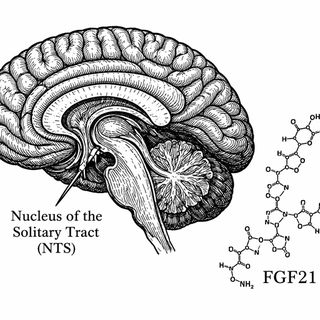
The real action, it turns out, happens in the nucleus of the solitary tract - the NTS - a brainstem structure better known for processing gut signals and helping you not choke on your dinner. Using a clever Klb-Flp mouse line combined with intersectional genetics (which sounds like an academic conference but is actually a very precise way of targeting specific neurons), the team identified a discrete population of glutamatergic, KLB-expressing neurons in the NTS that light up when FGF21 comes knocking.
Here's where it gets properly convincing. When they ablated these NTS-KLB neurons - surgically removed them from the equation - mice on a low-protein diet simply... didn't adapt. No change in food intake. No shift in food preference. No bump in energy expenditure. The entire protein-restriction response just vanished, as if someone had cut the telephone line between liver and brain.
And the reverse experiment was equally striking. Using chemogenetics to artificially activate these same neurons in mice eating a perfectly normal diet, the researchers could mimic every feature of the protein restriction response. The mice ate more, spent more energy, and shifted their food preferences - all without a single protein being restricted.
Why This Matters Beyond Mouse Brains
The protein leverage hypothesis - the idea that animals (humans included) will overeat carbohydrates and fats to meet a protein target - has been kicking around for two decades. It's been invoked to help explain the obesity epidemic, given that modern diets are increasingly protein-dilute. FGF21 has emerged as the molecular messenger behind this leverage (Hill et al., 2022), and now we finally know which neurons are picking up the phone.
This matters because the NTS is accessible. It sits outside the blood-brain barrier in a region bathed by cerebrospinal fluid, making it potentially easier to target therapeutically than deep hypothalamic nuclei. If you wanted to design a drug that modulates protein-sensing behaviour - say, to help people feel satisfied with less food, or to treat metabolic disorders linked to dietary protein imbalance - you now know exactly which cellular address to send it to.
The Quiet Revolution in the Brainstem
What strikes one most about this work is how long the field spent looking upstairs when the answer was in the basement. The NTS has always been the brain's unsung bureaucrat - processing visceral signals, relaying satiety cues, keeping the lights on. Now it turns out this modest brainstem structure is also running the protein-sensing programme, coordinating a whole suite of metabolic responses through a single hormone receptor. One suspects the hypothalamus is having a bit of an identity crisis.
References:
-
Spann RA, Kim SQ, Khan MSH, et al. FGF21 signals through hindbrain neurons to alter food intake and energy expenditure during dietary protein restriction. Cell Reports. 2026. DOI: 10.1016/j.celrep.2026.117218. PMID: 41920734
-
Laeger T, Henagan TM, Albarado DC, et al. FGF21 is an endocrine signal of protein restriction. Journal of Clinical Investigation. 2014;124(9):3913-3922. DOI: 10.1172/JCI74915. PMCID: PMC4153701
-
Hill CM, Laeger T, Dehner M, et al. FGF21 signals protein status to the brain and adaptively regulates food choice and metabolism. Cell Reports. 2019;27(10):2934-2947. DOI: 10.1016/j.celrep.2019.05.022. PMCID: PMC6579533
-
Hill CM, Albarado DC, Cber LG, et al. FGF21 is required for protein restriction to extend lifespan and improve metabolic health in male mice. Nature Communications. 2022;13:1897. DOI: 10.1038/s41467-022-29499-8. PMCID: PMC8991228
-
Geng L, Lam KSL, Xu A. The therapeutic potential of FGF21 in metabolic diseases: from bench to clinic. Nature Reviews Endocrinology. 2020;16:654-667. DOI: 10.1038/s41574-020-0386-0
-
Brandhorst S, et al. Dietary protein restriction elevates FGF21 levels and energy requirements to maintain body weight in lean men. Nature Metabolism. 2025. DOI: 10.1038/s42255-025-01236-7
Disclaimer: The image accompanying this article is for illustrative purposes only and does not depict actual experimental results, data, or biological mechanisms.