
Depression in multiple sclerosis isn't just "feeling sad about being sick." That explanation has always been too convenient, too dismissive, and frankly, wrong. A new study from Italian researchers just caught the brain's reward circuitry doing something sneaky in MS patients with depression, and the findings suggest we've been missing the neurological equivalent of a loose wire behind the wall.
The Usual Suspects: Meet Your Brain's Pleasure Centers
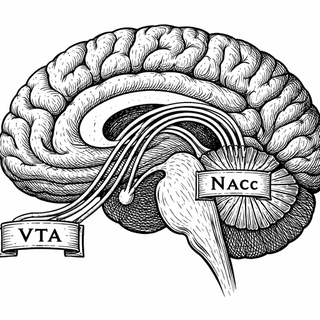
Two tiny brain regions run most of your motivation and reward processing. The ventral tegmental area (VTA) pumps out dopamine like a neurochemical espresso machine, while the nucleus accumbens (NAcc) receives those signals and essentially decides whether that chocolate bar, promotion, or sunset was worth getting excited about. Together, they form the core of your mesolimbic pathway, the circuit responsible for making things feel good.
When this system malfunctions, you get anhedonia, the clinical term for "nothing feels enjoyable anymore." It's not that you're lazy or ungrateful. Your reward hardware is literally broken.
What the Researchers Actually Did
The team at the University of Genoa recruited 90 participants: 30 MS patients with depression, 30 MS patients without depression, and 30 people with major depressive disorder but no MS. Everyone got stuffed into an MRI scanner for resting-state functional imaging (basically taking a video of the brain doing nothing in particular, which turns out to be surprisingly informative).
Here's where it gets technical but interesting. They measured two types of connectivity. Functional connectivity (FC) shows which brain regions are chatting with each other. Effective connectivity (EC), calculated using something called dynamic causal modeling, reveals who's actually influencing whom. It's the difference between noticing two coworkers always eat lunch together versus figuring out which one always picks the restaurant.
The Plot Twist Nobody Expected
MS patients with depression showed reduced functional connectivity compared to both other groups. Not just compared to non-depressed MS patients (which you'd expect), but also compared to depressed people without MS. The combination of MS and depression appears to hit the reward circuit harder than either condition alone.
The effective connectivity analysis revealed even weirder findings. The VTA in depressed MS patients showed negative self-modulation, essentially suppressing its own activity. Additionally, there was inhibitory signaling between the VTA, NAcc, and the right amygdala (that last one handles emotional processing, because of course the amygdala had to get involved).
Translation: in depressed MS patients, the brain regions responsible for pleasure and motivation are actively dampening each other's signals. It's like having your car's accelerator connected to the brake pedal.
Why This Matters Beyond Academic Interest
Depression affects up to 50% of MS patients, making it two to three times more common than in the general population. And it's not just about quality of life. Depression in MS correlates with faster cognitive decline, higher disability progression, and increased suicide risk. Understanding the mechanism isn't academic navel-gazing; it's the first step toward treatments that actually work.
Previous research has already linked white matter lesions in MS to circuits previously identified in major depression, suggesting a dopamine-based connection that could open doors to new treatment approaches. The dopamine imbalance hypothesis has been gaining traction for years, proposing that disrupted communication between the striatum and prefrontal cortex underlies fatigue and depression in MS.
The Biomarker Angle
The researchers suggest their combined FC-EC approach could become a non-invasive MRI biomarker for detecting depression risk in MS patients. Currently, we diagnose depression by asking people questions (revolutionary, I know). Having an objective brain signature would let clinicians identify at-risk patients before symptoms become debilitating and potentially tailor treatments to the specific connectivity disruptions present.
Recent work on reward circuit connectivity in depression has shown that functional connectivity patterns could serve as biomarkers for treatment response, particularly for interventions targeting the dopamine system.
What Comes Next
The study has limitations (small sample size, cross-sectional design, the usual suspects). But it provides a neurobiological framework for understanding why MS depression might respond differently to treatment than garden-variety depression. If the reward circuit is being disrupted by MS-specific mechanisms, then MS-specific interventions might be warranted.
Deep brain stimulation of the nucleus accumbens has already shown promise for treatment-resistant depression. Dopamine-targeting medications, non-invasive brain stimulation techniques, and combined exercise training that regulates dopamine-mediated immunomodulation are all on the table.
The brain's reward system in MS patients with depression isn't just sad. It's miscommunicating at a fundamental level. And now, for the first time, we can actually see it happening.
References
-
Lombardi G, Leveraro E, Cipriano E, et al. Functional and effective connectivity disruptions of the dopaminergic reward circuit in multiple sclerosis patients with depression. Journal of Neurology, Neurosurgery & Psychiatry. 2025. DOI: 10.1136/jnnp-2025-336798. PMID: 41825870
-
Kampaite A, Sherwood R, Sherlock H, et al. Brain connectivity changes underlying depression and fatigue in relapsing-remitting multiple sclerosis: A systematic review. PLOS ONE. 2024;19(3):e0299634. DOI: 10.1371/journal.pone.0299634. PMCID: PMC10980255
-
Dobryakova E, Genova HM, DeLuca J, et al. The Dopamine Imbalance Hypothesis of Fatigue in Multiple Sclerosis and Other Neurological Disorders. Frontiers in Neurology. 2015;6:52. DOI: 10.3389/fneur.2015.00052. PMCID: PMC4357260
-
Felger JC, Li Z, Haroon E, et al. Functional connectivity in reward circuitry and symptoms of anhedonia as therapeutic targets in depression with high inflammation. Molecular Psychiatry. 2022;28(1):432-442. DOI: 10.1038/s41380-022-01715-3
-
Rocca MA, Barkhof F, et al. Fatigue, depression, and pain in multiple sclerosis: How neuroinflammation translates into dysfunctional reward processing and anhedonic symptoms. Multiple Sclerosis Journal. 2022. PMCID: PMC9131410
Disclaimer: The image accompanying this article is for illustrative purposes only and does not depict actual experimental results, data, or biological mechanisms.