
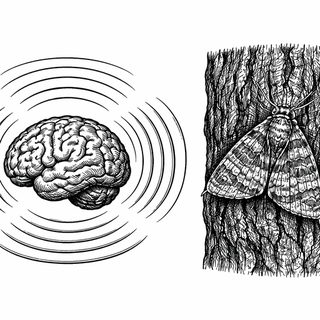
People who can instantly spot a camouflaged moth on tree bark or pick out a friend's face in a packed stadium have something happening deep in their visual cortex that people who struggle with those tasks don't: tighter, more coordinated bursts of electrical chatter between neurons firing at roughly 30 to 80 times per second. These rapid-fire oscillations, called gamma rhythms, have been at the center of one of neuroscience's spiciest debates for decades. And a new study just dropped some seriously compelling evidence that the critics got it wrong.
The Binding Problem (A.K.A. Neuroscience's Longest-Running Soap Opera)
Here's the setup. Your brain doesn't have a single "vision pixel" that sees a whole coffee mug. Instead, separate clusters of neurons handle the color, the shape, the handle, the steam rising off the top. So how does your brain stitch all that into one coherent object instead of a confetti explosion of unrelated features? This is the binding problem, and it's been haunting neuroscientists since the 1990s.
One popular theory says gamma oscillations are the glue. Neurons that fire together in synchronized gamma waves effectively "tag" their signals as belonging to the same object. Think of it like a stadium crowd doing the wave - individual people (neurons) doing their own thing until a rhythm coordinates them into something unmistakable (Ghiani et al., 2021).
But here's where it gets contentious. Critics pointed out two seemingly fatal flaws: gamma frequency shifts depending on what you're looking at (a high-contrast grating fires neurons at a different frequency than a low-contrast blob), and the synchronization weakens when image elements are far apart (Hermes et al., 2015). If the rhythm keeps changing, how can it possibly bind anything? The gamma-as-binding-glue hypothesis looked like it was heading for the scientific dustbin.
Plot Twist: The "Bug" Was Actually a Feature
Enter Karimian and colleagues from Maastricht University, who basically said: what if those stimulus dependencies aren't a problem, but the entire point?
Their argument leans on the theory of weakly coupled oscillators (TWCO) - a framework borrowed from physics that describes how oscillating systems influence each other. In this model, whether two oscillators synchronize depends on two things: how different their natural frequencies are (called "detuning") and how strongly they're connected ("coupling"). Map that onto the visual cortex, and contrast differences between image elements control the frequency mismatch, while physical distance controls the coupling strength.
The team designed a clever texture segregation experiment. Eight participants had to identify a rectangular figure hidden within a background of oriented texture elements. The figure wasn't defined by color or brightness - just by having slightly less variation in contrast compared to the noisy background. Like finding a calm patch in choppy water (Karimian et al., 2026).
The Numbers Don't Lie (And They're Kind of Beautiful)
Here's where the computational neuroscience nerd in me gets excited. The researchers built a model where each texture element was represented by an oscillator, with frequency set by local contrast and connections weighted by distance. The TWCO framework predicted exactly when the figure should pop out and when it should vanish into the background. And human performance tracked those predictions both qualitatively AND quantitatively.
But wait, there's more! They added a Hebbian learning rule to the model - basically the "neurons that fire together, wire together" principle. Over nine experimental sessions, participants got better at the task. The model's increasing gamma synchrony from strengthened connections predicted exactly how much better people got. Training literally tuned the brain's oscillatory network to be a better figure-ground detector. Previous work using similar oscillator frameworks had already shown this approach could explain how flanking visual elements help or hinder target detection (Evers, Peters & Senden, 2021), but extending it to perceptual learning across sessions is a genuinely new contribution.
Why Should You Care About Brain Waves at 40 Hz?
Beyond settling an academic grudge match, this matters for real reasons. Disrupted gamma oscillations show up in schizophrenia, autism, and Alzheimer's disease. If gamma synchrony genuinely drives how we parse visual scenes, then understanding its mechanics could open doors for clinical interventions. Recent research has even suggested gamma rhythms serve as a "guardian of brain health," regulating blood flow and waste clearance in neural circuits (Ichim et al., 2024).
What makes this study elegant is that it reframes what looked like gamma's weakness as its superpower. The stimulus dependence isn't noise in the system - it's the system doing its job, encoding local image statistics into a synchrony code that the brain can read. The frequency shifts and distance effects aren't bugs to be explained away. They're the mechanism.
So next time you effortlessly pick your dog out of a park full of other dogs, tip your hat to those 40-Hz oscillators humming away in your visual cortex. They've been vindicated.
References
-
Karimian, M., Roberts, M. J., De Weerd, P., & Senden, M. (2026). Principles of gamma synchrony predict figure-ground perception in texture stimuli. eLife, 105482. DOI: 10.7554/eLife.105482
-
Ghiani, A., Maniglia, M., Battaglini, L., Melcher, D., & Ronconi, L. (2021). Binding mechanisms in visual perception and their link with neural oscillations: A review of evidence from tACS. Frontiers in Psychology, 12, 643677. DOI: 10.3389/fpsyg.2021.643677 PMCID: PMC8019716
-
Hermes, D., Miller, K. J., Wandell, B. A., & Winawer, J. (2015). Gamma oscillations in visual cortex: The stimulus matters. Trends in Cognitive Sciences, 19(2), 57-66. DOI: 10.1016/j.tics.2014.12.009 PMCID: PMC4395850
-
Evers, K., Peters, J., & Senden, M. (2021). Cortical synchrony as a mechanism of collinear facilitation and suppression in early visual cortex. Frontiers in Systems Neuroscience, 15, 670702. DOI: 10.3389/fnsys.2021.670702
-
Ichim, A. M., Barzan, H., Moca, V. V., Nagy-Dabacan, A., Ciuparu, A., Hapca, A., Vervaeke, K., & Muresan, R. C. (2024). The gamma rhythm as a guardian of brain health. eLife, 100238. DOI: 10.7554/eLife.100238 PMCID: PMC11578591
Disclaimer: The image accompanying this article is for illustrative purposes only and does not depict actual experimental results, data, or biological mechanisms.