
You're using it right now - the very organ reading these words is also quietly managing your body temperature with the precision of a Swiss watchmaker. Somewhere deep in your hypothalamus, a cluster of neurons is making micro-adjustments to keep you at a comfortable 37°C, deciding when to dilate blood vessels, when to sweat, when to shiver. It's seamless, invisible, and for about 70% of people going through menopause, it goes spectacularly haywire.
When Your Internal Weather Goes Rogue
Hot flashes are the body's thermostat glitching like a smart home device during a firmware update. One moment you're fine; the next, your brain has decided you're overheating and throws open every heat-dissipation valve it has - flushing skin, drenching sweats, racing heart. Except you weren't overheating at all. For decades, we knew estrogen withdrawal triggered this chaos, but the how stayed frustratingly murky.
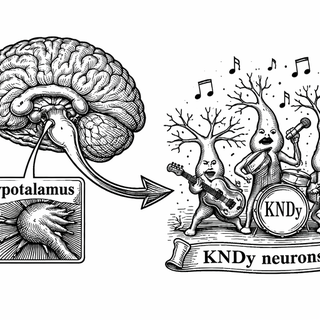
Enter KNDy neurons. (Pronounced "candy," because neuroscientists apparently have a sweet tooth for acronyms.) These cells, nestled in the hypothalamus's arcuate nucleus, co-express three neuropeptides: kisspeptin, neurokinin B, and dynorphin. Think of them as a tiny three-person band. Normally, estrogen keeps this band playing at a reasonable volume. But when estrogen drops during menopause, the band loses its sound engineer, cranks everything to eleven, and floods the brain with neurokinin B (Rance et al., 2013; Mittelman-Smith et al., 2012).
The Thermostat's Secret Wiring
Here's where it gets clever. All that excess neurokinin B doesn't just slosh around aimlessly. It travels to a neighboring brain region called the median preoptic area, which happens to be loaded with neurokinin 3 receptors (NK3R). This region is basically the control room for your body's heat-dissipation system. When neurokinin B hits those NK3R receptors, the control room gets a false alarm: too hot, initiate cooling protocols! Blood vessels in the skin dilate, sweat glands activate, and you experience the full glory of a hot flash - your body's fire drill for a fire that doesn't exist (Padilla et al., 2018).
This insight, painstakingly assembled through years of rodent studies and human genetics, cracked open something remarkable: a drugable target that had nothing to do with hormones.
Blocking the False Alarm
If hyperactive neurokinin B signaling is the problem, blocking its receptor is the logical fix. And that's exactly what NK3R antagonists do.
Fezolinetant (brand name Veozah) became the first to cross the finish line, earning FDA approval in May 2023. Clinical trials showed it cut moderate-to-severe hot flashes by roughly 64% within 12 weeks - and the relief kicked in within the first week, faster than traditional hormone therapy (Pinkerton et al., 2023). Then in October 2025, elinzanetant (Lynkuet) raised the bar further. This dual NK1/NK3 receptor antagonist reduced hot flashes by nearly 74% at 12 weeks while also improving sleep quality - a welcome bonus, given that night sweats and insomnia tend to travel as a miserable package deal (Pinkerton et al., 2024).
The significance here isn't just incremental. For people with hormone-sensitive cancers, blood clot history, or other conditions that make estrogen therapy dangerous, these drugs represent the first targeted, non-hormonal option that actually addresses the neurobiology rather than just masking symptoms.
Why a Thermostat Bug Matters More Than You Think
It's tempting to dismiss hot flashes as a minor inconvenience - a seasonal weather pattern of middle age. But VMS can persist for seven to ten years. They fracture sleep, erode concentration, and compound into real consequences: cardiovascular strain, mood disorders, reduced productivity, and a quality-of-life hit that ripples outward into relationships and careers.
The KNDy neuron story is also a beautiful example of how basic neuroscience - the kind where researchers spend years tracing neural circuits in rodent brains, one synapse at a time - eventually yields treatments that change lives. Nobody studying kisspeptin in the early 2000s was thinking about pharmaceutical blockbusters. They were following the wiring diagram of the hypothalamus like naturalists mapping a river system, curious where the current would lead.
And it led here: to a molecular understanding precise enough to design drugs that quiet a specific neural alarm without touching the hormonal system at all. The thermostat doesn't need replacing. It just needed someone to figure out which wire was crossed.
References
-
Torres, E., Wall, E. G., & Navarro, V. M. (2026). Neurokinin receptor antagonists for vasomotor symptoms: from KNDy neurons to clinical translation. Nature Reviews Endocrinology. DOI: 10.1038/s41574-026-01247-8 | PMID: 41981275
-
Pinkerton, J. V., Redick, D. L., Homewood, L. N., & Kaunitz, A. M. (2023). Neurokinin Receptor Antagonist, Fezolinetant, for Treatment of Menopausal Vasomotor Symptoms. The Journal of Clinical Endocrinology & Metabolism, 108(11), e1448. DOI: 10.1210/clinem/dgad209 | PMID: 37097747
-
Pinkerton, J. V., et al. (2024). Elinzanetant for vasomotor symptoms in menopause. JAMA. DOI: 10.1001/jama.2024.14618
-
Rance, N. E., Dacks, P. A., Mittelman-Smith, M. A., Romanovsky, A. A., & Krajewski-Hall, S. J. (2013). Modulation of body temperature and LH secretion by hypothalamic KNDy neurons: A novel hypothesis on the mechanism of hot flushes. Frontiers in Neuroendocrinology, 34(3), 211-227. DOI: 10.1016/j.yfrne.2013.02.003 | PMC3833827
-
Padilla, S. L., Johnson, C. W., Barker, F. D., Patterson, M. A., & Palmiter, R. D. (2018). A Neural Circuit Underlying the Generation of Hot Flushes. Cell Reports, 24(2), 271-277. DOI: 10.1016/j.celrep.2018.06.037 | PMC6094949
Disclaimer: The image accompanying this article is for illustrative purposes only and does not depict actual experimental results, data, or biological mechanisms.