
Monday: normal brain. Tuesday: still normal. Wednesday: a team of neuroscientists published a review arguing that psychedelics can basically hit "undo" on one of your brain's most stubborn design features - and suddenly everything we thought we knew about how these drugs work needs a serious rewrite.
The "Chemical Imbalance" Story Was Too Simple
For decades, the dominant explanation for why psychiatric drugs work (or don't) has been the biochemical imbalance model. Depressed? Must be low serotonin. Anxious? Probably a GABA thing. Pop a pill, tweak the chemistry, problem solved. Except... it was never that clean. In a new review in the Annual Review of Neuroscience, Gul Dolen and Makenzie Wilkinson argue that psychedelics blow this model wide open (Dolen & Wilkinson, 2025).
Here's the thing that kept bugging researchers: psychedelics bind to serotonin receptors, sure. But so do a lot of drugs that don't make you rethink your relationship with your mother during a therapy session. The binding-target explanation can't account for the sheer weirdness of psychedelics - their effects are durable (one or two sessions can produce months of improvement), context-dependent (set and setting matter enormously), and wildly diverse across compounds. Ketamine, MDMA, psilocybin, and ibogaine have almost nothing in common pharmacologically, yet they all seem to do something remarkably similar at a deeper level.
Your Brain Has a Construction Schedule (and It's Overdue)
Remember how kids pick up languages like it's nothing, while you've been "learning" Spanish on an app for three years and still can't order lunch? That's critical periods at work - developmental windows when your brain is absurdly good at rewiring itself in response to experience. Language, vision, social bonding - they all have their moment, and then the window slams shut.
What slams it shut is partly the extracellular matrix (ECM), a dense meshwork of proteins that wraps around neurons like biological cement. Specifically, structures called perineuronal nets form tight cages around certain neurons, essentially locking your neural circuits into place. Great for stability. Not so great if you're an adult trying to unlearn a trauma response.
Psychedelics: The Brain's Renovation Crew
The big reveal from Dolen's lab (which started making waves with their 2023 Nature paper) is that psychedelics reopen these critical periods. All of them. Every psychedelic they tested - MDMA, LSD, psilocybin, ketamine, ibogaine - restored the brain's juvenile-like capacity for social reward learning in adult mice. And here's the wild part: the duration of the reopened window was proportional to how long the drug's subjective effects lasted. Ketamine's short trip opened the window for about 48 hours. Ibogaine, which produces effects lasting days in humans, kept critical periods open for over a month in mice.
The mechanism? About 20% of the genes that psychedelics modify are involved in regulating the extracellular matrix (Nardou et al., 2023). It's as if these drugs signal the brain to loosen the cement, dissolve the perineuronal nets, and let neurons talk to each other like teenagers again. Meanwhile, psychedelics also induce metaplasticity - they don't just change your synapses, they change your synapses' ability to change. Specifically, they restore oxytocin-mediated long-term depression in the nucleus accumbens, a form of plasticity that normally disappears after adolescence.
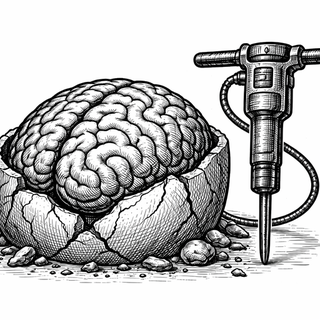
(Basically, your brain's renovation crew shows up, jackhammers the hardened grout between your neural tiles, and says "okay, now you can rearrange the bathroom.")
Why This Actually Matters for Real Humans
This isn't just elegant mouse neuroscience. The critical period framework explains things the chemical imbalance model never could. Why does context matter so much? Because reopening a critical period without the right environmental input is like unlocking a door nobody walks through. Dolen's own 2019 MDMA study showed the drug only reopened social learning windows when given in a social context - alone, nothing happened (Frontiers in Neuroscience, 2021).
It also explains durability. You're not masking symptoms with a daily pill - you're literally re-learning, rewiring circuits during a temporarily reopened window. That's why one or two psychedelic-assisted therapy sessions can produce effects lasting months or years.
Dolen's lab at UC Berkeley has already launched clinical trials using this framework, combining psychedelics with targeted rehabilitation for stroke patients - using the reopened plasticity window to help brains relearn motor functions that were lost (Berkeley News, 2024).
The Punchline
The old model said: your brain chemistry is broken, here's a molecule to fix it. The new model says: your brain learned something (trauma, addiction, depression) during a flexible period, the cement hardened, and now you're stuck with it. Psychedelics don't fix your chemistry - they soften the cement so you can learn your way out. Which is honestly a much more hopeful story, even if it does mean we wasted a few decades chasing the wrong metaphor.
(Science: occasionally getting the right answer by a scenic route.)
References
-
Dolen, G., & Wilkinson, M. L. (2025). The Emerging Neurobiology of Psychedelics: Critical Periods, Metaplasticity, and Extracellular Matrix Remodeling. Annual Review of Neuroscience. DOI: 10.1146/annurev-neuro-112723-045129 | PubMed
-
Nardou, R., Lewis, E. M., Bhatt, D. L., et al. (2023). Psychedelics reopen the social reward learning critical period. Nature, 618, 790-798. DOI: 10.1038/s41586-023-06204-3 | PubMed
-
Lepow, L., Bhatt, D. L., & Bhatt, A. R. (2021). Critical Period Plasticity as a Framework for Psychedelic-Assisted Psychotherapy. Frontiers in Neuroscience, 15, 710004. DOI: 10.3389/fnins.2021.710004 | PMC8488335
-
Psychedelics and the Extracellular Matrix: Rewiring Neuroplasticity and Metaplasticity for Next-Generation Psychiatric Therapies. (2026). Biological Psychiatry. ScienceDirect
Disclaimer: The image accompanying this article is for illustrative purposes only and does not depict actual experimental results, data, or biological mechanisms.