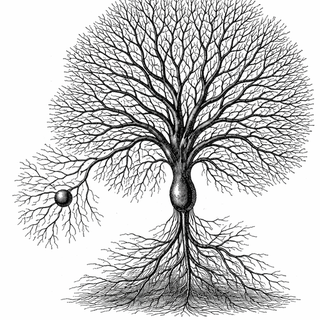
A single Purkinje cell - one of roughly 30 million crammed into a structure the size of your fist - unfurls a dendritic tree so elaborate it looks like a coral reef designed by a maniac with a protractor. Each of these cells receives input from up to 200,000 other neurons simultaneously. And according to a new study in Nature Neuroscience, these ornate little show-offs have been quietly teaching themselves probability theory behind your back.
Your Brain Has a Gambling Problem (In the Best Way)
Here's the setup. Your brain is constantly guessing what's about to happen next. Will that car stop at the red light? Is that sound a door closing or your cat knocking something off the counter again? The problem is that your sensory information is noisy, incomplete, and honestly kind of unreliable. So your brain cheats - it uses what it already knows about how the world usually works to fill in the gaps.
Neuroscientists call this Bayesian inference, named after Reverend Thomas Bayes, an 18th-century statistician who would be absolutely floored to learn his math ended up inside a mouse's brain. The idea is that the brain combines incoming sensory data with "prior knowledge" - a running tally of past experience - to make its best guess about reality. It's basically your neural system going, "Well, usually this happens, so let's go with that until proven otherwise."
The thing is, while plenty of behavioral studies have shown that humans and animals act like Bayesian statisticians, nobody could pin down where the brain actually stores these priors. It's like knowing someone in your office keeps eating your lunch but never catching them at the fridge.
Enter the Cerebellum (Stage Left, Slightly Underestimated)
Julius Koppen, Devika Narain, and their colleagues at Erasmus University Medical Center decided to look in a place most people wouldn't think to check: the cerebellum. For decades, the cerebellum has been typecast as the brain's "motor coordination guy" - the region that keeps you from falling over and helps you catch a ball. Useful, sure, but not exactly glamorous.
Turns out, the cerebellum has been moonlighting.
Using eyeblink conditioning in mice (a classic neuroscience paradigm where animals learn to blink in anticipation of a puff of air - thrilling stuff, really), the researchers exposed mice to different statistical distributions of when the air puff would arrive. Some mice got a uniform distribution - the puff could come at any time with equal probability. Others got distributions skewed early or late.
Here's where it gets wild: the Purkinje cells in these mice didn't just learn when to blink. They learned the entire probability distribution of when the puff might show up. Their firing patterns - both simple spikes and complex spikes - literally encoded the shape of the statistical distribution they'd been exposed to. The mice's cerebellums were building internal models of probability, not just reacting to stimuli.
Spikes, Plasticity, and a Model Named TRACE
The team also found a particularly intriguing signal they call the "prior-related complex spike" - a burst of activity that doesn't correspond to any immediate sensory event but instead predicts when the prior distribution says something should happen. It's the neural equivalent of checking your watch because the bus is usually here by now.
To explain how this works mechanistically, the researchers built a computational model called TRACE (Temporally Reinforced Acquisition of Cerebellar Engram). The model shows how two opposing forms of long-term plasticity in Purkinje cells - one strengthening connections, one weakening them - could work together to sculpt internal representations that match different probability distributions. It's an elegantly simple explanation for something that sounds impossibly complex (a recurring theme in cerebellum research, honestly).
Why This Matters Beyond Mouse Blinks
This study provides some of the most direct evidence yet that the brain doesn't just behave in a Bayesian way - it has actual neural hardware encoding prior probability distributions. The cerebellum, that underappreciated lump at the back of your skull, appears uniquely built for this job, thanks to its massive parallel architecture and rapid learning dynamics (Narain et al., 2018; De Zeeuw et al., 2023).
The implications stretch well beyond mouse eyeblinks. Disrupted timing and prediction are hallmarks of conditions like schizophrenia, ADHD, and Parkinson's disease. If the cerebellum is where probability priors live, understanding how these circuits break could open entirely new therapeutic angles.
Also, if you've ever caught a ball thrown at an unexpected angle, navigated a conversation with unpredictable pauses, or instinctively known your toast was about to pop up - thank your Purkinje cells. They've been doing statistics homework so you don't have to.
References:
-
Koppen, J., Klinkhamer, I., Runge, M., Bayones, L., & Narain, D. (2026). Neural circuits encode prior knowledge of temporal statistics. Nature Neuroscience. https://doi.org/10.1038/s41593-026-02255-7
-
Narain, D., Remington, E. D., De Zeeuw, C. I., & Jazayeri, M. (2018). A cerebellar mechanism for learning prior distributions of time intervals. Nature Communications, 9(1), 469. https://doi.org/10.1038/s41467-017-02516-x | PMCID: PMC5794805
-
De Zeeuw, C. I., Koppen, J., Bregman, G. G., Runge, M., & Narain, D. (2023). Heterogeneous encoding of temporal stimuli in the cerebellar cortex. Nature Communications, 14, 7523. https://doi.org/10.1038/s41467-023-43139-9
Disclaimer: The image accompanying this article is for illustrative purposes only and does not depict actual experimental results, data, or biological mechanisms.