
In the winter of 1944, Nazi blockades starved the western Netherlands into what historians call the Dutch Hunger Winter. Decades later, epidemiologists noticed something unsettling: the grandchildren of women who'd been pregnant during the famine showed higher rates of obesity and metabolic disease - even though they'd never missed a meal. The trauma had somehow seeped into the family tree. For years, that finding sat in a gray zone between spooky and speculative. Now, a team at Columbia University has zoomed all the way into the nose of a mouse and found something that makes the whole idea a lot harder to ignore.
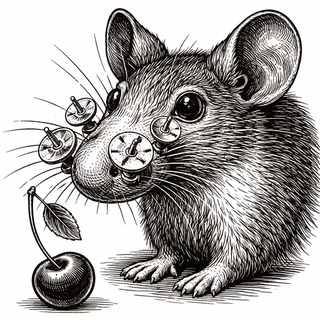
The Nose Knows (and Apparently Tells Your Kids)
Okay, buckle up, because this one is a ride. Researchers in Bianca Jones Marlin's lab at Columbia took mice, exposed them to a specific smell paired with a mild foot shock - classic fear conditioning, the neuroscience equivalent of Pavlov's bell but with more screaming - and then looked at what happened inside their noses. Not their brains. Their noses.
Here's where it gets wild. The mice that learned to fear a particular odor (acetophenone, which smells like cherries, because of course the terrifying smell is cherries) grew more olfactory sensory neurons tuned to that exact scent. Their nasal lining literally remodeled itself, cranking out extra detector cells for the scary smell. Think of it like your nose building more satellite dishes, all pointed at the one channel that keeps broadcasting bad news (Liff et al., 2025).
But wait - there's a loop on this roller coaster. The researchers then looked at the offspring of those fear-conditioned mice. Pups who had never smelled acetophenone. Pups who had never been shocked. Pups who, for all intents and purposes, had lived the most pampered mouse lives imaginable. And those pups? They also had extra neurons tuned to the odor their fathers had learned to fear.
Stem Cells With a Suspicious Agenda
You are not ready for this part. The team used a tissue-clearing technique called iDISCO+ and light-sheet microscopy to image the entire olfactory epithelium in 3D - basically making the nose transparent and counting every relevant neuron in volumetric cubes. What they found is that the stem cells in the nasal lining - globose basal cells, the factory floor of smell - were biased toward producing neurons with the "fear" receptor. It's not that the nose grew more neurons overall. It specifically ramped up production of the ones tuned to the scary smell.
It's like a theme park that keeps building more of the one roller coaster that made everyone scream. The park didn't get bigger. It just got more intense in one very specific spot.
Not Exactly a Phobia, But Not Nothing
Now, before anyone panics about inheriting their father's irrational fear of cilantro, there's a twist. The F1 offspring didn't actually behave like they were afraid. They didn't freeze or avoid the odor the way their conditioned parents did. But when researchers used unsupervised behavioral analysis - letting algorithms rather than humans score the movements - they found subtle, odor-specific behavioral differences. The pups weren't terrified, but they weren't indifferent either. Something had shifted (Liff et al., 2025).
This builds on the landmark 2014 study by Dias and Ressler, which first showed that fear-conditioned male mice could pass odor sensitivity to their pups via changes in sperm DNA methylation (Dias & Ressler, 2014). That paper was like dropping a grenade into the field of epigenetics. Marlin's team has now followed the shrapnel all the way into the stem cell layer of the nose, showing where the inherited change physically manifests.
Why This Is a Big Deal (Even If Mice Aren't People)
Transgenerational epigenetic inheritance - the idea that experiences can chemically tag your DNA and pass consequences to offspring without changing the genetic code itself - remains one of the most debated topics in biology (Bhatt et al., 2023). Skeptics point out that most epigenetic marks get wiped clean between generations. But studies like this keep finding exceptions, and those exceptions keep getting more detailed and harder to dismiss.
The olfactory system is the perfect testing ground because it's one of the few places in the adult mammalian body where neurons are constantly being born from stem cells. If an experience can bias which receptors those new neurons express - and if that bias can be inherited - then we're looking at a mechanism by which the environment literally sculpts the sensory hardware of future generations.
Your nose, it turns out, might be carrying receipts from experiences it never had. And honestly? That's the kind of plot twist that makes every other roller coaster in the park look boring.
References
-
Liff, C. W., Ayman, Y. R., Jaeger, E. C. B., Cardeiro, A., Lee, H. S., Kim, A., Vina-Abarracin, A., Ferguson, D.-L. K. D., & Marlin, B. J. (2025). Fear conditioning biases olfactory sensory neuron frequencies across generations. eLife, 13, e92882. https://doi.org/10.7554/eLife.92882 | PMID: 41979323
-
Dias, B. G., & Ressler, K. J. (2014). Parental olfactory experience influences behavior and neural structure in subsequent generations. Nature Neuroscience, 17(1), 89-96. https://doi.org/10.1038/nn.3594 | PMID: 24292232
-
Bhatt, B., Rosado, J. O., & Bhatt, D. L. (2023). Transgenerational epigenetic inheritance of traumatic experience in mammals. Genes, 14(1), 120. https://doi.org/10.3390/genes14010120
Disclaimer: The image accompanying this article is for illustrative purposes only and does not depict actual experimental results, data, or biological mechanisms.