
Picture this: a patient walks into my clinic complaining about constipation that's been getting worse for fifteen years. No big deal, right? Happens to a lot of people. Then, a decade later, that same patient comes back - this time with a tremor in their right hand. Two very different complaints, fifteen years apart. Except they weren't different at all. They were the same disease, making the long commute from belly to brain.
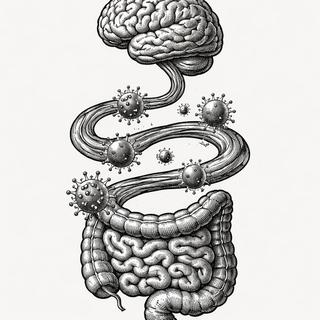
For years, neurologists have been suspicious about this gut-to-brain connection in Parkinson's disease. Somewhere between 50 and 90% of people who eventually develop Parkinson's had gut problems - constipation, bloating, the whole unsexy catalog - years or even decades before the first tremor showed up (Tansey et al., 2022). We knew something was traveling upward. We just didn't have a good mugshot of the accomplice.
The Immune System's Worst Employee of the Month
Enter muscularis macrophages - immune cells that live in your gut wall, where their job is essentially to be the body's cleanup crew. They're supposed to gobble up anything suspicious, digest it, and move on. Think of them as your intestinal Roomba: efficient, mindless, gets the job done.
Except when they don't.
A landmark study by De Schepper and colleagues, published in Nature this year, found that these gut macrophages happily vacuum up misfolded alpha-synuclein - the sticky, toxic protein at the heart of Parkinson's - but then completely choke on it (De Schepper et al., 2026). Their lysosomes (the cellular equivalent of a stomach) get overwhelmed. The macrophages showed a 14-fold increase in phosphorylated alpha-synuclein compared to normal cells. That's not cleaning up. That's hoarding.
When the Cleanup Crew Calls for Backup (And Makes Everything Worse)
Here's where things get properly wild. Instead of quietly dealing with their dysfunction, these bloated macrophages start signaling to T cells - the heavy hitters of the adaptive immune system. As De Schepper put it, the macrophages can "vacuum up harmful alpha-synuclein for a while" before becoming overwhelmed, at which point "the system flips" toward T cell activation.
Those T cells, now primed in the gut, don't stay put. Using elegant tracking experiments with photoconvertible fluorescent markers, the researchers watched gut-resident T cells pack their bags and migrate through the bloodstream to the brain's dura mater and, eventually, deep into the substantia nigra - the very region whose dopamine-producing neurons die off in Parkinson's (Baekelandt, 2026).
Your gut's immune cells are essentially sending angry postcards to your brain. And your brain opens every single one.
The Old Roadmap Gets an Update
This fits beautifully with what we already knew. Back in 2019, Kim and colleagues at Johns Hopkins demonstrated that injecting pathologic alpha-synuclein into the gut wall of mice caused it to crawl up the vagus nerve - that long cable connecting your gut to your brainstem - and systematically destroy dopamine neurons along the way (Kim et al., 2019). Cut the vagus nerve, and the spread stopped cold.
But that was the nerve highway story. The new research reveals a parallel immune highway running alongside it. The toxic protein doesn't just hitchhike along neurons - it recruits your own immune system as a rideshare. A recent Lancet Neurology review confirmed this broader picture: systemic inflammation and autoimmune mechanisms driven by the gut microbiome appear to accelerate Parkinson's progression through multiple overlapping pathways (de Castro Fonseca et al., 2026).
So... Can We Stop It?
Here's the genuinely exciting part. When the researchers depleted gut macrophages in mice before exposing them to alpha-synuclein, pathology spread to the brain was dramatically reduced and motor symptoms improved. No macrophage middlemen, no T cell road trip, no brain damage delivery service.
This matters enormously because roughly two-thirds of Parkinson's cases are thought to be "body-first" - meaning the disease starts cooking in the gut long before anyone notices a tremor. If we could identify and target gut macrophage dysfunction early, we might intercept Parkinson's during the constipation phase rather than the shuffling-walk phase. As Dr. Tim Bartels from the UCL research team noted, this could someday lead to "simple blood tests to screen for it, enabling diagnosis long before damage to the brain starts."
We're not there yet. Mouse guts are not human guts, and translating immune-depletion strategies into safe therapies takes work. But for a disease where the best we can currently offer is managing symptoms after most of the damage is done, catching it at the front door - or rather, the gut door - would be a game changer.
References
-
De Schepper S, Konstantellos V, Conway JA, et al. Intestinal macrophages modulate synucleinopathy along the gut-brain axis. Nature. 2026;651(8104):174-184. DOI: 10.1038/s41586-025-09984-y. PMID: 41606336. PMCID: PMC12960212.
-
Baekelandt V. Immune cells from the gut drive development of Parkinson's disease in the brain. Nature. 2026;651(8104):36-37. DOI: 10.1038/d41586-026-00284-7. PMID: 41639552.
-
Kim S, Kwon SH, Kam TI, et al. Transneuronal propagation of pathologic alpha-synuclein from the gut to the brain models Parkinson's disease. Neuron. 2019;103(4):627-641.e7. DOI: 10.1016/j.neuron.2019.05.035. PMID: 31255487. PMCID: PMC6706297.
-
Tansey MG, Wallings RL, Houser MC, et al. Inflammation and immune dysfunction in Parkinson disease. Nature Reviews Immunology. 2022;22(11):657-673. DOI: 10.1038/s41577-022-00684-6. PMID: 35246670. PMCID: PMC8895080.
-
de Castro Fonseca M, Zanetti L, Fanourakis S, Sulzer DL, Mazmanian SK. The gut microbiome, systemic inflammation, and autoimmunity in Parkinson's disease. The Lancet Neurology. 2026;25(1):103-114. DOI: 10.1016/S1474-4422(25)00382-5. PMID: 41389810.
Disclaimer: The image accompanying this article is for illustrative purposes only and does not depict actual experimental results, data, or biological mechanisms.